


Ep 17. Nicolo Amati Part 4, master violin maker
Description
Nicolo finds love, the workshop is full steam ahead and this violin maker has to find creative ways to get family members out of his house so his future bride doesn’t freak out! This is one busy luthier. Follow Nicolo Amati as his family grows and his influence as a violin maker branches throughout Italy and Europe.
In this episode you will also meet a very important family in the story of the violin, the Guarneris, see how their lives overlap with the Amatis as we start to see the beginning of the end of the “house of Amati”
Transcript
Hello and welcome to the Violin Chronicles, a podcast in which I, Linda Lespets, will attempt to bring to life the story surrounding famous, infamous, or just not very well known, but interesting violin makers of history. I'm a violin maker and restorer. I graduated from the French Violin Making School some years ago now, and I currently live and work in Sydney with my husband Antoine, who is also a violin maker and graduate of the French school, l'Ecole Nationale de Lutherie, in Mirecourt.
Welcome back to the story of Nicolò Amati, the third in this generation of violin makers. We now find him in his mid 40s. He has survived the bubonic plague in which he lost many of his family members. He lives in the house his grandfather, Andrea Amati, bought and passed on to his sons. And now Nicolo finds himself with an odd crew of orphaned cousins, nephews, nieces, and siblings to look after post pandemic.
The world in which Nicolo lived was changing dramatically. These were the years that Europeans were arriving in the Americas. There were the Spanish and Portuguese in the south. Up north were the English, Dutch, French, and the Swedes. In 1644, when Nicolo Amati was entering his late 40s, the young Antonio Stradivari was born.
Most likely in Cremona and not far from the Amati home. The question, looking at Nicolo Amati this week is, was he just an artisan at the beck and call of musicians and wealthy patrons, looking to have a collection of instruments for musicians coming to their house or court? Socially speaking, where did Nicolo Amati sit in the greater scheme of things?
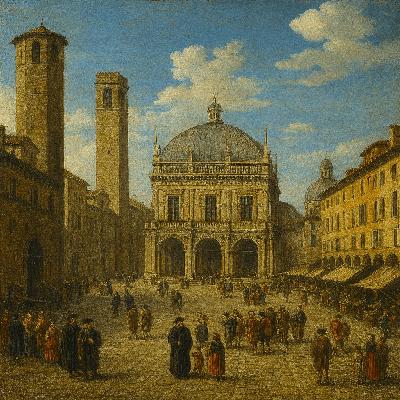
And why was it that Luthiers from Cremona had this reputation of producing excellent instruments? Why were they better than any other city in that part of Italy at the time? Rome, Naples and Venice were all important cultural centres then, so what made this relatively small city stand out? Well, in the last episode of the Violin Chronicles, we saw Nicolo Amati surviving the plague and getting on with his life.
He gives up depending on family members to help him in the workshop and starts to employ apprentices who come and live and work with him, notably two teenagers. Andrea Guarneri and Giacomo Gennaro. He also starts to make his grand pattern violin. It is surprising that by making something a few millimetres bigger and slightly changing the outline and archings of the violin, he really does change the potential of this instrument and lay the groundwork for the very well known violin makers to come after him.
Niccolò Amati's clients were often noble families and the church, much like his father and grandfather had. And he would even sell instruments that were not his, such as a local priest and musician, Don Alessandro Lodi, whose family turned to him when he died to sell his collection. Here we see Nicolò Amati’s instruments fetching a good price, where others were selling their instruments for 5 ducati Nicolò's violins were going for 15 ducati and 22 for a viola. The double bass he sold from the priest's collection that was not his. It could have been a Brescian instrument, was only 13 Ducati. From the high prices Nicolo Amati demanded for his instruments, we can clearly see that he was not a lowly craftsman, but was an educated and literate member of his community, having gone to school before learning his trade with his father. It would have been important for him, in dealing with his noble clientele, to have a certain level of learning and a knowledge of business, mathematics, and accounting, as would many of his artisan colleagues. At this time in Cremona, schools were attended mainly by children of merchants and nobles, but not only. At school, they would learn. In addition to the traditional subjects of Geometry, Arithmetic, and even Astrology, subjects such as Geography, Architecture, Algebra, and Mechanics, both theoretical and applied.
Carlo Chiesa, violin maker, expert, researcher, and author from Milan.
It is also worth noting that the Amatis at that point, they were wealthy enough people. This is very important because It means they, the kids had an education. They were able to go to school, to be trained properly, not just in the workshop. And they were artisans of a high level anyway. So the daughters of Andrea who got married, they usually got married with good doweries with the people who were from the same social status, and that is also worth noting important because they were not. It means that they were not working for low class musicians, but usually their commission went. to noblemen or high-class customers, which they were able to deal with. That is also another of the reasons for the success of cremonese making, because the artisans were able to deal with the high class.
Nicolo Amati was a product of the Cremonese system. He was not only a talented artisan, but also had a level of education that enabled him access to the upper echelons of society. And this appears to have always been where violin makers sit. Never being part of the nobility as they were in trade and part of the merchant class, yet their product interested and sometimes fascinated the noble classes, somehow giving them a form of access or small door into their world being almost acceptable. As for Nicolo's workmanship, he had always shown a spirit of innovation and thought. He was experimenting in different sizes of instrument in an effort to improve his product and this reflects the time and place he lived. It was, don't forget, the renaissance, and as their world was a relatively small place, he would certainly have known fellow artisans in town, such as the very interesting Alessandro Capra and his sons. Cremona was renowned for its engineers, both civil and military, who published books on their work. They were, after all, on a military highway. What better place to have your shop window? Alessandro Capra, architect and plumber, had opened his workshop in town where he would display his inventions and offer his services as either a military or civil engineer. He also carried out teaching activities for apprentices interested in learning science, art, maths and geometry. From his workshop, he would obtain commissions from various parts of Italy for machines and inventions. In his domestic artisans workshop, he displayed his machines and various models. Lining the walls were precious books filled with information on land surveying, perspective, applied geometry, arithmetic, and merchant accounting.
These were handbooks written expressly for craftsmen, artisans, artists, and technicians. They were not for a specific trade but information for people involved in these activities. and were practical guides on how to go about business. The printed works of Capras were like professional development manuals. They were presented as a collection of craft and commercial problems useful for the training of future generations of craftsmen and traders, land and real estate owners. It also advised landowners on how to earn more money and lower income earners on how to manage better their real estate. It was a 17th century version of how to make friends and influence people. Alessandro Capra also mentions the benefits of following military campaigns, scientific skills linked to the solution of problems, fortifications, ballistics, engineering, mechanical and hydraulic, management and organization of people. Cremona was a great place to be for this as it was continually in the midst of military campaigns and would have facilitated this scientific environment.
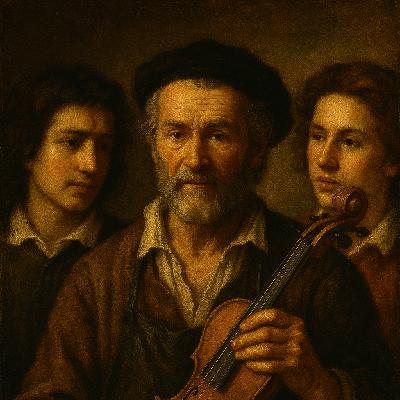
But back to the Casa Amati. Nicolo had two assistants living with him that I mentioned earlier and they are actually quite important to our story. They made a team in the workshop and Nicolo trusted them not only with the work on it, instruments but also in his business dealings and everyday life. They were legal witnesses on legal documents and even civic occasions such as his wedding. These two assistants were of course Giacomo Genaro and Andrea Guarneri. Andrea Guarneri is the first in the great family of the Guarneri makers of Cremona and here we see his close relationship with his master.
Carlo Chiesa explains.
And, and then did Andrea Guarneri did he go on to, his instruments, were they based on the Nicolo's Grand Patten?
Sometimes and sometimes also on the other side, Andrea was was a good maker, intelligent maker. And he also, and I'm sure he went on working for Amati also after he moved to his own workshop because their workshops were very close to each other in the same block. And there was a back alley in which they both had a door. So that through the back alley, the two workshops were very, very close to each other.
They could pass a violin.
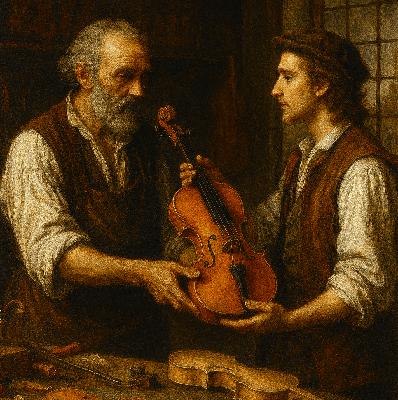
There's a customer here. I have not a violin finished. You've got one. Yeah, I'm finishing that one. Take it. Take this one. Put your label in.
In 1640, Nicolo Amati stops using the brothers Amati label. It is now almost as if he is truly affirming himself, starting a new chapter in his life. By using the brothers Amati label, his father's, he was in no way trying to deceive people who knew very well that his father was dead, but rather that he had built this instrument in his father's style. Even though he had made the instrument, it was in essence an Amati Br










 United States
