


How to Remember a Story Using a Memory Palace
Description
 If you want to remember a story, the process is actually pretty simple.
You can be as detailed as you like, or just recite the general gist of a tale.
And by the end of this lesson, you’ll be able to entertain people at parties or include stories in your speeches and presentations.
Or maybe you want to better convince your friends to read stories and watch the movies you love. That will be much easier for you to do as well.
If you want to become a better writer, nothing will help you more than knowing stories inside and out.
Even better than that, on this page, I’m also going to show you how to memorize the ins-and-outs of plot.
Who am I to teach you about remembering stories?
Well, in addition to having told a story at a TEDx event that now has nearly 2.5 million views, I spent nearly a decade as a Film Studies professor.
I also spent a few years working as a story consultant on movies that actually got made. And I’ve written two well-received books about screenwriting.
Indeed, I got my story consulting gigs partly because of the books I’ve written on screenwriting. I even have a writing credit on my IMDB profile.
<figure class="wp-caption aligncenter" id="attachment_2770" style="width: 600px;">
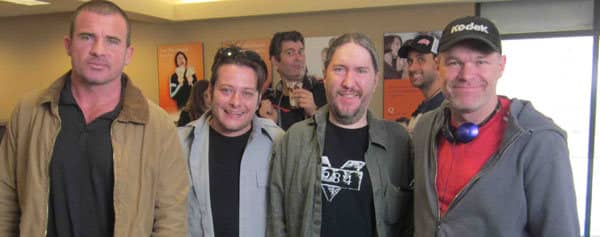 <figcaption class="wp-caption-text" id="caption-attachment-2770">Anthony Metivier on the set of Bailout with Eddie Furlong, Dominic Purcell and Uwe Boll</figcaption></figure>
Although I certainly don’t know everything under the sun, I’ve proven that I can write and help craft successful stories. I’ve memorized detailed stories and delivered them before the masses.
And if you’re ready to remember any story, I’m confident my tips will help you out
So let’s get started!
https://www.youtube.com/watch?v=DM4TxD6ez1Y
Two Different Ways to Remember a Story
When it comes to reciting a story from memory, there are two main ways to proceed.
Both approaches are powerful. Which one you pick depends on your goal.
You’ll also want to consider your existing skills with memory methods overall. You can check my guide to the main memory techniques to get a sense of where you currently stand.
With that in mind, let’s look at the two main strategies for remembering stories.
Story Strategy #1: Verbatim
Memorizing a story verbatim is powerful when you care about the exact language.
There are many circumstances where word-for-word recall matters.
Take my TEDx Talk, for example. This platform requires you to deliver your message within a particular timeframe. You simply cannot afford to go off on tangents, and verbatim memorization helps make sure you follow the script and finish on time.
People who memorize scripture tend to want to memorize a particular translation verbatim for theological or poetic reasons.
Then there are actors like my fellow mnemonist, Ashley Strand. On this episode of the Magnetic Memory Method Podcast, he shared how he memorized the entire Book of Matthew:
https://www.youtube.com/watch?v=0op9LSE3_yQ
Ashley’s example involved acting, but fits more exactly under the banner of monologue memorization.
In addition to his recitation of the Book of Mark, the most impressive recitation I’ve seen was Ralph Fiennes in Faith Healer.
I caught the play while living in Manhattan, but had read it many years earlier as an undergrad in an English course.
As a stage production, Faith Healer is remarkable because the Frank Hardy role involves two long narrative monologues. The first one is at least 30 minutes long and I was blown away by watching Fiennes deliver it.
Even more remarkably, the play is itself about how memory shifts and changes. As Fiennes shared in this Irish Times article, he spent a very long time with the text. But during the last two weeks he focused specifically on “feelings, emotions, and nuances.”
Like Ashley Strand, Fiennes needed to deliver the exact words.
Unlike Strand’s experience, however, Fiennes did not have to work on interpreting the text. As Fiennes told his interviewer, Faith Healer is “extraordinary because when you’ve got it inside you, in the memory, it’s a support. With writing that is less masterful, you would have to compensate or find things in the interpretation to keep it buoyant.”
If you choose to memorize a story verbatim, keep these points in mind. Some stories will have features built into them that help you remember them better.
Others, like various stories in the Books of the Bible, may require more interpretation and even additional research or personal study.
Story Strategy #2: Generative Memorization Based on “Story DNA”
Many people know that ancient cultures passed their stories on verbally.
But that doesn’t mean they recited them verbatim.
As Alfred Lord reports in Singer of Tales, many story tellers actually memorized a variety of formulas.
In this video, I talk about how this technique likely worked, one that I’ve used myself as a Film Studies professor many times:
https://www.youtube.com/watch?v=20En1Nm8VOY
There are quite a few ways you can memorize formulas to generate new versions of stories on the spot.
Or, you can learn formulas in ways that help you recite and explain particular sequences in movies.
You can see an example of me doing this in my case study of Minority Report or the one on Training Day. Each of these video lessons is based on one of the Film Studies lectures I delivered while teaching at the University of Saarland in Germany.
To talk about story architecture in this way, it’s not that I memorized the stories verbatim. No, I literally memorized the “Story DNA” based on an understanding of Vladimir Propp‘s Morphology of the Folktale amongst other narratological tools found in the field of literary criticism.
Should you take such a deep dive into story mechanics in order to remember stories better?
Personally, I believe so. Here’s why:
Why Remembering Stories is an Underrated Career Skill
Reciting stories is not a trick.
It’s a skill that can give you an unfair advantage, especially in high-stakes careers. These career areas include:
- The legal industry
- Bartending
- Being a musician addressing an audience between sets
- Therapeutic careers (medicine and psychology)
- Leadership and management
- Sales and marketing
There are more use cases in my Guide to Using Mnemonics in Your Everyday Life.
I’m especially fond of the mixologist David Curtis who shared on this episode of the Magnetic Memory Method Podcast how memory techniques have boosted his bartending career.
And although we’ve already discussed acting above, we should not forget becoming a magician.
As discussed in an episode of my podcast with the inventive magician, novelist and AI innovator Andrew Mayne, there are many benefits for magicians who use memdecks in their performances.
Story deck routines fall u


 United States
