



How to Turn Any Painting Into A Mental Hard Drive
Description
 Although basing your Memory Palaces on buildings you’ve seen with your own eyes will always be a best practice, it’s not your only option.
Sure, buildings are generally best.
That’s because remembered locations let us easily “offload” what we want to learn onto walls, corners and furniture as if they were hard drives.
But you can also develop thousands of Memory Palace options simply by utilizing art. And there are countless works waiting to be discovered using the phone in your pocket.
Using art is in fact one of the most elegant and pleasing ways to expand your memory practice.
From paintings and photographs to album covers and book jackets, I’ve long expanded my Memory Palace collection by using art.
There is a trap, however.
If you use art in the wrong way, you’ll double your cognitive load and confuse yourself faster than you can say “Giordano Bruno.”
(In case you don’t catch the reference, Bruno was the Renaissance memory master who used many statues in his Memory Palaces to expand them.)
In this tutorial, I’m sharing with you how to use any piece of art as a Memory Palace effectively, including the one “golden rule” you definitely don’t want to break.
Believe me, I’ve tried and it’s not worth the hassle.
Ready to massively expand your use of mnemonics by drawing upon art you’re already familiar with?
Let’s dive in!
https://www.youtube.com/watch?v=z7bkrmYJOmE
Paintings as Memory Palaces: Architecture Within Architecture
Let’s start with the basic concept first.
When you use a painting as a Memory Palace, you are opening up a number of options.
The simplest involves either using a painting that is already in a building that you are using. Or you place a painting inside of a Memory Palace you’ve used before to expand it.
As a third option, you can refer to a painting and use it as a Memory Palace unto itself without reference to where it exists in space.
Finally, as I discuss in my post about visiting art galleries to help improve your memory, you can turn galleries and museums into Memory Palaces. By using the various artworks that stood out to you, it’s possible to wind up having an exceptionally strong Memory Palace.
One of the Memory Palaces I used to memorize a Sanskrit mantra used Brisbane’s Gallery of Modern Art, for example. Many pieces from one particular exhibition formed part of the encoding process, assisted by an effect memory scientists call context dependent memory.
Either way, as I discuss in my main tutorial on how to use the Memory Palace technique, the key is to avoid increasing cognitive load.
There’s always the risk of putting pressure on your brain instead of reducing it unless you use the painting variation of the Memory Palace technique carefully.
To that end, let’s go through some best practices, starting with the most important.
Metivier’s Golden Rule: Do Not “Memorize” Any Memory Palace
Some people will hear that I use paintings in my Memory Palaces and start looking at art and memorizing it.
Although you can certainly do so, this is not what I mean.
Rather, I mean to suggest that if you use any of the possible options I listed above, you make sure that the painting or artwork is already in your memory.
This point seemed to be very important to Giordano Bruno, whom I mentioned above.
In his book, Thirty Statues, Bruno places his mnemonic associations on mythological figures he already knows.
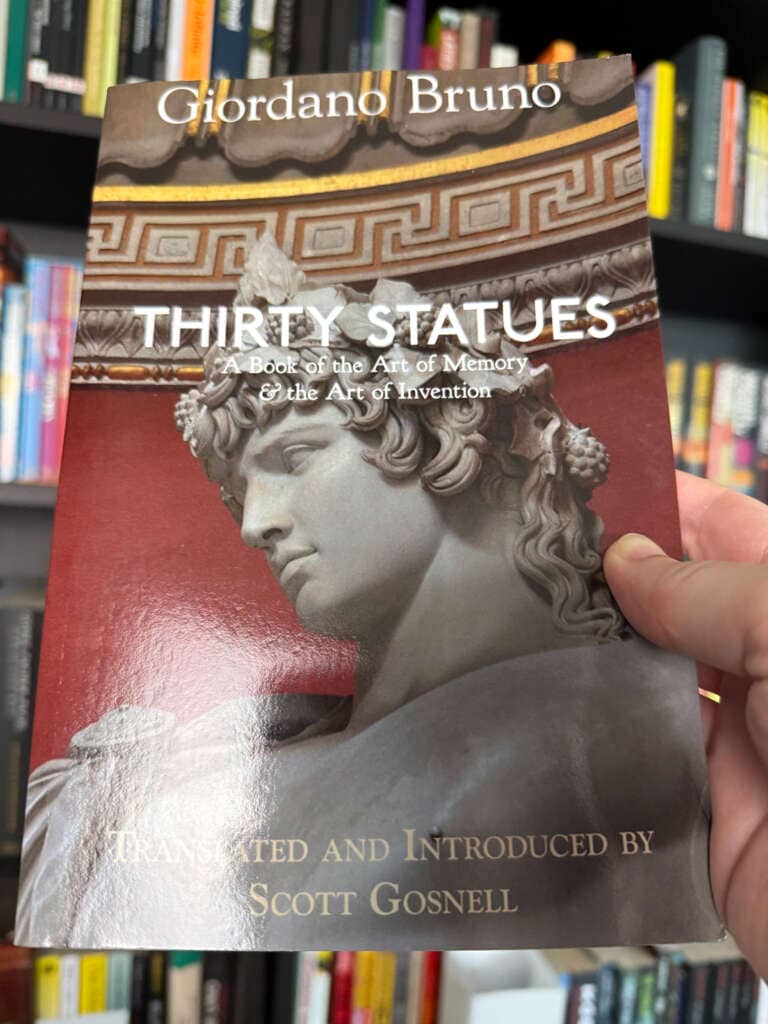
He’s following a principle crucial to all ancient memory techniques that distinguish them from the processes of some memory competitors that have led to a lot of confusion.
Whereas memory competitors may learn a lot of associations assisted by techniques like the Major System and the PAO System, that’s for accomplishing short-term retention.
For this reason, I wince whenever someone tells me that they’re going to memorize a bunch of locations to use as Memory Palaces.
Even after looking at my massive collection of Memory Palace ideas and Memory Palace examples, some people still charge forward and memorize despite learning that the most accomplished mnemonists did not do this.
So the point is that if you’re going to use the Mona Lisa as a Memory Palace, make sure you already have a basic mental image of this artwork in your mind.
The Mona Lisa Test
I’m mentioning the Mona Lisa because it’s both relatively simple and very famous. It’s almost certainly in your long-term memory.
But a great way to start using a variety of paintings is to create an inventory. The following activity is a powerful memory exercise unto itself.
Step One:
- Write A-Z on a piece of paper
- For each letter name an artwork or artist that comes to mind
- When you’re just starting, I recommend sticking with portrait paintings or photographs
You might not be able to complete the whole alphabet. So if Agostina Segatori Sitting in the Cafe du Tambourin by Van Gogh doesn’t leap to mind, move on to B and the other letters until you have at least a few artworks listed.
The key to this exercise is to work with what you’ve got. Do not look up any of the artworks using a search engine. Just list what you can come up with on your own by name, or the name of the artist if that’s all you remember.
If you can’t remember the name of either, just list down where you remember seeing the artwork. Or jot down anything else about it that will help you recall the image you mean at a glance.
Step Two:
Pick one of the paintings and sketch it out from memory.
You don’t have to be an artist to complete this step. Just look at how basic my example is for Francis Bacon’s Study for Portrait I is:

Keep going with this exercise until you have 5-6 of these sketches based on your list. Don’t stress it if you can’t come up with that many.
Likewise, feel free to produce many more.
The key is to produce examples and test that you remember enough of each image so that it can function as a Memory Palace.
This is why I suggest you start with portraits. They’re generally simple figures in space and not overloaded with all kinds of elements that probably never entered your memory.
Step Three:
Divide your sketch using the rule of threes. Just like you see in this example:


 United States
