


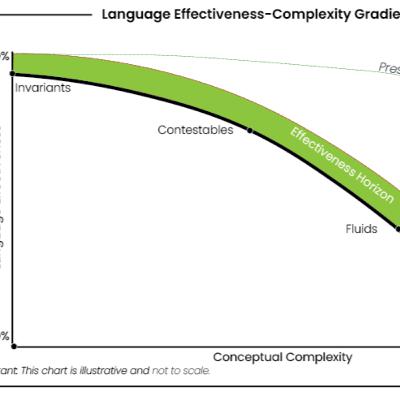
Language Insufficiency Gradient Explained
Description
In The Language Insufficiency Hypothesis, Bry Willis argues that human speech is a fundamentally flawed tool that becomes increasingly unreliable as we move from concrete objects to abstract concepts. The book introduces the Effectiveness–Complexity Gradient to map how linguistic precision inevitably decays as ideas grow more sophisticated. Willis categorises words into four zones: Invariants, which are stable and clear; Contestables, which are prone to institutional dispute; Fluids, which drift across different disciplines; and Ineffables, which entirely defy verbal description. A core tenet of the work is the Presumption Gap, the idea that we consistently overestimate how well we are being understood by others. The author demonstrates how institutions like law and politics often substitute raw power for this lack of clarity to enforce meaning. Ultimately, the text suggests that while we cannot fix these structural cracks in communication, we can navigate them with greater humility and awareness.
👉 https://philosophics.blog/2026/01/16/language-insufficiency-hypothesis-the-gradient/

















 United States
