


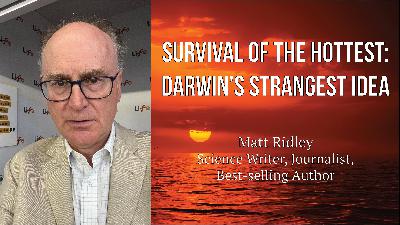
Matt Ridley - Survival of the Hottest: Darwin's Theory of Sexual Selection
Description
In this episode of Science From the Fringe, Bryce Nickels speaks with acclaimed science writer and best-selling author, Matt Ridley. Topics include who is “winning” the debate over COVID-19’s origins, the state of modern science, the ethics of de-extinction efforts, and the fascinating premise of Ridley’s latest book, Birds, Sex and Beauty.
Science from the Fringe is a reader-supported publication. To receive new posts and support our work, consider becoming a subscriber.
The conversation begins with Ridley’s perspective on the origins of COVID-19, where he argues that a lab leak in Wuhan remains the most plausible explanation. He cites the institutional bias, centralized funding, and fear of reputational harm inherent to academic science as barriers to legitimate inquiry. Ridley contrasts science as an institution, which he views as increasingly corrupt and conformist, with science as a philosophy, which thrives on skepticism and decentralized exploration. He calls for reforms that would empower independent thinkers and “maverick ideas” rather than enforcing consensus through funding monopolies.
The conversation then turns to de-extinction efforts, particularly those led by Colossal Biosciences. Ridley argues for the revival of extinct species such as the great auk and woolly mammoth, stating that humanity has a moral responsibility to restore what it has destroyed. This leads to a deeper discussion with Bryce about the ethical complexities of animal suffering, genetic experimentation, and the potential erosion of public trust following the COVID-19 pandemic.
In the third and final segment, Ridley outlines the premise of his new book, Birds, Sex and Beauty. Bryce and Matt discuss Darwin’s theory of sexual selection, female mate choice, and the evolution of beauty in birds — from the peacock’s tail to the bowerbird’s colorful displays. Ridley explains how these traits reflect aesthetic preference rather than pure survival advantage and draws intriguing parallels to human evolution, elevating the importance of sexual selection — vs. Darwin’s theory of natural selection, a.k.a. “survival of the fittest” — in how creativity, humor, and intelligence may have been shaped in humans.
As a unifying concept, Ridley emphasizes the importance of honesty in science as a foundation for restoring public trust. He cautions against “just-so stories” in evolutionary biology — narratives that sound plausible but lack testable evidence — and urges scientists to embrace uncertainty and intellectual humility.
Timestamps
00:31 – Introducing Matt Ridley02:50 – Lab leak theory gaining public traction despite resistance from scientific elites03:49 – Comparison of a lab accident to industrial disasters; the moral duty to investigate05:10 – Preference for natural origin but insistence on scientific honesty and transparency07:15 – Analogy to plane crashes: avoiding investigation to protect reputations is unacceptable09:23 – Distinguishing science as a philosophy of inquiry vs. a corrupted institution10:55 – How decentralized science historically fostered breakthroughs and dissent12:16 – Warning against scientific monopolies and parallels to Lysenkoism17:38 – Discussion of censorship and stigma surrounding lab leak proponents19:29 – Attacks on Ridley’s climate reporting used to discredit his COVID origins work26:25 – Introduction to de-extinction and Ridley’s involvement with Revive and Restore32:09 – Balancing hype and credibility in Colossal’s projects35:16 – Ethical issues in genetic experimentation and animal welfare42:52 – Darwin’s struggle with sexual selection and aesthetic beauty45:25 – Female choice and the “sexy sons” hypothesis47:27 – Bowerbirds’ artistic displays as evidence of aesthetic evolution50:42 – Why most birds lost penises: female control and evolutionary trade-offs53:06 – “Just-so stories” and the limits of evolutionary storytelling56:23 – Human parallels: sexual selection and the evolution of art, humor, and intelligence
intro and outro by Tess Parks
Get full access to Science From the Fringe at sciencefromthefringe.substack.com/subscribe





 United States
