


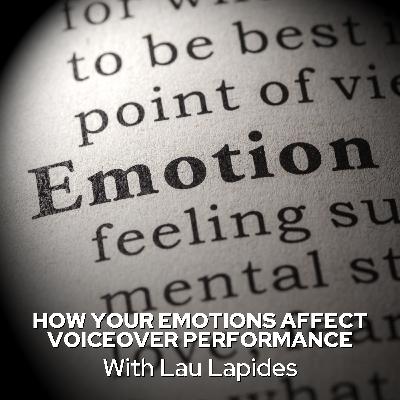
Mood Affects Voiceover Performance
Description
BOSSes, Anne Ganguzza and Lau Lapides explore a core challenge for every voice actor: managing personal emotions and moods to deliver a consistent, authentic performance. The Bosses delve into how easily actors can slip into autopilot or let personal frustration compromise a read. This episode provides practical acting methodologies to help you discipline your thoughts, shift your emotional state on demand, and utilize your entire emotional range to serve the story.
00:00 - Anne (Host)
Hey Boss, listeners, Anne Ganguzza here. Leveraging years of expertise in the voiceover industry, I offer coaching and award-winning demo production that embodies excellence. I am dedicated to your success. Let's work together to get your career to where you've always wanted it to be. Visit anneganguzza.com to find out more.
00:24 - Speaker 2 (Announcement)
It's time to take your business to the next level, the boss level. These are the premier business owner strategies and successes being utilized by the industry's top talent today. Rock your business like a boss a VO boss. Now let's welcome your host, Anne Ganguzza.
00:43 - Anne (Host)
Hey everyone, welcome to the VO Boss Podcast and the Boss Superpower Series. I'm your host, Anne Ganguzza, and I am here with Superpower co-host Laura Lapidus. Yay, thank you, annie. I love being called a superpower. Well, I'll tell you what your shirt is so colorful today. I love it.
01:06 - Lau (Guest)
Yeah, I'm feeling like this blue is putting me in a certain mood. You know, getting me very moody, but not in a blue mood, more in a hot mood.
01:15 - Anne (Host)
Yeah, it's blue and flowers, so there's kind of like a cult, like a culmination of moods, maybe I thought you were going to say a cult.
01:22 - Lau (Guest)
No, not a cult, but more of a comedy, more of likes, maybe I thought you were going to say a cult.
01:33 - Anne (Host)
No, not a cult, but more of a comedy, More of like artistic meets, comedy meets, I don't know, meets like hot diva thing, oh my gosh. Well, you know that's funny. I'm always so thankful to talk to you, Law, because you're always so positive and upbeat and happy.
01:41
And you know it's interesting because I, as you know, I mean I work with a lot of students and a lot of them that are working full time and then doing voiceover part time, and so they've got, or they've got life happening you know life you know, life, life can happen, life happens and I'll tell you what your mood and how you are dealing with the day can so affect your reads, because I'll have some people that'll be like, yeah, I did it last night, after you know, I came home from work and I'm like, well, yeah, I can tell, because you were exhausted or did you have a bad day, because it actually reflects in your read and I thought it'd be great to talk about how your mood affects your performance.
02:30
I mean, it seems so obvious and we just say, yeah, your mood affects your performance, but maybe it affects it more than you even know, because a lot of times I feel like we go on autopilot. When we're in a certain mood, or we don't want to deal with certain things, or you know, we're not going to acknowledge certain feelings, we then compartmentalize, and we don't always compartmentalize in a way that's helpful for our performance.
02:53 - Lau (Guest)
So true. And you know, I first thought about mood as a young, young kid, really, when I was being trained in the theater. I would have directors that would say for rehearsal, leave your trash at the door. Don't worry about it, it'll be there to pick up on your way out.
03:11 - Anne (Host)
Leave your trash.
03:12 - Lau (Guest)
What does that mean? And meaning that to discipline yourself in the workspace, you cannot bring in every feeling, every thought and every mood that you're walking in with. You have to leave it behind and come into that neutral discipline space.
03:28 - Anne (Host)
Unless.
03:28 - Lau (Guest)
maybe you're using it to create a character Unless you're channeling it, but even so it's like can you move in and out of it?
03:37 - Anne (Host)
That's tough to do. Yeah, that's tough to do.
03:40 - Lau (Guest)
Yeah, or is it so adopted in you, so inside of you, that you can't see it? You no longer have the self-awareness to see the mood that you're in.
04:03 - Anne (Host)
They're like no, I thought it thought it was great. And then, in reality, I'm like you were tired, weren't you? You know, or you were exhausted, or you were frustrated, or and sometimes it'll become it'll come out right in the first few words I'm like you hate this script, don't you? It's like, well, I had a bad day and so, yeah, being able to compartmentalize or put that aside. And then the probably, I would say, the biggest problem for me in the niches that I teach is that it's. You can start off in one mood. You can say, ok, I've got to be positive, I got to get my energy up, and because I've had a long day, and so let me get my energy up. And then you've got it up for a couple of seconds and then, and then, all of a sudden, you go into autopilot and you lose track of the fact that you got out of right, you got out of that energy and you just went on autopilot. I think going on autopilot is like 90% of the problems in, let's say, long format narration anyways.
04:58 - Lau (Guest)
Yeah, and also really being able to you know, with your analysis that you're doing of your script, it's really being able to pinpoint what is the mood of the story, how does the tonality change, not just the writing of it and the language of it, but also the rhythmic cadence of it and the musicality of it. What is happening with the mood? Because, as actors, if we don't have mood, if we don't understand mood and there's no mood to it, then we completely lose our momentum. There's no momentum without mood.
05:28 - Anne (Host)
And I love how. All right, so now we just took it from our mood to the script and the script's mood, and that's a really important, I think, factor to consider, because not only do we have to put aside any mood that might be detrimental to our performance, but we also have to read the mood of the script and then apply a point of view that would equal the mood of the script in order to serve it. You know, properly, really, and the mood doesn't just happen at the beginning of the script.
05:58
The mood is all throughout the script and it changes which I think is so important to understand that it changes and you need to figure out how it's changing. You can't just assume that you're going to be happy from the first sentence all the way to the end, because a good story, right, there's always an evolution of. You know, you start off maybe questioning or concerned or hey, what's the best solution for this? And then, all of a sudden, the discovery right, you start learning about this product or you realize how this product has helped, and then you become more excited about it and then you want to share that with that listener. So it's an evolving story and I think if you don't analyze that script for the evolving mood, yeah, you're not doing it justice.
06:38 - Lau (Guest)
And so many VOs, I think certainly at the early stages of voiceover, really miss the point of when a coach might say oh, who are you speaking to? Where are you at. It just becomes a pedestrian and saying oh, I'm talking to a best friend or I'm talking to my teacher, and then they leave it at that. But they don't realize that not only is that specific in terms of your environment and how you behave and the mood that you're in when you walk in a doctor's office, for instance.
07:07
But each doctor is different. Doctors are not the same, they're different people. So how many voiceover talent really investigate the depths of let's say, who am I talking to, or where am I, or what's happening, because of the kind of tones and moods that it's going to shift you into?
07:27 - Anne (Host)
Well, yeah, because you would talk to your doctor a whole lot different than you would talk to your friend and the whole, the whole thing in casting where it says like you're talking to your best friend, right. I think that kind of did a disservice to a lot of voice actors who took that at face value and did not realize that the intention behind that was simply to get you to not sound like a commercial or sound like you're trying to sell somebody something. And I think it doesn't, because I have I have a number of students are like OK, so I'm talking to my friend Sue and I'm like but Sue doesn't care about, sue doesn't care about Lincoln Financial, like Sue uses Bank of America. So you have to really figure out who is it that you're talking to that's interested and can benefit from the topic that you're talking to.
08:16
And it may not be your best friend, sue, like I always use SAP as an example. Like Sue doesn't even know what SAP is right, and so how can you talk to Sue about it? Because she's gonna be like what, what is SAP? Why do I care about it? And it's hard to talk to somebody in a scene, right as an actor, when it's not relevant to them, and so who you are talking to is so, so important. Talking to your doctor is much different than talking to your best friend, betty.
08:43 - Lau (Guest)
And not getting complacent or lethargic or lazy about stopping at finding out the information. Now we have to go into the emotional mindset of the person in the situation. Sure, it's not enough to just know where I am or who I'm speaking to. I have to know in context what we're discussing and how I feel about. That's where your point of











 United States
