


Mover. Shaker. Rocker.
Description
I recently posted a story about the making of Sugar ‘n’ Spice, and Michael Gillespie’s instrumental role (no pun intended) in that band’s remarkable journey. This podcast features the man himself, in his own words.
Raised on Rock and Roll – stories from the days when rock was young, and my hometown Winnipeg was the rock and roll centre of Canada…
I’m Larry Hicock, author of Raised on Rock and Roll, the book. In today’s podcast, one of Winnipeg’s preeminent behind-the-scenes movers and shakers, Michael Gillespie…
Gillespie: I was working at an electronic shop. I was hanging out at this radio station. I was managing the band. And I was designing and building things. My attendance through junior high and high school was spotty, because I was taking university courses at the same time. With some support from a couple of good teachers – they allowed me to do that. So I was actually taking Fortran computer programming at the University of Manitoba when I was in grade nine….
Electronics, design and engineering, computer programming (in the early sixties no less). Put all this together and you have the makings of a true super geek, a dyed-in-the-wool propeller head. But then there’s that clue in Michael Gillespie’s remarks that gives lie to the stereotype. What’s this about managing a band?
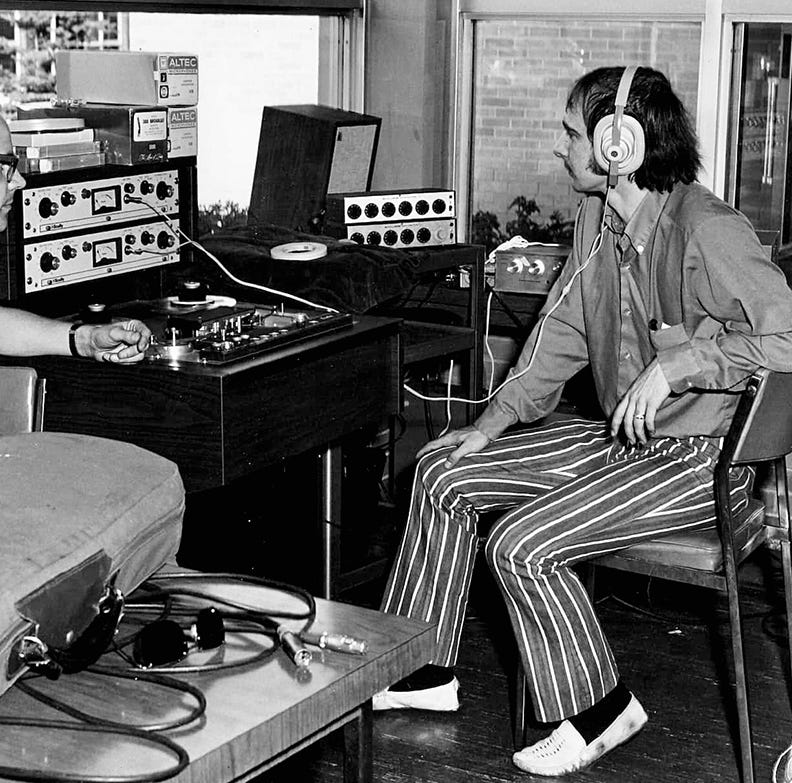
Micheal’s technical and entrepreneurial chops brought him industry-wide acclaim and a thriving international business. The audio components and systems he designed and manufactured are found in the studios and control rooms of broadcasters all over the world. His recording equipment has been used by such major artists as the BeeGees, Fleetwood Mac, Tom Petty, Barbara Streisand, Neil Diamond and countless others.
And Michael’s great successes might never have happened without his passion for the music, and the radio stations he heard it on, in the heady days of sixties rock and roll…
My mom used to listen to 40s classics, and symphony, and I just became very attracted to music at that time. I got into listening to the radio. As a kid, I would repair old wooden radios, the types of size of small refrigerators. And some of them had a really good sound. So I would recall when blue suede shoes came on, you know, I would crank it up and and enjoy that.
But unfortunately, I fall into the same category as every other person I know, that my big epiphany for music was February 1964 on The Ed Sullivan Show. Prior to that I had actually been keen enough and interested enough that I’d been ‘interning’, I’ll say, is a nice way of putting it – at CKY radio. From about the time I was 14. It was in love with the disc jockeys. I was in love with the concept. I became enamoured – I became in lust with broadcasting and music.
I would go and spend my time after school in the evenings sitting in the control room at the radio station. I go down in the daytime on weekends, I would go out to remotes that they did – I’d sit in the booth at champs Kentucky Fried Chicken with Darryl Birmingham while he spun records to the drive-in crowd at the place. I would ride in his convertible or Chuck Dan’s convertible out to the sock hops or the dances that they hosted.
And that was at age 15. And as enamoured as I was with that, that was going great, it was the Ed Sullivan Show that just changed my my life. Like everybody else – well, not everybody else I know – but the following Monday morning I went to junior high school with my hair combed forward, you know, simply because the Beatles wore their hair forward. And I start getting sent to the principal’s office from that point until I left school, for being ‘out of sorts.’
I guess at a certain point during that period, while at university, I became a disc jockey at student radio at U of M. It was not a broadcast, it was actually wired across campus. So it was about as exciting as playing records on the PA system in high school. But I did that too, and did some of my first recording there. So it came from a love of music from my mum, and then just through association with a lot of very influential radio people.
I’m not a naturally talented musician. It’s real hard work for me and I personally honestly admit I don’t have the discipline to practice and learn properly, but I fell in love with it. With the first real band I got involved with, watching the other guys in the band, I said well this would be a good way to get a girlfriend. And because I couldn’t play anything else, I decided I could probably play bass. I didn’t know how girls viewed bass players at that point. It was a Hofner bass, an original Hofner bass, Beatle bass, and I got really good. I could pick out the bass lines on the records I heard, but I didn’t have the stamina to play them for the entire length or time with the people that I happened to be around.
So – and this is where I did have a major epiphany – I decided I made a better manager than a bass player. And I took over management of the band. My entrepreneurial skills, which I do admit to having, came to the fore, and I booked the band and we played two or three times a week. Neil Young is correct. There were 200 pounds in Winnipeg at that time, we were the Liverpool of Canada. A community club, a Kiwanis hall, a church basement, a hockey rink – we would play anywhere – but we were playing about three times a week. And I managed to get our rate up. I was the salesman, I had to convince them that we were worth the money. We were getting $75 to $80 a night for a five piece band with a manager. And at that time, I remember clearly, I had a separate part time job doing electronic repair. And at that time I was being paid 50 cents an hour. So, put it into perspective of how many days a week did I have to earn to get the 10% I got off of one gig. Seven and a half bucks. Well, that was a long working day. That was two days…
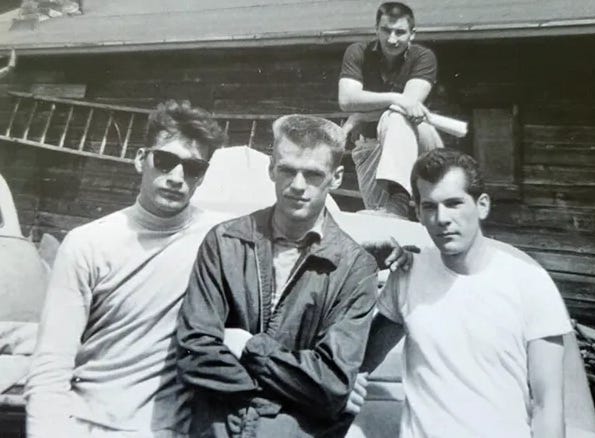
That first band, the Griffins, started in 1966. They were still doing well in 1968, but for Michael, things weren’t going well enough. That’s when he had another one of his epiphanies…
The one thing that I recognized is that our success and every other band success was our enemy. Because we had so many competitors. We couldn’t raise our rates, we couldn’t get more money because the Mongrels would play for the same rate, or the Other Five would show up, you know, for nothing. It got tough. And that the material, the genre that everyone’s playing was generally the same. So you could go to the same community club every week and hear a different band play, and it was the same music, which wasn’t very creative. And so it was difficult for us to stand out. We’re all long-haired, moustached, sideburns like crazy, we had more sideburns than hair… Wearing tweed British jackets and slacks and Beatle boots, you know – but I mean, if you blinked your eyes, it could be the Mongrels. They looked the same…
I said, you know, the music that’s beginning to become very popular is Motown. And there are a lot of female groups coming from there with female harmony, and there isn’t a single band out of our 200 bands that had a female member let alone a female singer or musician. We should find ourselves a really good quality female singer, and we could begin to take on a different genre and be unique amongst the Winnipeg bands.
Gillespie put some of the guys from the Griffins together with some new musicians and started a new band. It would have a new carefully designed approach, complete not just with one female singer but three. They called it Sugar and Spice.
I wrote a full chapter of my book (plus a Substack feature) on the making of this band and just how close they came to breaking out internationally. It’s a story in itself.
For two years Gillespie navigated Sugar and Spice throughout that band’s roller coaster ride. But starting in 1970, his band-managing days would take a back seat.
Randy Moffat when he hired me for the job. He says you have two jobs here Michael he says you keep us on the air. Because if we’re not on the air, the 75 people in this building aren’t earning a wage. That was a good point. And he said I want you to make us sound as good as possible. If you can accomplish those two things, your time is your own. You come and go when you want to do what you need to do. You do those two things, you’re doing your job. That gave me the free rein to research. And on CKY’s dime I did a lot of design and fixed, figured out, a lot of things. It was having the opportunity to be there that gave me the ability to research and design a product the way I was trained to design product, and I did it. So I built, installed, designed or renovated 30 AM, FM, TV and recording studios in Canada. That’s my broadcast package.
That broadcast package took Michael well beyond Winnipeg, soon enough beyond Canada, and soon after that, beyond the broadcasting industry. The same entrepreneurial chops he’d honed during his rock and roll run would now take him, his products, and his new businesses, into the stratosphere.
I’d go into a station and, ‘We need this’ – well, there is no such products by design, we build it. So at a certain point, I end up with a catalog of products that I built special for these places. But now people are phoning me and saying ‘I need one of those things that you put in CKLW,’ or, you know, CKCK or whatever it is. And so I’d be able to sort of piecemeal start to market them. Well, pretty soon I was hiring people to build product so I



 United States
