


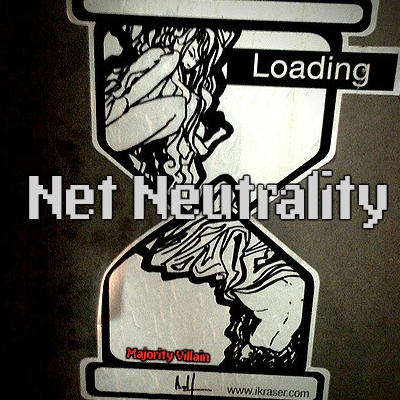
Net Neutrality
Description
Welcome to Maj-j-j-j-jo-o-o-rity Vil-l-l-l-lain-n-n-n The future of the internet under the elimination of Net Neutrality
What is Net Neutrality?
Today, the internet and access to it remain open. It remains accessible. It remains “free”, because anyone, anywhere at anytime can use it.
But that very freedom is scheduled to be rolled back dramatically on December 14th when the Federal Communications Commission is expected to vote to remove the internet as a public utility from Title II of the Communications Act.
Exactly. That legalese is most likely what your internet service provider, commonly called simply ISPs, has been counting on in order to keep consumers willfully ignorant about the future of the internet. But here’s where the rubber meets the road: it’s not working. Yep, as high as 2/3 of Americans from all walks of the political spectrum are keen to this corporate coup. And for good reason, right? From ridiculously long and non-intelligible user agreement forms to shoddy bundling packages with landlines that most kids in the year 2017 don’t even know exist, to simply trying to terminate your cable plan with customer service representatives who are more beast than man (Video of guy cancelling). This last video went viral after that man repeated those cancellation requests to Comcast customer service for nearly 20 minutes. Hell, I personally was sent to collections by Comcast over their mistake for about $30. Cable companies and internet service providers clearly have one lasting motive: the bottom line.
So is Net Neutrality just the latest gimmick? Most experts say it’s much more serious than that.
Columbia University media law professor Tim Wu first used the term “Net Neutrality” in 2003 when discussing “common carriers”. Companies that have a purpose of moving goods or services from one point to another. They “carry” your phone call from your mother, they “carry” our oil in pipelines, our Christmas packages on railways, and even “carry” precious YouTube videos all the way to your ears. Obviously, some applications may be more useful than others.
The important part is that the goods get to you when you need them, and are done so efficiently and quickly.
So what might happen in the aftermath of the death of Net Neutrality? Some are saying:
The Death of Online Activism the Expansion of Censorship
Right now, I can say whatever I want about Verizon. I can say that President Trump’s FCC Chairman, Ajit Pai, whom he personally appointed, is a dirty former lawyer of Verizon that likes to play with his poopy for foreplay in front of his corporate overlords at weird Verizon headquarter sex parties where the board of directors dress up like futuristic S&M dolls and virgins are led to the slaughter at the hands of anatomically correct killer robots all for the purpose of revitalizing their decrepit old skin in bizarre witchcraft rituals. And while this is clearly a true statement, under proposed FCC guidelines, they could simply block this very website altogether if they chose to.
This past December 7th saw some of the largest organized efforts to stop the FCC’s proposed changes as nationwide protests in front of Verizon stores took place. Those organizers like verizonprotests.com and battleforthenet.com could be in a state of perpetual loading if their ISP doesn’t like the content. Imagine if verizonprotests.com were located in an area where their only ISP was Verizon. There is literally nothing stopping Verizon from simply shutting down that operation. It sure doesn’t sound like a booming success for consumers, does it? It doesn’t resonate with options or protections for Jon and Jane Doe. The question presents itself then as a debate over whether or not access to the internet is a right. Should it be designated a common carrier and should consumers have proper access to it, as regulated by the government?
The words “more government” automatically give a lot of people the heeby jeebies. Fair enough, let’s look at why eliminating Net Neutrality is a good thing.
Probably the most common argument for ending Net Neutrality is economic. That argument goes like this: Why would ISPs continue to invest in internet infrastructure if the incentive for building it is financially undermined by everyone having the same access to it. Instead, internet service providers argue that being able to provide faster internet to those willing to pay for it will help create the financial incentive to build a faster internet for everyone, fast lanes for all, faster lanes for some. Sounds simple enough.
Companies like Comcast, Charter and Cox have said for sometime that slowing down internet speeds for most consumers wouldn’t be the goal of these new internet rules. Instead, they make the claim that consumers already have robust options in the internet market, and therefore this wouldn’t be a giveaway to the major ISP players. In other words, your internet service will be largely unaffected as the invisible hand of the market plays out and competes for your dollar. If company A is too slow, then company B will be a tough competitor in that market, or company c or d and so forth. Absolutely a solid argument with a strong foundation. But do people really have multitudes of ISP options?
Furthermore, could it be that the real reason money is not being invested in infrastructure is become the cable lobby is well aware that competition is weak. The main economic argument by ISPs assume that resources have been tight, and consumers can walk to another provider anytime they want. Business Insider’s Jeff Dunn doesn’t seem to think so in an April article saying, “Could Pai's net-neutrality plan lead ISPs to invest in more robust internet, and even offer it at cheaper prices? Possibly. But most of these companies have been sitting on piles of money for a long time, and they haven’t been very eager to spend the hundreds of millions needed to build out their private infrastructure into more places.”
However, according to a popular piece by John Oliver on Last Week Tonight (video clip) and on another episode from the show in 2014 he stated as high as “96% of the population has access to two or fewer broadband companies.” That would seem to contradict the cable and internet lobby’s claims. According to a piece by Jon Brodkin in Ars Technica this past July cable companies consistently make the claim that there is no shortage of competition in the market, even stating “Competition is alive and well in the TV and Internet marketplaces and consumers are benefiting every day.” Brodkin argues that this claim is only true, because the cable lobby uses a 3Mbps threshold in their definition of high speed internet. That’s the kind of internet connection that makes you want to drown your computer in the bathtub. So what was all that fast and faster talk about? Brodkin again: “Out of 118 million US households, more than 10.6 million have no access to wired Internet service with download speeds of at least 25Mbps, and an additional 46.1 million households live in areas with just one provider offering those speeds. Even including fixed wireless connections, there were still nearly 50 million households with one 25Mbps provider or none at all, based on the analysis of FCC data.” Basically, there are millions of Americans systematically disadvantaged in job searching, connecting with friends and family or having access to key information in a timely manner.
Brodkin finishes the July piece stating, “That report was issued before current Chairman Ajit Pai (former Verizon lawyer) took over for Tom Wheeler (former cable lobbyist). Pai voted against the 2015 decision to raise the broadband speed definition, criticized Wheeler for excluding satellite and mobile services from the new broadband benchmark, and has said the broadband market is too competitive for strict privacy rules. Under Pai's leadership, the FCC's future conclusions about broadband deployment and competition might be more in line with the cable lobby’s.”
Letters from an Outsider, by Vili Branyik “They're crazy. It's like everything everywhere is going crazy, so we don't go out anymore. We sit in the house, and slowly the world we are living in is getting smaller, and all we say is, 'Please, at least leave us alone in our living rooms. Let me have my toaster and my TV and my steel-belted radials and I won't say anything. Just leave us alone.' Well, I'm not gonna leave you alone. I want you to get mad!” -Howard Beale, The Network
One of the things I’d get in trouble for when I was a kid was playing Devil’s Advocate. My parents hated it to the point that they made me a shirt that had a quote from Dante’s Divine comedy - “The hottest places in hell are reserved for those who, in times of great moral crisis, maintain their neutrality.” I’m reluctant to take a stand for either side of an argument because both sides usually have their own merits. And, to paraphrase Penn Jillette, you should defend the people you don’t agree with at some point in your life. That act is a step to finding out what your priorities truly are. Now, with times being what they are, it’s difficult to support the repeal of Net Neutrality. For me, that means it’s time to stand for something. Part of the reason I’m explaining that is because there aren’t a lot of ways I can approach Net Neutrality without calling someone a fucking asshole - either the corporations supporting the repeal of Net Neutrality or the Chairman of the FCC, Ajit Pai. None of the people supporting the repeal of Net Neutrality come off to me as genuine in their efforts to pursue innovation or take further steps to make the open internet a basic right. I could make the argument that repealing Net Neutrality could be a step to the betterment of the open internet - the FCC has said that because of Net Neutrality, investing in corporations



















 United States
