


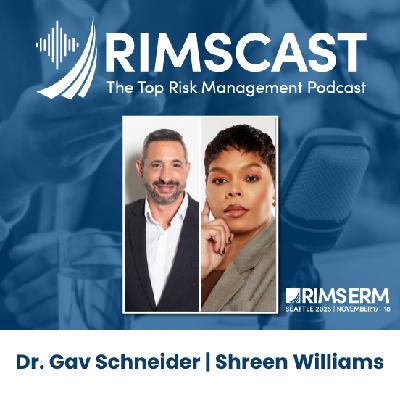
Presilience and Cognitive Biases with Dr. Gav Schneider and Shreen Williams
Description
Welcome to RIMScast. Your host is Justin Smulison, Business Content Manager at RIMS, the Risk and Insurance Management Society.
In this episode, Justin interviews two guests who presented at the RIMS ERM Conference 2025 in Seattle, Washington. First, Dr. Gav Schneider, Group CEO Risk 2 Solution Group and Founder, Institute of Presilience Risk 2 Solution, and second, Shreen Williams, Founder & CEO, Risky Business SW, LLC, and a member of the RIMS Rising Risk Professional Advisory Group. Dr. Schneider explained the meaning of Presilience and risk intelligence in ERM. Shreen Williams discussed the cognitive biases that can be mitigated through the six stages of an ERM Framework.
Listen for insights into implementing an ERM Framework in your organization.
Key Takeaways:
[:01] About RIMS and RIMScast.
[:17] About this episode of RIMScast. Our interviews were recorded live on site at the RIMS ERM Conference 2025 in Seattle. Our guests are Dr. Gav Schneider and Shreen Williams. We're going to have fun in this episode! But first…
[:48] The next Virtual RIMS-CRMP Exam Prep will be held on December 9th and 10th. From December 15 through the 18th CBCP and RIMS will present the RIMS-CRMP Exam Prep Boot Camp.
[1:05 ] Another virtual course will be held on January 14th and 15th, 2026. These are virtual courses. Links to these courses can be found through the Certifications page of RIMS.org and through this episode's show notes.
[1:18 ] RIMS Virtual Workshops! "Managing Data for ERM" will be led again by Pat Saporito. That session will start on December 11th. Registration closes on December 10th. RIMS members always enjoy deep discounts on the virtual workshops.
[1:37 ] The full schedule of virtual workshops can be found on the RIMS.org/education and RIMS.org/education/online-learning pages. A link is also in this episode's notes.
[1:48 ] The RIMS CRO Certificate Program in Advanced Enterprise Risk Management is hosted by the famous James Lam. This is a live, virtual program that helps elevate your expertise and career in ERM.
[2:01 ] You can enroll now for the next cohort, which will be held over 12 weeks from January through March of 2026. Registration closes on January 5th. Or Spring ahead and register for the cohort held from April through June of 2026. Registration closes on April 6th.
[2:21 ] Links to registration and enrollment are in this episode's show notes.
[2:25 ] This episode was recorded at the RIMS ERM Conference 2025. We've covered a lot of ERM ground in the last few episodes, and for those who want to catch up, I've included a link to the RIMS ERM Special Digital Edition of Risk Management magazine in this episode's notes.
[2:49 ] RIMScast ERM coverage is linked as well. Enhance your ERM knowledge with RIMS.
[2:54 ] On with the show! We are following up last week's episode with ERM Global Award of Distinction winner Sadig Hajiyev by featuring interviews with two of the presenters who appeared at the RIMS ERM Conference, Dr. Gav Schneider and Shreen Williams.
[3:12 ] Long-time RIMScast listeners may remember Dr. Gav Schneider from an episode in November of 2023. We were delighted that he made the trip all the way from Australia to join us at the ERM Conference in Seattle.
[3:27 ] Dr. Gav is the Group CEO at Risk2Solution Group and the Founder of the Institute of Presilience. The title of his session on November 17th was "Embedding Presilience and Risk Intelligence into ERM." This harkens back to his prior episode about wicked problems.
[3:45 ] We're going to start there and discuss how presilience takes that thinking to the next level for ERM leaders, and we're going to get some of his risk philosophies and have a great time. Let's get to it!
[3:56 ] Interview! Dr. Gav Schneider, welcome back to RIMScast!
[4:24 ] Dr. Schneider is here at the RIMS ERM Conference for the first time. It's the second-highest-attended ERM Conference in RIMS history. His session, later today, is called "Embedding Presilience and Risk Intelligence into ERM."
[4:54 ] On Dr. Schneider's last visit to RIMScast, he talked about wicked problems. How does presilience take that mindset and thinking to the next level for ERM?
[5:08 ] Dr. Schneider says the core idea of ERM is about getting scalable decision-making, recording, and outcomes, in terms of risk, for your organization. More and more, our organizations are facing these wicked problems.
[5:25 ] We can't function anymore in a world of absolutes. When we plug risk intelligence into the way we think, act, and plan, we become adaptive. We also become opportunity-centric.
[5:37 ] A wicked problem is not easily solved. When you implement a solution, it often leads to more problems. You have to be able to learn. If you can't learn, you can't adapt.
[6:17 ] What are the core components of the Presilience Framework? Dr. Schneider says, simplistically, we think about tackling risk at three levels: the self, the team, and the organization. Then we overlay that with people and process, connected through leadership.
[6:34 ] To make that work, we have to develop a set of core attributes: situational awareness, critical thinking, enhanced decision-making, effective and directive coms, the ability to act and enact, and the ability to learn and grow.
[6:46 ] When you can plug that into your architecture, leveraging insight, hindsight, and foresight, you then can make the right calls about whether or not to do something. It becomes an overlay model for most ERM-type structures, where we can plug the human piece into the system.
[7:15 ] Dr. Schneider says the core aim of ERM turns risk management into a team sport, with everyone across an organization reporting, collaborating, and understanding to make great decisions about where the organization is and where it's going, not where we think it is.
[7:32 ] To do that, we need to plug certain things into the ecosystem of the organization, some of which are policies, procedures, and tech. Most ERM experts do that. The piece that we've ignored is the human part, because it's hard.
[7:49 ] Dr. Schneider has compiled The Organizational Risk Culture Standard. It took about nine months of work. It was a thorough process. Five experts wrote it, 15 peers reviewed it, and 11 organizations have approved it, endorsed it, and are supporting it.
[8:09 ] For years, Dr. Schneider had heard that organizations would not focus on human-centricities that they couldn't measure.
[8:17 ] Dr. Schneider's framework has 10 domains with a maturity model that aligns beautifully with RIMS's ERM Model. It's built to encapsulate and incorporate ISO 31000 and COSO. Dr. Schnieider has just released it, free to download.
[8:39 ] Dr. Schneider is excited about presenting his session in a couple of hours. Everyone tells him that the RIMS ERM Conference is the sharp end of the spear, with the smartest risk people. The session is "Embedding Presilience and Risk Intelligence into ERM."
[9:10 ] Session attendees will learn about risk intelligence. Dr. Schneider's definition is an applied attribute or living skill that enables you to seize upside opportunities while you manage potential negative outcomes.
[9:44 ] When you speak of risk intelligence as a living skill and applied attribute, it becomes an ability to scale great decision-making. You want risk-intelligent people, working in risk-intelligent teams, empowered and structured into a risk-intelligent organization.
[10:18 ] Dr. Schneider says if we can't get those three layers to integrate and work together, you get frustrated stakeholders. Get your ERM team working to get everyone to understand the basics of risk reporting, using the metrics, and sharing information.
[10:33 ] Justin compares it to the gears in a watch. Dr. Schneider agrees; there's not one moving piece, it's a complex ecosystem in most organizations because humans are complex. We're relying on tech and on variables we don't control.
[10:46 ] Dr. Schneider says, in the conference, everyone's accepted how disruptive the current climate is, how difficult it is to forecast, and how uncertainty and volatility are dominating.
[10:59 ] With that in mind, we've got to think of it differently. You can't force people to adopt a system and think it will work. If you want to get a high-performance culture, ERM is an incredibly useful tool, but only if people want it, like it, want to use it, and understand the benefit it adds.
[11:17 ] Dr. Schneider thinks ERM is going to take a massive leap forward because of generative AI and because we've done well in process-based risk management. There are models, standards, and tools we can reference on how to do this.
[11:32 ] Why most organizations fail is that people don't understand people and the drivers people have. The one thing that Dr. Schneider would love people to take away from his session is that "I have to start with me."
[11:43 ] Dr. Schneider continues. If I'm trying to get people to do something, I need to understand the voice in my head, what's coming out of my mouth, and what my actions are. If I can't control that, what makes me think I'm go






 United States
