


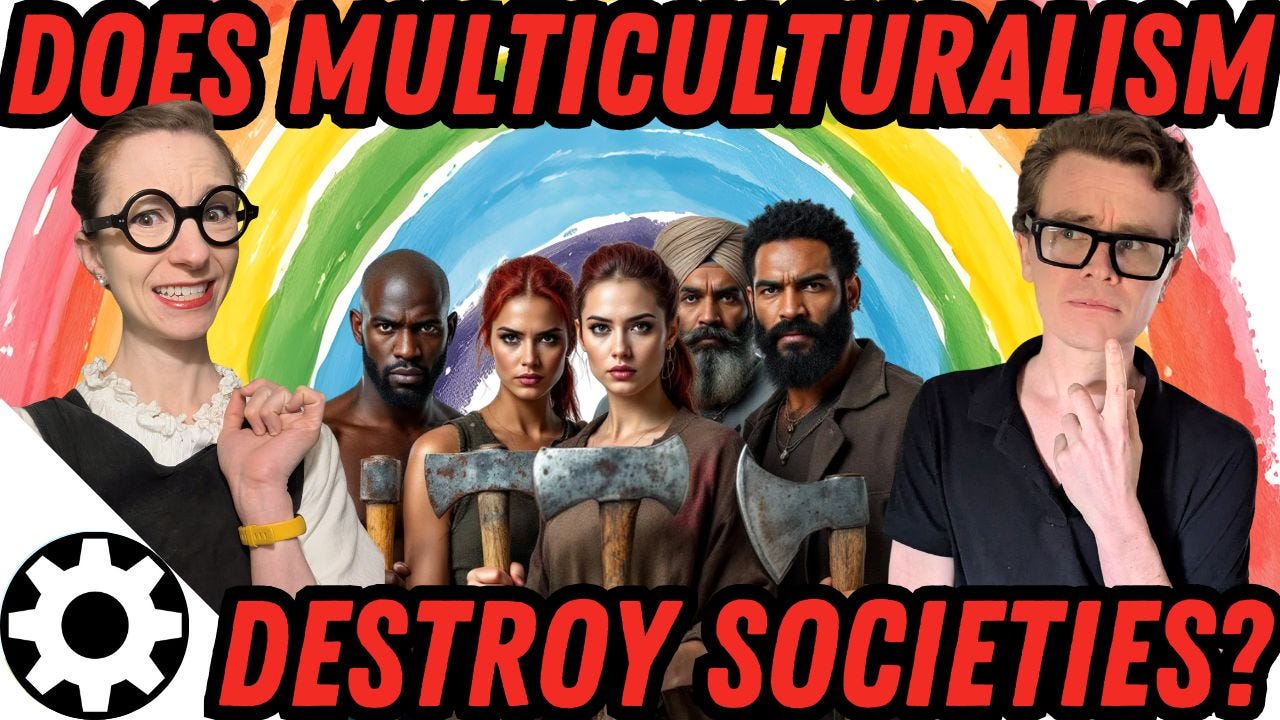
We Changed Our View On Multiculturalism: The Game Theory Problem
Description
In this thought-provoking episode of Based Camp, Malcolm and Simone Collins dive deep into the complexities of multiculturalism, high-trust societies, and the challenges that arise when diverse cultures interact within a single system. Malcolm shares his updated views on multiculturalism, exploring historical and modern examples—from the Victorian Empire to contemporary South Africa and the United States. The conversation covers topics like in-group preferences, the evolution of cultural trust, the impact of immigration, and the unintended consequences of social safety nets.
The hosts discuss how cultural backgrounds shape our moral frameworks, using analogies from classic cartoons like Bugs Bunny to illustrate differences in ethical perspectives. They also examine the pitfalls of trying to recreate homogenous societies in today’s interconnected world, and why some strategies that worked in the past may no longer be effective.
Whether you’re interested in sociology, politics, or just enjoy a candid, nuanced discussion about the forces shaping our world, this episode offers fresh insights and challenges conventional wisdom. Join Malcolm and Simone as they unpack the real rules of the game and what it means to adapt in a rapidly changing society.
Don’t forget to like, comment, and subscribe for more episodes of Based Camp!Malcolm Collins: [00:00:00 ] Hello Simone. I’m excited to be here with you today. Today’s conversation is going to be interesting because I have massively updated my own views on multiculturalism and whether or not it is a strictly good thing and how it transforms society. In addition to that, we will be talking about I was going to make a full episode on this topic before, but after the, the channel got in some trouble.
I can’t. But the the, the fashionistas actually have a point which is to say what is the core difference?
See, some people will be like, oh, well, you know,, fashionistas are different from typical leftists and that they are far right. And I’m like, far right. How though, like, well, they, they killed gay people. I’m like, almost every communist state has killed gay people except for like. I think like three in one short period in the Soviet Union.
Mm-hmm. But generally speaking, they have been much more likely to kill gay people than capitalist governments have been. And, and, and this is, this is just true story history. It’s like a very easy thing to check. So Okay. That’s not what really made [00:01:00 ] them, what really made them significantly different from a, a modern day socialist, right?
Mm-hmm. Is that they believed in. Ethno and cultural separation. Mm-hmm. So they attempted to separate different eth like for example, the, the, the, the you know, the Italians and the Germans and the Japanese all clearly worked together, right? Like they, they, it wasn’t just like one of their groups.
They all had their own weird ideology and they were working together to see an endstate. Not, not, not so dissimilar to the way that, you know. An Islamist today might work together with somebody who’s an LGBT advocate or something like that, right? Like, their, their end goals may be different, but they’re willing to have a, a multicultural movement.
Right? What made them distinct from, from something like the, the Islamists working alongside the L-G-B-T-Q population is these two groups would say, well, we need to find a way to live together in the same communities. In the same neighborhoods. Whereas these other groups, you know, the [00:02:00 ] traditional fashionistas from history they said, well, you know, we might work with the Japanese, but we’re not gonna like import Japanese people into our cities and stuff like that, right?
Mm-hmm.
Speaker: , what if we took species from all different planets in the universe and put them together on the same planet. Great tv, right? Asians, Jews, and Hispanics, all trying to live side by side on one planet. It’s great. We put them all together on Earth, and the whole universe tunes in to watch the fun!
Malcolm Collins: And I’m gonna argue, and this has helped me really understand these ideologies and why some modern people have them today. And I will argue that they’re fundamentally very flawed in the way that they have them today. But it is still a major update for me. Okay. So if you have a, and this is a quote I’ve said a hundred times, it’s like one of my core rules of politics.
Mm-hmm. You, you cannot act. And I got it from my grandfather who had a, a congressman. So yeah, I took it from him. I loved it. ‘cause I wanna keep him alive. You know, family tradition of intellectualism here. You cannot have. Porous borders and [00:03:00 ] generous social services at the same time.
Mm-hmm.
Because, like osmosis, the people who want those social services the most, eg the people least likely to pay into the system, most likely to take outta the system will differentially migrate into your SY country eventually breaking the system.
Yeah.
Okay. So this is, this is sort of where we’re starting here.
Simone Collins: Mm-hmm.
Malcolm Collins: Well,
Simone Collins: no
Malcolm Collins: one
Simone Collins: has pushed back on that.
Malcolm Collins: Right, right. But we’re gonna get to some more controversial things. Yes. We’re gonna get some more controversial things.
Simone Collins: Yeah, yeah, yeah. Well, and I think that’s because people haven’t thought this through to its logical conclusion which has been laid bare by comments we received on a video about disability maxing this phenomenon whereby a bunch of people who aren’t really disabled are claiming disabled status at universities, especially elite universities.
Mm-hmm. To get more time on tests and a bunch of other privileges like solo dorms and housing, which a lot of people think is unfair because. They’re not actually disabled. But this is the similar dynamic. Just thought through more to its conclusion.
Malcolm Collins: It’s it is a Well, no, because you will get instances in [00:04:00 ] which, because you have a common culture and a common group, you can have opportunities to exploit a system like this.
Mm-hmm. But people won’t use it. Right. This is what you have within. Culturally uniform or I’d call it. Culturally homeostatic societies. Mm-hmm. So you don’t necessarily need them to be cultural uniform.
They can have a few cultural units, but you, you, you need to broadly have like, you know, maybe like four or three cultural units in a society max. And it becomes harder than more s you have in a society. Mm-hmm. ‘cause you can think of each culture like an individual. I’ve talked about this in other recent videos, but I’m basically stitching together a bunch of individual thoughts I’ve had into a bigger thought, which is a say.
If you look at why a country like South Africa is falling apart, and I’m using South Africa as an example here to point out that this is not a problem that is necessarily caused by immigration. It is simply caused by having too many cultures under one governing body. So you look at a [00:05:00 ] country like South Africa where you have strong cultural unity to different tribal groups, or the BOS or the English or the, you know, blah, blah, blah, blah, blah, right?
Like a bunch of groups, right? And, often one group will attempt to control specific branches of governments or the wider government more broadly. And various groups attempt to take money from the the, the tax system for their own sorts of corruption. Now, if you go historically to, let’s, let’s go to a more monocultural society historically, like mm-hmm.
The Victorian Empire, right? Mm-hmm. Within the Victorian Empire in the early days, ‘cause we’re gonna talk about how it changed and how you can accept multiple cultures into a society. In the early days if you were embezzling money from the Victorian government or if you were acting in a way that benefited yourself, but hurt other people in society you were fundamentally.
Hurting your own culture and moral constructs values, right? Mm. Because your culture would be less likely to hold more [00:06:00 ] sway on a, in a world stage. And this matters because the more sway your cultural group holds on a moral SI world stage, the more morality that looks like yours is held on the moral stage.
Also, I
Simone Collins: think you, because you identify more with that culture, you care more about what they think of you. Exactly. And you’ll feel more shame. For, for exploiting it. Like when they, when they, when they shame you for exploiting it, you will be cast out from a society that you care about that you wanna participate in.
And that will make you sad as opposed to other instances where they’re like, I don’t care what you think about, I don’t respect you at all.
Malcolm Collins: Right. So now let’s, let’s, let’s look at the situation in South Africa right now. Okay. In South Africa it’s very different if you can embezzle money from the government to benefit your own group, your own tribal group, or not only tribal groups.
‘cause obviously you have the BOS and English and all the other, you know, basically your own. Cultural group, right? If you can embezzle money from the government, if you can cheat on a contract, if [00:07:00 ] you can act nepotistic to benefit your own subgroup mm-hmm. That is just strictly a good, because if, when you even
Simone Collins: see this, and I think people forget with South Africa, this isn’t just about like apartheid.
It’s, it’s one of the bigger issues. Was that after, a




















 United States
