



Yes, Both Sides
Description
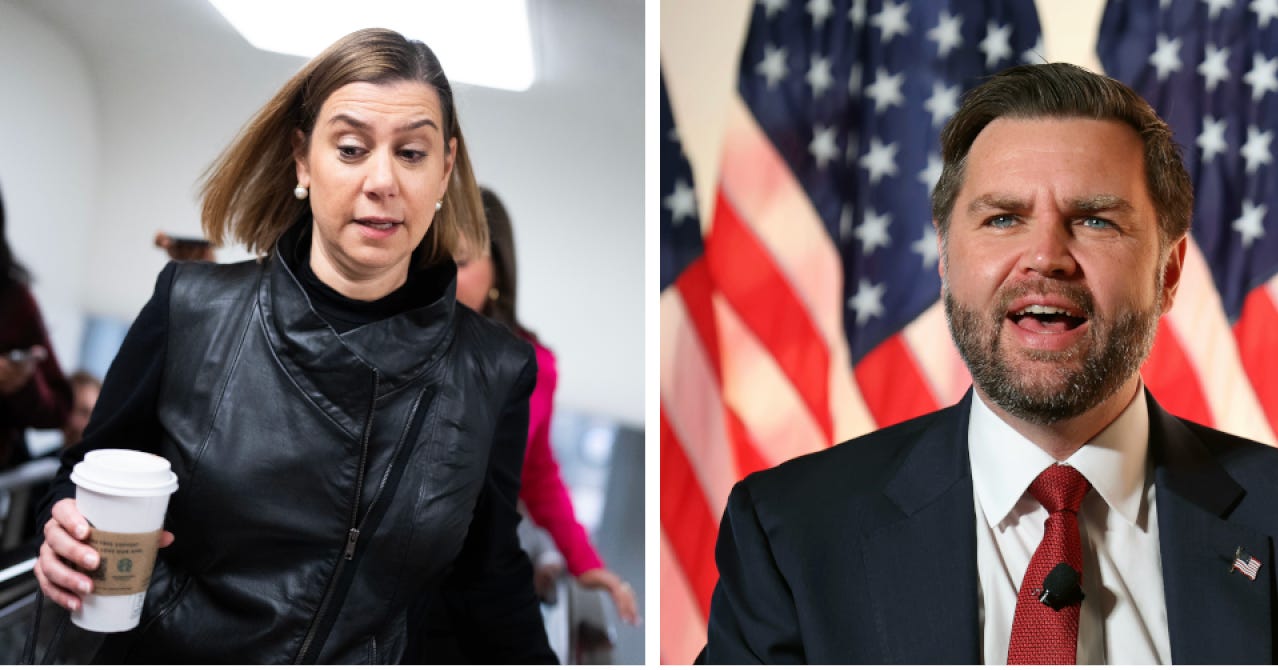
Days before Thanksgiving, when I must be like millions of Americans in just wanting to reach five days of permission to ignore the madness, the country is unraveling. Unlike most of us, who will look for ways this week to set aside differences for the good of our families, our political leaders are bitterly, senselessly escalating. American politics has become a suicidal farce, in which two teams locked in mutual hatred keep trying to finish the “guilty” side off, but instead end up cheek-to-cheek, dancing us all toward the cliff-edge of history. The idiotic framework has never been more evident than in the fast-worsening “illegal orders” crisis, where both sides are clearly at fault:
The circus started a week ago today, when Democratic Party Senators Elissa Slotkin of Michigan and Mark Kelly of Arizona launched a high-stakes gambit along with House members Maggie Goodlander of New Hampshire, Jason Crow of Colorado, and Chris Deluzio and Chrissy Houlahan of Pennsylvania, telling “members of the military and the intelligence community” that “you can refuse illegal orders.”
This slick composition was designed to send several messages at once. Despite the firm-but-soothing score (it sounds like the background music for a military massage parlor) and repeat reassurances along the lines of “We know it’s a difficult time” and “We have your back,” the real subtext is threat. The You must refuse illegal orders line about obligation and culpability is as important as their more-publicized You can refuse illegal orders message, about conscience and saving the nation. “Don’t give up the ship” was the dying gasp of Captain James Lawrence, killed in June 1813 in a Boston Harbor battle with the HMS Shannon, but the modern Lawrences aren’t planning on dying at British hands but looking to the future. This came out in later media appearances.
When ABC News Sunday interviewed Slotkin, anchor Martha Raddatz elicited several damning admissions. (Incidentally, the slog back toward occasional difficult questions for both parties by news networks is one of the few encouraging developments of this past horrible year.) First, Raddatz interrupted after Slotkin claimed Trump “asked his secretary of defense and his chairman of the Joint Chiefs to ‘shoot at their legs’ at unarmed protesters,” reminding the ex-CIA official-turned-Senator that though this was mentioned in former Defense chief Mark Esper’s A Sacred Oath, Trump “didn’t exactly say that. [Esper] said the president suggested that, but they were never ordered to do that.” Raddatz then pressed further, asking, “Do you believe President Trump has issued any illegal orders?”
Slotkin offered a curious reply: “To my knowledge, I am not aware of things that are illegal.” When Raddatz kept after her, Slotkin mentioned “legal gymnastics that are going on with these Caribbean strikes and everything related to Venezuela,” then talked about “the use of U.S. military on American shores, on our city, in our cities and in our streets,” where “people in uniformed military get nervous, get stressed, shoot at American civilians.” Raddatz from here asked the obvious question, namely that Slotkin sounded like a person describing murky or unclear situations, so “couldn’t you have done a video saying just what you just said?” In other words, if you’re unsure if something is legal, here’s the proper procedure. That would be the truly apolitical, public service announcement version of a “You can refuse illegal orders” video.
That’s not the only message they wanted to send, however, as became clear when Slotkin laid out “Don’t Give Up The Ship” in greater detail:
I mean, going back to Nuremberg, right, that, “Well, they told me to do it, that’s why I murdered people,” is not an excuse. If you look at popular culture, like, you watch, you know, “A Few Good Men,” like we have plenty of examples since World War II, in Vietnam, where people were told to follow illegal orders, and they did it, and they were prosecuted for it.
Invoking a movie as if it were a real-world example of being “told to follow illegal orders” exposed the cynicism of Slotkin and Kelly’s ploy. They could have mentioned specifics in the video, explaining what to do about the administration’s drug boat bombing campaign, under a cloud after the resignation of Southern Command chief Admiral Alvin Holsey, or the deployment of National Guard troops to streets of Democratic-run cities, already interrupted in some cases by judges.
Steering so far from specifics that the Code Red from A Few Good Men became the example, though, invited the entire population of military and intelligence officers to ponder their orders, not just in terms of legality but the potential to be “prosecuted for it,” as Slotkin put it. Underneath its lawyered veneer, the video was a clear message to the rank-and-file that they might be Nuremberged by a future administration, one presumably run by a party already comparing this one to the Third Reich.
That’s not just a legal calculation, but a political one. Trump is deriving authority for the boat strikes from memos drafted by his own Office of Legal Counsel, the same dubious framework the Bush administration successfully used to sanctify torture and the Obama administration used to “legalize” droning American citizens. If I were an officer in the current drone program and watched both the funeral of Dick Cheney (lavishly attended by former leaders of both parties) and the Slotkin-Kelly video, I’d find myself paralyzed by calculations. Will I be held accountable for the questionable practices in which we’ve been engaging all along, or just the new policies unique to Trump? How clear are those lines?
It’s a nightmare that will force officers to


 United States
