


Ki to the City
Subscribed: 3Played: 42
Subscribe

© Jon Di Luca
Description
51 Episodes
Reverse
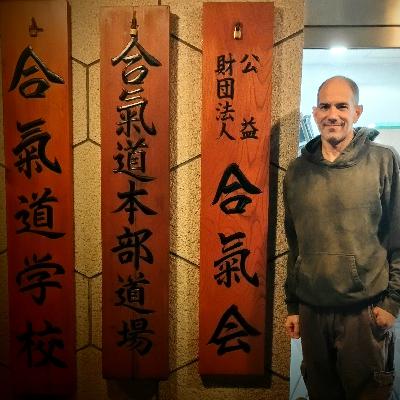
As we roll through the holiday season, I’d like to take a quick moment to wish you all joy and felicity (I love that word).2025 has been quite interesting, to say the least. Am I right?This is an especially reflective time for me, specifically in regards to this podcast, as its one-year anniversary is coming up on January 15th.I’m deeply grateful for the subscriber support, the vast insight gleaned from my guests, and the quality interactions I’ve been fortunate enough to engage in over the past year.Aikido is (obviously) tremendously important to me, and I hope to be able to continue this project for as long as humanly possible, digging ever deeper and seeking new avenues to extend some more ki to the city.On this episode, I had the pleasure of speaking with Tom Gardner Sensei, an integral long-time member and teacher at Bond Street Dojo.Tom Sensei has been a profoundly positive influence for me personally during the decade since I first joined Bond Street. He’s essential to the dedicated lineage of instructors ensuring that Aikido remembers its mission and maintains its relevance.Through four decades of diligent training at various world-renowned dojos, both in the U.S. and Japan, he’s refined a practice that balances astute technical savvy with an extraordinary exhibition of Aikido principles in action.In every class Tom Sensei leads, without fail, I find myself learning something new, whether it’s a subtle nuance in a weapons kata or a timely tip on how to further strengthen the “mind-body connection”.His approach to teaching is indicative of what makes Bond Street so special. Classes often feel like a collaborative workshop, where we test our ability to stay centered and calm under the intense pressures of conflict.In this conversation, we delve into Tom’s tremendous wealth of experience training with a myriad of well-respected (and sometimes polarizing) teachers.We also spend some time reflecting on the future viability of our beloved art.I don’t want to give too much of his profound secret wisdom away, so, please, check out the episode…By the way, there are still some limited copies of Don Dickie Sensei’s book, Silent Winds of Aikido, available.Please don’t hesitate to reach out to me if you are interested in receiving a copy, and I’ll fill you in on all the details.Happy New Year! Get full access to Ki to the City at kitothecity.substack.com/subscribe
Kenneth Kron Sensei’s perspective on Aikido has been shaped by a truly remarkable lineage; he’s a long-time student of Robert Nadeau Shihan and Richard Moon Sensei.To understand the depth Kenneth Sensei brings to his practice, one must first consider the well he’s drawn from.Robert Nadeau Shihan is one of the few, fortunate, “westerners” to study directly with O-Sensei, bringing home a vision of Aikido which prioritizes the transformation of self and the shifting of dimensional awareness over physical combat. His influence on Aikido in America is enormous in importance.Richard Moon has trained with Nadeau Sensei for over 55 years, yet maintains a humble approach to instruction, frequently stating that he doesn’t teach, but is instead learning out loud. He focuses heavily on the “Aikido that cannot be seen,” prioritizing the energetic pulse and the transformation of awareness over physical mechanics.(If you’re new to this podcast and have not yet heard my previous interview with Richard Moon Sensei, I highly recommend it. Or, just wait a few weeks for when I speak to him about his upcoming book: Quantum Aikido.)Kenneth Sensei has been instrumental in preserving and transmitting this lineal wisdom via the popular YouTube channel: Moon Sensei.This channel acts as a vital digital dojo, archiving the “Centered Wisdom” that characterizes their unique exploration of the art.It’s a repository for those who seek to understand how aiki operates as a socio-organizational technology—something that can be used to reconcile the discords of daily life.Oh, and they got a Substack too! Quantum AikidoFair warning: our conversation gets pretty deep and personal.Could be a consequence of recording on the winter solstice.Speaking of, I want to take this moment to wish everyone reading/listening a very Happy Holiday.I’m hoping to get one more episode out before the New Year, but I don’t have anyone booked as of yet. If you have any suggestions/volunteers, let me know…Fret not, I got a full slate planned for January.I’d like to take a brief moment to remind you of Don Dickie Sensei’s generous offer from a few weeks ago.In support of the mission of this podcast, he’s graciously donated a limited number of copies of his deeply reflective volume of poetry, Silent Winds of Aikido.This book is a magnificent vehicle for spiritual inquiry utilizing freeform verse. If you are able to make a donation to help keep Ki to the City on “the airwaves,” we can arrange to get a copy (or a few) to you.Please email me directly at jondiluca@yahoo.com to set something up.Enjoy! Get full access to Ki to the City at kitothecity.substack.com/subscribe
On this episode, I had the pleasure of being joined by a true inspiration and a good friend of mine (from real life), Phil Cappello.We met when I was an uchi-deshi back in ‘08—and here we are, seventeen years later, as he put it, “Still training, still trying to figure some of this stuff out.”Phil’s journey is remarkable, an extraordinary story in which the discovery of Aikido provided holistic relief from severe injury trauma and catalyzed his mission to transform how we approach the simple, yet potentially terrifying, act of falling.At twenty years old, Phil survived an astounding fifty-foot fall off the roof of an apartment building. This life-changing event put him way past the statistical margin of survival; as I learned in this episode, falls over thirty feet are about 50% fatal.This incident (obviously) instantly transformed his life.The physical damage was immense: Phil emerged with seventeen broken bones, broken ribs (as in, all of them), a perforated lung, a damaged spleen, and catastrophic injury to his arm, resulting in his humerus, elbow, and shoulder being blown out, leading to paralysis in his elbow and wrist for years.The medical advice he received was counterintuitive to his nature as a highly active Division 1 lacrosse player: he was told to protect the injury, and cautioned against exercise.Yet, even the doctors admitted that his athleticism was likely what saved him from contracting pneumonia, highlighting the irony that the active life they were telling him to abandon was the source of his initial survival.Despite the severity of his injuries, Phil possessed an inherent, deep-seated athletic drive, didn’t want to get pneumonia, and sought a way to maintain his conditioning. Driven by this necessity, he threw himself into rehabilitation, using a background in wrestling to inform his recovery.In 2003, Phil discovered Aikido. He was quickly disabused of the notion that it was a “soft art” when he saw that much of the practice was acutely devoted to the very physical challenge that now terrified him most: falling.He was faced with the immediate psychological pressure of grappling with an experience that had nearly killed him, yet he quickly realized that Aikido offered something revolutionary, providing more than a physical redemption arc. Aikido offered a healing modality unmatched by anything else.Through practicing throws and falls in the dojo, he was able to confront and overcome the (totally) understandable fear of falling that threatened to stifle his natural proclivity for action.This realization was revelatory: he was able to do what he’d always loved—wrestling and grappling—but in a “totally different” context where violence was not the objective.Phil’s experience has led him to dedicate his current work to sharing the unique value of Aikido’s distinct ukemi practice with the wider world.He is now the driving force behind the innovative program he calls “Ukemi: The art of falling.” Check out the website here: https://thefallingexpert.com/His goal is to translate a core skill of Aikido—the ability to fall safely and rise again—into a system accessible to the general public.This mission is directly inspired by his own family, noting that for elderly people, falling is a real concern and a worry. Phil realized that most people might not need to know how to perform Ikkyo, but everyone could stand to learn how to more safely engage with the dynamics of a fall.Phil has adapted the methodology of traditional martial arts masters, such as Jigoro Kano, structuring his curriculum around training a practitioner in forty foundational falls over a period of five years, consciously emulating the highly successful educational model of Judo.This program serves a wide range of individuals, from senior citizens in need of basic fall prevention to competitive martial artists who want to get more comfortable with the standing phase of grappling.Ultimately, Phil’s work epitomizes the principle of giving back, stemming from the self-mastery he achieved through dedicated training. He took the profound, life-saving lessons learned on the tatami and formalized them into a vital service, ensuring that the peaceful and protective dimension of the art is accessible to a much larger segment of the population.This, to me, is the ultimate expression of the spirit of Aikido, turning personal trauma into a universal therapeutic offering—a true art of peace and harmony in action. Get full access to Ki to the City at kitothecity.substack.com/subscribe
I first had Don Dickie Sensei as a guest back in April, and he blew my mind with his vivid, coherent, and powerful description of meditation, inspiring me to finally pursue my own inner practice in earnest.(Brief update on how that practice is going: I’ve so far cobbled together aspects of what I’m learning from Don Sensei, Linda Holiday Sensei, and Koichi Barrish Sensei, with some leftover vestiges of previous “astral travel” experiments. Overall, I’m feeling pretty connected to the universe.)Don Sensei’s impressive background includes intensive studies in kinesiology, cognitive psychology, and Tibetan Buddhism. This unique perspectival expertise provides him a multifocal lens through which to examine the connections between movements, mental states, and spiritual aspirations.His understanding of the mind-body connection is phenomenal.He’s also the author of several illuminating books you can find at this link: dondickie.com As someone who has attempted to juggle a fusion of creative writing and Aikido practice—while seeking to explore the dynamic flow of both—I’m thrilled to delve into an author’s work that consciously harnesses this synergy.On this special episode, Don Sensei reads selected pieces from his deeply reflective volume of poetry, Silent Winds of Aikido.This inspirational collection of poems is a vehicle for active spiritual inquiry, an eloquent path towards attaining greater awareness.I’m in awe of how viscerally he’s able to describe both the inner and outer worlds we inhabit in our practice—the action and the stillness, simultaneously.For instance, in the poem titled “Awareness,” this elusive concept is defined beautifully through metaphor, highlighting its subtle, pervasive quality:It’s a soft thing, not hard or sharp. More a blanket enveloping without constraint. No matter how comfortable, other things demand our attention… An attack comes silently, unaware, unprepared. You are hit.The lack of a soft, all-encompassing awareness ultimately leads to getting caught up in trifling conflict, describing the literal and figurative “Story of Randori.”Don Sensei emphasizes that the practice of overall awareness is not an end unto itself; it’s the catalyst for refining our intuition, an inner guidance granted divine provenance by O Sensei. This development is a crucial step on the way to fulfilling Aikido’s true stated goal: making the world a better place.But beyond the literary and metaphysical, we also, importantly, discussed Don Sensei’s extremely generous offer to help support this podcast.He’s graciously donated a limited number (125 copies) of Silent Winds of Aikido.They’re available to listeners who’d like to make a (badly needed) donation to help keep this project going.If you’d like to receive a copy (or multiple copies—think New Year’s gift for your dojo), please email me directly at jondiluca@yahoo.com for more details.I’m extremely grateful for this gesture. Don Sensei has been a great friend and supporter of this project since the very beginning.His faith in my mission means the world to me, and I’d love to introduce his writing to those who are otherwise unaware of his profound wisdom.So please, reach out to me if you’re interested in receiving a copy. Even if you’re unable to make a monetary contribution at this time, sharing this episode on social media (or something like that) would go a long way.The goal is to share the message.Peace Get full access to Ki to the City at kitothecity.substack.com/subscribe
I had the immense pleasure of speaking with yet another board member of Aiki Extensions, Susan Dutton Sensei, Chief Instructor at Aiseishinkan dojo in Green Bay, Wisconsin.If there’s one theme that’s continually revealed itself throughout this podcast’s first year of taking shape, it’s the phenomenal potential of Aikido to transcend boundaries beyond physical training.Susan Dutton Sensei’s fascinating background, expertise, and dedication to applying Aikido principles make her work wonderfully unique and highly impactful, particularly in the realm of emotional and psychological well-being.Eq-do (her own brilliant portmanteau) is the term she’s coined for her coaching practice, bridging the philosophical depth of Aikido with contemporary somatic/psychological science and applying these integrated principles to facilitate healing.According to Susan Sensei, a fundamental insight of EQ-do is that by using the physical body to teach emotional concepts, they stick at a much deeper level than purely cognitive information.A great example she uses is teaching emotional distancing by demonstrating that once students learn to take hanmi and feel their power to not be affected by a gentle push, they realize they are responsible for their own balance, not the actions of another.Susan Sensei’s practice is many-layered, drawing on principles that go beyond simple technique, incorporating mental and spiritual intention:One particularly fascinating facet of her work involves the practice and teaching of TRE (Tension and Trauma Releasing Exercises), a sequence of exercises designed to facilitate the release of deep tension through body tremors. These neurogenic tremors are a natural way to reset the body when the nervous system is locked in fight or flight mode, thereby freeing the mind to access higher wisdom.It’s really incredible stuff.Pretty much blew my mind.But I don’t want to give too much away…Because I want you to listen to the episode!Don’t forget to check out all the amazing things going on at Aiki Extensions. They’re genuinely trying to make the world a better place. I cherish every conversation I’ve had with them so far and hope to do my part to spread the word far and wide. Get full access to Ki to the City at kitothecity.substack.com/subscribe
Exploring the transformative potential of Aikido through this project has led me down some unexpected, yet highly rewarding, paths.Connecting with (and receiving wisdom from) truly visionary people like Richard Sims has positively influenced my own practice substantially.Our conversation sits right at the heart of everything this podcast aims to explore: the intersection of philosophy and tangible, interpersonal impact.Richard serves as a dedicated board member of Aiki Extensions, which shows right off the bat how devoted he is to extending the principles and practices of Aikido beyond the physical dojo space, pursuing a broad societal benefit.As you may have noticed by my recent guest list, Somatics has become a keen interest of mine as of late.Richard is instrumental in the field, serving as the president of the board of ISMETA (the International Somatic Movement Education and Therapy Association).He defines somatics as the “in-depth study of the self from your lived experience, emphasizing the intentional, coordinated awareness and use of the body, mind, and spirit for the betterment of the individual and their community.”We explore in depth the role that this heightened awareness could play in enhancing Aikido practice.We also discuss how the integration of Aiki principles and somatic awareness is culminating in an exciting project being currently undertaken by Aiki Extensions: A trauma handbook that Richard is co-authoring alongside fellow board members, Jamie Zimron and Susan Dutton, all of whom possess expertise in both Aikido and trauma work.This handbook is expected to roll out early next year. I will cover it extensively here, so stay tuned for that.I feel incredibly fortunate to be connected to this AE community. I’ve interviewed several AE board members so far, and every talk has led me to want to get involved deeper into the ultra-important work they are doing.Their sincere dedication to global peace and human betterment through the principles of Aikido constantly renews my own faith.I look forward to continuous learning about how we can all use the principles of Aikido to make the world a better place.To learn more about Richard Sims, please check out his website here: Richardesims.com Get full access to Ki to the City at kitothecity.substack.com/subscribe
On this episode,My talk with Liam Robertson, musician and aikidoka (Aikido of Petaluma), moved pretty deftly (if I do say so myself) into an exploration of the profound philosophical and physical resonances between these two harmonic arts.We got into a sound discussion (get it?) on the many parallels between Aikido and music, ultimately recognizing them both as empowering disciplines that refine our natural emotional expressions, offering the opportunity, through harmonic shifts, to move beyond “ego.”A further focus on authentic, present expression led us into the realm of somatics, specifically Liam’s understanding that the body is your first instrument.Strozzi-Heckler Sensei, defines somatics as the art and study of the soma, viewing the body as a “living wholeness” where mind, body, and spirit are integrated.Liam applies this principle directly in his music teaching, asserting that the body is the primary instrument for self-expression, preceding the voice. This approach requires the practitioner to witness what is occurring in the body, paying attention to posture and presence, etc.Sounds like Aikido...We also contemplated the critical role of competition in shaping both arts, particularly the revolutionary non-competitive stance of Aikido.In our modern, atomized, and hyper-competitive world, the Aikido dojo offers a necessary sanctuary for people seeking more harmony in their lives.As in playing music with a joyful devotion, when practice is collaborative, it allows us to transcend the illusory quality of separation and division.Don’t miss this one! Get full access to Ki to the City at kitothecity.substack.com/subscribe
On this episode of “Ki to the City,” we dive into one of our most candid and courageous conversations yet, featuring Matt Gano, a long-time student of Koichi Barrish Sensei.Despite engaging in some profoundly insightful conversations with Barrish Sensei, and having the honor of attending (online) his Chouhai morning prayer sessions on the weekends, I’ve yet to have the fortune of ever directly training with him.Matt gives us a panoramic view of what it was like to discover Aikido by chancing upon the dojo of this amazing Sensei and wonderful human being.Matt’s journey into Aikido began, as many do, with a search for self-defense, but has evolved into something much deeper: a search for awareness. He’s come to the understanding that we are all expressions of nature, and our practice is the dedicated process of refining that awareness and expression.We ruminate on the numerous allusions O Sensei made to Aikido being expressed most clearly in nature, which led to a long, but highly infotaining (I promise) digression into the behavioral intelligence of crows and ravens and our own personal experiences trying to befriend members of the corvid family.Matt views his struggles with Obsessive-Compulsive Disorder and social anxiety through the lens of training, considering difficult experiences like appearing on this podcast as a form of practice – shugyo in daily life.His unique insights provide another timely reminder that Aikido is far more than just a set of physical techniques; it’s a therapeutic exercise and a vital source of strength for navigating the complexities of modern life.I could write much more about the deep, frank, open, lively, joyful conversation we had, but I want you to listen to the episode!If you’d like to read some of Matt’s impressions on Aikido and life, please visit Aikiweb.com, where you can find his writing.(I tried to post the link, but as we talk about in the episode, I always have trouble accessing Aikiweb. My computer told me to “delete my cookies”. I don’t even know what that means. Sorry.) Get full access to Ki to the City at kitothecity.substack.com/subscribe
How does embracing our body’s non-cognitive intelligence offer us infinite pathways to creativity and conflict resolution that our overthinking minds cannot?This week, I had a vivifying conversation in which we traverse that very question.I had the immense pleasure of speaking with Dr. Elisabet Lahti, a brilliant researcher and educator from Helsinki, Finland.Dr Lahti is world-renowned for studying and celebrating the ancient Finnish concept of Sisu, which she describes as Somatic Resilience: the universal human capacity to endure under pressure and take action against slim odds, unearthing courage from deep within.Sisulab is her fantastic website and podcast, which I sincerely suggest you check out to learn more about the profound work she’s doing.Dr Lahti’s journey into understanding this deep inner strength is powerfully, deeply personal. Her own experience drove her probing research: How do humans find a way to overcome extreme difficulty? What is Sisu beyond concept?She pushed her limits, running 1,500 miles across the entire length of New Zealand to research Sisu viscerally while simultaneously supporting a campaign to end domestic violence.Intense effort led to a massive realization: the old idea of “mind over matter” wasn’t the path to true strength. This discovery led to the foundation of her groundbreaking concept: Gentle Power.Dr Lahti describes Gentle Power as the high octave version of Sisu. It’s the way to use the primordial human life force in a conscious manner. She emphasizes that being relaxed is vital; being relaxed doesn’t mean that you’re powerless. Gentle Power is the yin and the yang, the hard and soft qualities in harmony.Gentle Power is strength that is unforced, tender, and tempered, combining fierce resolve with softness and discernment. When describing its effect, she states that Gentle Power doesn’t grasp, doesn’t impose, doesn’t demand, doesn’t pretend, and yet, it expresses, states, and excels, allowing you to use your vital life force (Ki) without burning out.One huge takeaway from our talk, for me, was the reminder that cognitive reality is not the only reality. I notice that in most of these talks, this resolution of the schism between “mind” and “body” is often discussed. I’m learning so much.Dr Lahti shares how her background in social psychology had conditioned her to view human behavior and strength as something primarily mental. But her own research helped her realize that Sisu is more somatic than cognitive. She notes that as we grow up and enter society, we are often robbed of our natural way of moving through the world, forcing most things to seem to happen only in the cognitive realm, almost like we are constrained by a “cognitive broadband.” This is limiting, to say the least.She views Aikido as the necessary “yin side” to balance sheer determination, constantly giving the impetus to relax more. This helps develop the intelligence of the body and teaches us how to harmonize and blend to dissolve conflict of energy.Borrowing a phrase from past guest, Richard Moon, we were really just “learning out loud” together.Hope you enjoy the episode! Get full access to Ki to the City at kitothecity.substack.com/subscribe
On this episode of Ki to the City, I was joined by Scott Engler of Two Rock Aikido, a long-time student of Richard Strozzi-Heckler Sensei.Scott’s journey represents a remarkable path of integrating intellectual pursuits with physical and somatic disciplines. His story moves from the rarefied air of academia and the stark environment of corporate technology to the Aikido dojo and, eventually, to becoming a professional practitioner of Biodynamic Craniosacral Therapy.Check out his website here: Heart of Stillness(And his Instagram is replete with informative and inspirational content)In his own words, Scott began his adult life as a highly academic person, focusing his university studies on ancient Greek and Latin, becoming deeply fascinated with the ancient world. Interestingly, at the same time he was entrenched in those studies, he was competitively engaged in saber fencing, a Western martial art. He recalls that fencing generated a profound sense of aliveness—a feeling he describes in detail—a feeling much the same as what he experiences in the dojo.Scott later transitioned into the burgeoning world of computers, working for large software companies. However, the sedentary reality of “sitting in cubicles” proved physically taxing, eventually leading to breakdowns in his neck and back, compelling him to seek solutions like chiropractic care and massage.This crucial period marked his recognition that body awareness and touch needed to be integrated into his life in profound new ways.The catalyst for his full commitment came at the end of 1991 when a friend introduced him to Strozzi-Heckler Sensei’s influential book, In Search of the Warrior Spirit.Scott found the book to be a huge, personal revelation, speaking directly to his inner struggles, particularly the conflict between a deeply rooted pacifist side and a martial side, and questioning how to handle confrontations or bullies. This synchronicity deepened when he realized Richard Sensei lived nearby, leading him to the dojo in February 1992. At this pivotal moment, during a painful personal transition, when the ground was shaking beneath him, he found in Aikido and in Richard Sensei a guide to what would become his life’s work.A central theme of Scott’s training is Somatics, defined for as the art and study of the soma—an ancient Greek word for body. Scott elaborates that Somatics views the whole person—heart, mind, soul, spirit, and physicality—as interconnected. He explains that Aikido is inherently a somatic art, along with all martial arts, provided they are approached as a means to expand beyond mere technique and encompass the entire self and one’s conscious creations. This holistic approach is seen as a therapy for the schism or disconnect often fostered by Cartesian dualism in Western thought, offering a path to a more unified, aware way of being.Scott’s current professional practice, Biodynamic Craniosacral Therapy (BCST), flows directly from his somatic foundation. BCST originated from cranial osteopathy and is distinguished by its focus on the body’s inherent, subtle processes rather than just the biomechanics of tissues, tendons, and bones. In BCST, Scott places his attention on the unified fluid field within the body, listening intently to the slow, deep rhythm described as the “primary respiration” or the “long tide”. This practice is fundamentally concerned with supporting the body’s innate healing capacity, offering a less mechanical route than other forms of bodywork.He made the deliberate decision to transition to this work full-time in January 2007, recognizing the necessity of cultivating his practice over a “long horizon view”.Our conversation bridges Scott’s deeply physical and therapeutic work back to his intellectual roots in ancient Greek and Latin, in the oldest literature: the epic poems Iliad and Odyssey.These are essentially warrior stories, but when studied deeply, they reveal clues about the universal human condition, mortality, and the complex questioning of violence.Together, we muse on the relationship between this ancient, martial-themed literary tradition and the modern martial path of Aikido—comparing the feeling of wrestling with the nature of a life defined by cubicle work, political cataclysms, and economic necessity, with the more acute fatalistic stresses of “battle”.Ultimately, Scott’s story embodies the somatic ideal: turning life’s conflicts and ruptures into generative actions, cultivating a path toward a more “vivid peace,” through the expansion of awareness and the continuous practice of being truly alive. Get full access to Ki to the City at kitothecity.substack.com/subscribe
On this episode of Ki to the City, I sat down with my good friend and fellow Bond Street Dojo instructor, Nico Puertollano, for a candid, yet casual conversation about almost everything under the Aikido umbrella.We dove straight into the deep end, questioning the very relevancy of Aikido in the modern world. If it doesn’t feel relevant, then what’s the point?That led us to discuss the perpetually challenging state of our home dojo, Bond Street—the perils of toughing it out in NYC.This is one of the more down-to-earth episodes I’ve done.Since Nico and I train together on a regular basis, we naturally drifted into talking about some of the more technical and physical aspects of practice than I usually do on this show.How important are front rolls? How does it shift your perception of training if you view the techniques as “Kata”? What’s the function of Uke?I’m not going to spoil the answers for you, mainly because there are no definitive answers to these questions, but if you’re interested in our 4 cents’ worth, please check out the episode.Here are Nico’s Links:I’m not really an Instagram person, but Nico has a really cool IG account: AikiGramAnd look! He’s also on Substack: Nico’s SubstackI have to give you a quick peek behind the “Ki to City” curtain for a minute.I usually cap the episodes at an hour and ten minutes because my mic/headphone set-up is less than ideal, so I have to export the audio into Garageband to polish up the sound quality.This episode went a little longer than that, so I had to clip the last 15 minutes and include it here. Nico makes some very profound points, so please check it out.I truly love having and sharing these conversations, making aiki ripples, and connecting with the community. If you so happen to be in the position to become a paid subscriber, it would make a huge difference in ensuring that I can continue this project for the foreseeable future.Also, I’ve also started an alternate Substack for my writing that’s not so Aikido-focused. If you’re interested in that you can find it here: OptimysticThank youJon Get full access to Ki to the City at kitothecity.substack.com/subscribe
It’s a true honor and absolute privilege to present this episode of Ki to the City, featuring my conversation with one of the most vital figures in contemporary Aikido.Linda Holiday Sensei is the founder of Aikido of Santa Cruz and the esteemed author of Journey to the Heart of Aikido: The Teachings of Motomichi Anno Sensei.In addition to being an authentic, accomplished martial artist and writer, Holiday Sensei is a cultural intermediary. Her academic background, which includes a Master’s degree in East Asian Studies from Stanford University, positions her as an exceptionally reliable and significant conduit for understanding / transmitting the teachings of O-Sensei and the many other influential Sensei she’s met along the way.Her critically acclaimed book is instrumental in articulating the spiritual depth inherent in the art. It vividly describes her personal experience training closely with O-Sensei’s direct students in the mystical Kumano region of Japan, the life and trajectory of her primary teacher, Motomichi Anno Sensei, and important aspects of the founder’s path, ultimately inviting the reader into a deep study of Aikido as O-Sensei originally articulated it.This monumental work also serves as an act of cultural preservation, faithfully capturing the wisdom of Anno Sensei, one of the last remaining direct students of O Sensei—shining a bright light on the heart of Aikido.I highly recommend reading it, if you haven’t already. Here’s the link: Journey to the Heart of AikidoHoliday Sensei’s own work in founding Aikido of Santa Cruz as a non-profit educational organization, her international travels to teach (and learn from) others, and her online misogi sessions (see below), align magnificently with the founder’s aspiration to unite humanity through harmony and build a world family.I don’t want to give away too many spoilers, because I don’t want you to miss out on listening to the episode with a pair of fresh ears. (Is that even a saying, “fresh ears”?)But I do want to mention that I’m invigorated and encouraged by our chat and also now very much looking forward to participating in Holiday Sensei’s aforementioned (just one paragraph up) online misogi sessions, which you can join here: Misogi link.These virtual classes (Mon. and Wed. at 8AM PST) are an open invitation to experience misogi, chinkon kishin, chanting practices, and inspiring discussions drawn from O Sensei’s philosophy.Hope to see you there. Get full access to Ki to the City at kitothecity.substack.com/subscribe
On this episode of Ki to the City, I had the distinct honor of being joined by Robert Kent, President of Aiki Extensions.Robert Sensei received Ben & Jerry’s 2008 “Peace Pioneer” prize and the Small Business Council of America’s “Humanitarian of the Year” award in 2016.I’m incredibly proud to share this conversation with you.The work being spearheaded by Aiki Extensions is profoundly important, shining as a beacon for global peace, conflict resolution, and betterment in this increasingly (to put it mildly) challenging human society.Established in 1998 by the late Professor Don Levine Sensei, Aiki Extensions Inc. is a US-based 501(c)(3) nonprofit educational hub rooted in O Sensei’s core philosophy, particularly the application of “Aikido as medicine for a sick world.”Kent Sensei, serving as its President since 2009, embodies the very mission of applying Aiki principles far beyond the cozy confines of the dojo. His deep commitment to Aikido is complemented by rigorous intellectual training: he holds a BA in Religion & Philosophy from Williams College and an MA in Ethics from Claremont Graduate School.This intersection of expertise—martial arts, ethics, and philosophy—provides him with profound three-pronged credibility. It allows him to discuss the application of Aiki principles in complex, abstract domains like ethics, leadership, and international conflict with practical insight and embodied wisdom. One of the most fascinating themes we explored was the physiological transformation that Aikido facilitates. Kent Sensei is preparing to teach a course at Williams College, “Forging Character, Aikido and Cultivating Your Best Possible Self,” which posits that character is the result of better decisions and actions taken over time.He explains how Aikido training can effectively retrain the amygdala. (The amygdala is the trigger for the high-stress, shortcut decision-making system we’re born with, which typically defaults to fight, flight, freeze, fawn, or “freak out” responses.) By training physically in Aikido, the nervous system is retrained to offer compassionate, calm, centered, and blending responses. This new response eventually becomes the default under stress, leading to better decisions, actions, habits, and ultimately, better character. This concept is crucial, demonstrating how Aikido training helps us cultivate our best possible selves.The importance of Aiki Extensions, particularly concerning their dedication to global peace-building programs, cannot be overstated.One of the jewels in their portfolio is the Peace Camp Initiative (PCI), which Kent Sensei founded as a direct outgrowth of his background in teen counseling and conflict resolution. PCI functions as a scholarship fund, bringing Palestinian and Jewish youth leaders to a sports camp in upstate Pennsylvania each summer. The explicit goal is to forge bonds of friendship and trust for the next generation of leaders in the Middle East to achieve peace.By requiring participants to engage in shared physical practice, the program facilitates the embodied connection necessary for genuine rapport, bypassing cultural and linguistic barriers more effectively than traditional political exchanges. This initiative, co-directed by Robert Kent and longtime AE board member (previous guest) Jamie Leno Zimron, has provided this valuable experience for many campers over the years. (AE looks forward to when they can resume sending campers.)We also discussed Aiki Extensions’ innovative approach to societal contribution through direct therapeutic support. AE is actively developing a trauma handbook, expected to be rolled out next spring. This handbook of exercises and explanations is designed as a therapeutic tool for trauma work, enabling dojo leaders to partner with local licensed community therapists.This collaboration utilizes the dojo leader’s physical expertise and Aikido tools (focused on reconnecting with the body, improving movement pathways, and re-framing events) alongside professional therapeutic guidance, addressing various forms of trauma such as combat-related PTSD or unhealthy family dynamics. The vision here is to equip dojo-cho with additional tools, providing them with more ways to make a living while sharing the healing benefits of Aikido.I’m really looking forward to that.Aiki Extensions also serves as a crucial connective hub, supporting a wider network of like-minded initiatives globally. This support is largely channeled through the Seed & Support Grant Program, which offers modest funding typically ranging from $500 to $1000. This decentralized, grassroots funding model is deliberate, allowing AE to maximize its global reach and catalyze diverse projects from local practitioners.Examples of the projects that AE supports demonstrate the breadth of its impact outside the traditional dojo:* Aikido With Veterans: Projects aimed at reducing PTSD symptoms and building healthy lifestyles.* Anti-bullying and ‘Aiki Kindness’ projects piloted in schools.* Community-focused initiatives, such as low-cost Aikido programs for kids and parents.* International efforts like Training Across Borders, which brings together people from conflicting nations, and projects supporting Aikido Ethiopia.* Support for related endeavors, including the International Aiki Peace Week and organizations dedicated to preserving Aikido history, such as Josh Gold’s work at Aikido Journal and Budo Accelerator.* This podcast :)It is my sincere hope that this episode sheds light on how organizations like Aiki Extensions, under the thoughtful guidance of Robert Kent Sensei, are actively transforming the philosophical ideals of Aikido into tangible global action. The philosophical commitment of Aiki Extensions aligns perfectly with my own goal of bringing more Ki to the CityTune in to hear how Aiki Extensions is supporting the movement for global peace and providing essential resources for trauma recovery, demonstrating that Aikido truly offers “vital ‘medicine’ of humane values” for an increasingly stressful world. I encourage listeners to explore the work of Aiki Extensions and consider how their personal Aikido journey can contribute to these crucial ripples of peace.For more information about Robert Kent Sensei and incredible peace-building programs and grant opportunities, please check out the following links:* www.politicalaikido.org (Robert Sensei’s article)* www.abilityproduction.org (Molly & Jeremy Hale’s website. Listen to the episode for Molly’s inspiring story)* aikiextensions.org - the AE website* peacecampinitiative.org - the PCI website * Seed Grants: https://www.aikiextensions.org/seed-grants* YouTube: https://www.youtube.com/@AikiExtensions* Facebook: https://www.facebook.com/aikiextensions* Budo Accelerator (Josh Gold’s program) - https://www.budoaccelerator.org/about-usEnjoy! Get full access to Ki to the City at kitothecity.substack.com/subscribe
I don’t know if you remember, but a few weeks ago I said I wanted to focus more attention on Aikido, on my guests—and less on my “self.”To that end, I decided to channel my more experimental and personal literary ambitions into a forthcoming book (tentatively titled Non Prophet Bourgeois Samurai).This Substack, after all, is called “Ki to the City,” right? It should be about promoting Aikido, not getting hijacked and subsumed by exercises in lyric essay exposition.The Aikido aspect of my life is going pretty well (thanks for asking). The energy in the dojo has picked up quite a bit. It’s Fall now, and people always point to the summer for lulls in attendance. We’ve gotten a few new members recently who seem keen on sticking around. The training has been invigorating.Ikeda Sensei is coming this weekend. I’m always blown away by his seemingly otherworldly abilities. During his seminars, I honestly do try to move my partners with my mind. So far, I’ve been unable to do it, but he clearly demonstrates that it’s possible, so I gotta keep trying.Regarding the podcast: I’m really excited about forthcoming episodes. I’ve got some great guests lined up. I’m not going to spoil who they are, but stay tuned, and I think you’ll be pleased with the discourse.When I started this project, I didn’t realize that I would actually be able to get anyone to come on. Maybe you can tell by now, I feel like I have little in common with other people. But what we do have in common is very special to me.Aikido is very special to me, the bonds… It’s funny because my dojo is called “Bond Street,” though we’re not on Bond Street anymore.Sometimes I think we should change the name to reflect our community better, you know, “Harlem Aikido” or “Harlem Budo Center” (something like that). Maybe we’d get more locals because they’d feel like we’re part of the neighborhood.But I like the symbolism of Bond Street. It is a street dojo. We’re on a very noisy, dirty, crowded New York City street. All through class we hear music and sirens blaring through the windows.I’m almost reminded of a quote relayed to me by a good friend years ago…I say, “almost reminded” because I don’t remember it verbatim and I can’t find it on the internet. Maybe he made it up himself? Here’s my paraphrased version:“It’s easy to meditate in a quiet temple; not so easy in a crowded marketplace.”Our dojo is not in a “nice” neighborhood—I’m saying that as someone who grew up in “not-nice” neighborhoods. I don’t mean it in a pejorative sense. Though some people might be scared off by the location, I’m proud of it. I’m proud that we have a dojo right smack dab in the middle of the mayhem. We’re bonded by the street we train on.You might be wondering how my book is coming along…I’ve gotten over 50,000 words written. It’s like a 50,000-piece puzzle. Okay, maybe not. Maybe it’s more like a hundred piece puzzle because I can usually manage to keep “on topic” for at least 500 words in a row.Maybe it’s because I’m from New York, or maybe it’s my milieu, the time I grew up in, my conversational wavelength. I change the subject often, I know that. This might hamper me as a writer (unless I finally just accept that I can only write ‘lyric essays’).Here are the working names of some of the “chapters”, just so you can get an idea of the psyche I’m contending with over here:Guru PhobicStarlight RefinedRare Nocturnal Talking CentipedeMaybe Now is a Good Time to Talk About the GenieAre Delusions Flammable?Raw FoolAlliterate GuineaOptimystic (with a “why”), get it?I’ll have you know that I’m trying to write as normally as possible. I’m trying. I’m aiming for the ‘mainstream.’ I don’t want to be ‘avant-garde.’I’m not trying to be hoity-toity. I still watch sports. I still watch detective shows, and wrestling (don’t tell anyone.) But here I am, writing lyric essays.I mean, how pretentious is that?At least the Aikido is going well. Get full access to Ki to the City at kitothecity.substack.com/subscribe
On this special edition of Ki to the City, we present a unique “swapcast” featuring an insightful conversation with a dedicated Aikidoka, Jeannys Nnembeng, who is driving a critical new initiative to ensure the future health and inclusivity of Aikido.Jeannys, a fellow member of Bond Street Dojo and Aikido Schools of Ueshiba (ASU), joins us to discuss her journey and this major project she is leading.(We structured this conversation as a “swapcast”—first, I interviewed Jeannys for Ki to the City; then, we switched roles to record my story for her exciting new initiative)Jeannys is heading a vital social engagement project for ASU, focused on promoting inclusion and diversity across the Aikido community. This project, titled “Aikido: Your Story,” aims to attract the next generation of Aikidoka by making the practice feel accessible and representative.She notes that while Aikido is a beautiful martial art, its non-competitive nature doesn’t always attract a younger demographic. To counter this, her team is leveraging social media to build a lasting resource. This database of interviews will showcase the stories of diverse Aikidoka, covering challenges faced and tips for newcomers.The objective is simple yet profound: representation matters. If potential students can look at this resource and see demographics that look like them, they might feel motivated to try Aikido.Jeannys’s commitment stems from her philosophical grounding, honed both on the mat and in her high-stress career as a physician and researcher, focusing primarily on health disparities and caregivers.She confessed that she originally started Aikido for “all the wrong reasons”—mainly seeking community and wishing to improve her English after moving to the U.S. from Gabon, Africa. However, she stayed for the “good ones,” drawn to the philosophy and the appeal of using mechanics and technique, rather than brute strength. The realization that personal growth stems from internal victory is core to her drive.Our conversation quickly expanded beyond the dojo, delving into how Aikido principles translate directly into managing real-world conflict and complexity. Jeannys detailed her own journey as a Type A perfectionist and how Aikido helped her develop resilience. She explained that Aikido taught her that if “the straightforward line doesn’t necessarily go... you have other options”. She learned to embrace circular and elliptic motions, realizing that having a plan B or C is essential, whether dealing with professional research reviewers or interpersonal relationships.Jeannys highlighted the central role of blending and mutual effort found in partner practice (Uke/Nage). She emphasized the Aikido principle of meeting a partner’s energy, observing, and then using their dynamic to make a technique work. She applies this in non-physical confrontations, preferring to “step back and observe” rather than being immediately offended or frustrated by behavior.She wisely suggests that you cannot change other people, but you can always change yourself, a powerful insight that guides her work in promoting inclusivity. She beautifully articulated how Aikido training demands relating to others, fostering cooperation, and breaking down duality, noting that if you are an aggressive Nage, you won’t find a cooperative Uke.The second half of our conversation shifts as Jeannys interviews me for the “Aikido: Your Story” project. This provides a window into my own deeply held, sometimes obsessive, motivation for launching Ki to the City and focusing so heavily on the art. And how, despite my personal aversion to social media and technology—a recurring theme in my writing, often prompted by the overwhelming “cybernetic dystopia” of modern life—I’m compelled to keep goingBut enough about me…Jeannys’s project is exactly the kind of grassroots promotion and community building that’s necessary for the art’s future; taking the ASU mission of inclusion directly to the next generation, proving that the principles of Aiki are the ultimate tool for navigating both the dojo and the overwhelming complexities of the modern world.The goal, common to both of our projects, is to articulate and communicate Aikido’s transformative power to a larger audience.And to get more people on the mat!If you are interested in becoming part of Aikido: your story, reach out to me (here on Substack, Email or Facebook) and I will get you in touch with Jeannys.Oh, and here are the “Koshinage videos” that we were talking about… Get full access to Ki to the City at kitothecity.substack.com/subscribe
On July 21 of this year, the world of martial arts and Eastern philosophy sadly marked the passing of John Stevens Sensei.Stevens Sensei was much more than an Aikido instructor; he was a scholarly interpreter, a literary bridge connecting esoteric traditions of Japan with a global audience seeking a pathway to harmony and peace.With over forty books to his name, Stevens Sensei’s enduring impact stems largely from his ability to synthesize these disciplines, consciously writing about the philosophical and spiritual facets of Budo to create a profound body of work.John Stevens Sensei’s books are considered indispensable for modern Aikidoka. As a scholar, he specialized in translating complex Japanese cultural concepts, like kototama and misogi, making them understandable and actionable for a global readership unfamiliar with Shinto mythology or esoteric Buddhism.His most influential contribution remains The Art of Peace, a translation and compilation of O Sensei's teachings. This book’s reach far exceeded the traditional martial arts community, introducing millions to the philosophy of Aikido. (And, as evidenced by its appearance in The Walking Dead, will come in handy during a Zombie apocalypse.)Stevens Sensei's articulation of Aikido as a path for lifelong physical and spiritual development and his view of the dojo as a mirror of an ideal society offers a vital antidote to stress and conflict.To explore the continuing vitality of this legacy, I sat down with Wilbert Sluiter Sensei, a long-time student of Stevens Sensei and a torchbearer for the lineage of Stevens and his deeply revered teacher, Rinjiro Shirata Sensei.Sluiter Sensei leads the Heiwakan Dojo in The Hague, Netherlands—a name bestowed by Stevens Sensei, meaning "Peace Hall," aptly suited for a city that hosts the International Court of Justice and embodies the philosophy of peace.Demands on his time highlight the practical necessity of this philosophical lineage: he currently maintains a busy life as an physician and family man while dedicating his remaining energy to preserving and teaching “Classical Aikido”.This balance underscores a central tenet of the art: true practice extends beyond the dojo mat into the chaos of daily life.A cornerstone of Sluiter Sensei’s teaching, and the philosophy championed by John Stevens, rests on the experiences of Stevens’ own teacher, Rinjiro Shirata Sensei. Shirata Sensei began his training in the founder’s hard-style Aiki Budo, entering the Kobukan dojo in 1931 as a young man. His path, however, was dramatically altered by historical conflict.Shirata Sensei was drafted into the Japanese army during the Second World War. As an officer and commander, he endured terrible experiences, evidenced later by the scars of bullets and cuts he bore on his body.This intense experience with mass death and destruction led him to harbor a deep disdain for fighting and fueled his dedication to the non-violent, spiritual core of Aikido. This background gave him a unique filter through which to receive the founder’s teachings, focusing intently on the philosophy of peace and reconciliation.This transformation is perhaps best illustrated by Shirata Sensei’s instruction on the technique shihonage (Four Directions Throw). While many view it merely as a physical technique, Shirata Sensei interpreted it as a fundamental lesson in gratitude. He linked the technique to O Sensei’s practice of shiho hai—a morning prayer bowing in four directions—expressing thanks to one's parents, teachers, and environment.For Shirata Sensei, having survived the horrors of war, the simple ability to practice shihonage was a profound act of thankfulness. This practice offers a powerful emotional and mental tool, as it is impossible to be fearful or depressed while genuinely summoning gratitude. This spiritual focus ensures that the practice remains a means of unification and personal transformation.This distinctive system inherited by Sluiter Sensei is known as Classical Aikido. This system, established by Stevens Sensei with the approval of Shirata Sensei, is a deliberate effort to preserve the spiritual and philosophical vision of Aikido.Classical Aikido operates on O Sensei’s dictum that "study and practice are the two wheels of the path". It rejects the notion of simply rote memorization of techniques. Instead, physical training should be coupled with contemplation and intellectual study of the art's deeper origins, including examining O-Sensei's calligraphy, poetry, and history. This approach embraces the founder’s three levels of the art: the manifest (physical techniques), the hidden (ki and breath power), and the divine (spiritual transformation).The curriculum is structured around Shirata Sensei’s philosophical framework (originally six, later nine pillars) designed to make the comprehensive and sometimes overwhelming techniques of the lineage accessible to "working people who visit the dojo three times a week". These principles ensure techniques must be "true, good, and beautiful"—meaning they must be martially effective ("true"), beneficial to both partners ("good"), and aesthetically harmonious ("beautiful").Furthermore, Classical Aikido integrates core spiritual methods, such as misogi (purification), kototama (the chanting of sacred syllables), and Chinkon Kishin (calming the spirit). As Sluiter Sensei explains: the core principle of Classical Aikido is irimi (entering), defining it not merely as a physical movement but as a means of "becoming one" with the partner, the spouse, or the world, moving together in a grateful and unified way.Through his dedicated work teaching and upholding the complex, spiritual, and physical curriculum of Classical Aikido—a task he performs while balancing the intense responsibilities of an emergency physician—Wilbert Sluiter Sensei is ensuring that the integrated legacy of John Stevens and Rinjiro Shirata Sensei continues to inform and enrich the lives of practitioners across the globe.For more information, check out his FB page Get full access to Ki to the City at kitothecity.substack.com/subscribe
Kevin Cunningham is the first Bond Street Dojo member (besides myself, of course) to be featured on this podcast. He holds a truly special place in the history of our dojo, and I’m eager to share our recent conversation.I hope you will be as encouraged by it as I was.Kevin’s insights are invaluable, providing a candid window into the rich traditions, the camaraderie, and the transformative experiences that have defined the dojo for so many.His dedication and consistent presence offer an unparalleled and deeply personal perspective on Bond Street's evolution and enduring legacy.For over two decades, he’s actively contributed to shaping the dojo's character and fostering its unique atmosphere, making him an indispensable figure and a steadfast pillar of the community.His remarkable background story is testament to Aikido's real-world application, starting from incredibly challenging circumstances.Kevin's introduction to Aikido (1973 in Austin, Texas) was far from conventional. He was working in high-security mental hospitals with violent psychotic individuals, a demanding environment that immediately put Aikido principles to the test.He recounts a transformative experience where he was required to work one-on-one with a severely disturbed 15-year-old, tied to him by a belt for 12 hours a day, functioning as the patient's "impulse control."This direct, daily application accelerated his understanding of ki flow and how to use energy from the heart. His expertise in non-violent self-defense and conflict resolution led him to become an instructor for the Texas mental health system, where he routinely used Aikido principles, including disarming individuals of weapons, when no other options were available. His personal experience vividly demonstrates how Aikido works in “real life.”Kevin's connection to Bond Street Dojo is deeply rooted. In Bond Street, he found a welcoming artistic community, the "mythical dojo" he’d sought upon moving to New York. He notes that the Bond Street style was less stiff and more responsive than his previous training, allowing him to integrate both good ki extension and solidity with a more “watery” and responsive approach. He recounts the privilege of working directly with Saotome Sensei, who taught him the principles of a less defensive and more connected and smooth response to a potential attack.Kevin is deeply invested in the dojo's future and (like most of us) recognizes the challenges of maintaining membership, particularly in this current milieu of societal atomization. Despite this, he remains an optimistic voice, actively working towards Bond Street's self-sufficiency model by expanding its offerings as a Budo center. He firmly believes that the dojo's commitment to community building and "cooperation, not competition" represents the Aiki way forward.Kevin probes the depths of the profound philosophical underpinnings of Aikido. His fascination lies in how "empathy works and musubi functions to change violence into something." For him, musubi—connection—is a "kinesthetic sense" felt even "before contact," enabling an empathetic response to an attacker. He passionately argues that while any Aikido technique can be a killing technique, its true focus is protection and offering choice, teaching practitioners to stay calm under pressure and analyze situations objectively rather than reacting instinctually. This training has proven invaluable in his professional and personal life.His brilliant work running 3LD.org, a non-profit arts organization, stands as a testament to this dedication and application of Aikido principles. His ability to remain centered, calm, and objective (particularly during high-pressure negotiations with the MTA) allows him to effectively defend the organization's mission and provide a crucial hub for pure creativity in New York City.Even in the face of post-COVID funding challenges, Kevin's commitment to cooperative ethics and finding self-sufficient models continues to inspire hope for the future of arts and technology.(And the dojo)Enjoy! Get full access to Ki to the City at kitothecity.substack.com/subscribe
With humanity being divided further into violently discordant ideological cults (at least from what I’m witnessing via current social media discourse), this conversation with Jamie Leno-Zimron is exactly what I needed to keep my faint faith flame flickering. I hope we can provide some peace and harmony to your timeline as well.Today, more than ever, I’m proud to practice “The Art of Peace,” and Jamie Sensei represents the true mission of Aikido as well as anyone I’ve spoken to.Her journey is one of remarkable, real-world impact and dedication.She was part of a pioneering group (led by Koichi Barrish) that introduced Aikido to the former Soviet Union in 1987, training dangerously underground when martial arts were outlawed.Her commitment to citizen diplomacy continued with initiatives like Salaam Shalom Aikido, an effort she started to bridge the cultural gap between Palestinians and Israelis through the art's non-violent principles, laying the foundation for further “Training Across Borders.” She’s also a co-director of the PeaceCamp Initiative, bringing teenagers from conflict-ridden areas in the Middle East to the United States to build bonds through Aikido.Jamie Sensei's involvement with Aiki Extensions demonstrates sincere dedication to global peace and human betterment through Aikido's principles. As a long-standing board member, she has been instrumental in extending the organization's founder, Don Levine Sensei's, visionary mission: to apply Aikido's principles and practices beyond the dojo into all realms of human activity, including education, business, leadership, psychology, healing work, sports, and, most critically, peace-building.Her current and urgent work is at the forefront of Ukraine relief efforts, spearheading funding and delivering, in person, somatic, Aikido-based stress and trauma relief sessions at refugee centers in Poland and Ukraine. These annual support trips highlight her unwavering resolve to empower war-weary individuals, especially women and children, with the vital "medicine of humane values and harmonious practices," creating lasting ripples of positive change and resilience.I feel like we could have talked for much longer. We were just scratching the surface of the immensely deep potential Aikido holds as a remedy for this increasingly hostile milieu we’re finding ourselves being subsumed by.Click the link for further information about the ultra important work being done by Aiki ExtensionsAnd to learn about Jamie Leno-Zimron Sensei, visit The Centered Way Get full access to Ki to the City at kitothecity.substack.com/subscribe
Thank you for indulging me these last few weeks.I know I've gotten a little bit off the track of what this project was originally supposed to be about; I've made it too much about myself.I guess you could say I went through a bit of a funk, but I feel like I'm back to normal now—well, as normal as I could be—and I'm happy to say that there are three really interesting guests lined up, so you won't have to endure any solo episodes for a while.In order to un-muddy these waters, I've decided to write a book to help me channel all that "personal writing" somewhere else.I know I said I was writing a book already, a few months ago, about “Aikido as Theurgy,” but I can't really write those kinds of books. I can't academically compare “Aikido and Theurgy.”It made for some fascinating research, but it was kinda based on a “marketing idea” I had. I was really into Neoplatonism and I wanted to somehow link the two worlds together—like get Aikido people interested in Neoplatonism and get Neoplatonists into Aikido—but I don't know how to do that. I went on some podcasts that I thought might be interested in hearing about Aikido from the theurgical perspective, but it just didn't work.I think Aikido is theurgical. I believe O Sensei was genuinely communicating with the divine. But I simply can't write academically. Even if I have “sources,” I always feel like I'm assembling a collage of other people’s writing.I like reading academic works, but I dropped out of community college for a reason, you know?From now on, "Ki to the City" is going to have much less of my own background noise—who I thought I was before I started Aikido, etc.All that personal rigmarole will be channeled into the aforementioned book I decided I was going to write just now when I went for a nice, long walk, because it's obviously still there bubbling on the surface, and I can't just ignore or suppress it.Whenever I sit down to write, there's an aspect of my persona that kind of jumps out—clamoring to be discussed.I don't mean like I have multiple personality disorder; I'm just me. But whenever it comes time to think about what "occupation" I want to have in the world—like how I want to fit into society, what "role" I want to play—I've never been able to decide on one.I get claustrophobic thinking I have to perform one action for the rest of my life. The only thing I've ever stuck to is Aikido because it's fun, because when I go to the dojo I can participate in this living, four-dimensional Tetris action figure practice and I feel better after—and I'm cultivating my life force. I'm growing my soul; I'm adding, not subtracting. Even though I'm spending a lot of energy, I'm also receiving energy. It's hard to explain, but if you practice Aikido, I'm pretty sure you already know what I mean.Before I discovered Aikido, I had this idea of the role I was supposed to play in the bazaar theatre that is modern human society. I had the persona that I was putting up for sale, and that, unfortunately, could best be described as a subtly suicidal, sad, psychedelic, celebrity shaman poet clown with a picaresque rascal tinge.Now I know I’d rather be like a mystic martial arts philosopher type (I really wish I had an Alan Watts accent; people would take me more seriously), so I want to focus on that, but I have to acknowledge… not my shadow… I don't wanna call it “my shadow” (I’m not a Jungian) because, you know, it's its own thing; it’s not a shadow of something else… but, whatever it is, I have to acknowledge it – so I'm going to channel writing about it into that book I was talking about. I'll be putting that out in a couple months, I guess. So, if you wanna know more about me, then you could just read my book. I won’t trouble you about it here anymore.Substack is a strange medium. You can't write too deeply – you only got five minutes. I only expect you to pay attention for like five minutes. I know you have a lot going on yourself – it's going to your email, and that's annoying. Also, there are new subscribers sometimes, so I never know how to keep them updated on what I’ve written before.Now, you can expect this podcast/Substack project to be much more cleanly delineated: more about Aikido, less about me. I can dispense with all of the other stuff I was trying to shoehorn in. That'll all be in the book.I’m sincerely excited about the next few episodes. They’re going to be very insightful and indicative of what I genuinely want to focus on going forward: how Aikido really can make the world a better place.The world, right now, according to the "news cycle," is completely insane. I'm talking about s**t like "nuclear reactors on the moon." (That story got kind of hidden; no one really talked about it, but it's a real story.) They're talking about putting nuclear reactors on the moon. That's insane. That's crazy—not to mention all the other s**t that's going on (techno-feudalism)—but anyway…I'm sure we can make a dent somehow. There's gotta be a way to conjure up some authentic harmony—not forced, not hypnotic harmony—not people just being turned into cybernetic drones to dully do what they're being told.A genuine harmony.For me—for my little part—I really believe in Aikido. It's the only thing that puts me in a more harmonious mood. And if it could put me in a more harmonious mood, then I think it's worth celebrating and doing my utmost to promote however I can.Peace. Get full access to Ki to the City at kitothecity.substack.com/subscribe
I’m tired of showing up to the dojo - to find only a handful of people there.It’s especially disheartening when considering consuming the vicious news cycle, the looming techno-feudal landscape creeping in, walking past rats scurrying through the garbage, and the “train traffic up ahead.”Last week, a couple of times, it was just me and one or another yudansha. We did a lot of weapons and jiyu waza, which was fun and selfishly good for me, but not beneficial for the overall well-being of the dojo.We need some more members. Now. Come on. Let’s go Universe…I did some “research” and discovered that Google has a program for nonprofits, offering up to $10,000 a month in “ad grants.” I figured it would be advantageous to sign up my dojo to increase our online outreach, and (so far) I’ve spent 15 hours of my life trying to get the proverbial ball rolling, to no avail.The dreary details of my failure to set this up are too tedious to recount here. It's utterly boring and stultifyingly complicated.Google doesn’t have a phone number for issues with “ad grants.” So I resorted to sending an email into the ether. Trust me, I called 5 times to try to finagle my way into a conversation with a living human being who could help, but all they did was send me links to “frequently asked questions.”Turns out, my question has not been frequently asked. Story of my life. Well, in my case, prose poem of my life. ‘Cause I can’t tell stories.I’m so unequipped for these android activities. I get petulant, impatient, unnerved, disconcerted, sitting bug-eyed in front of the computer.I could’ve spent this time on other projects (like this one) or maybe even engaging in some good old-fashioned “passing out fliers in the neighborhood.”Now I don’t know how to cajole myself into writing about something else. This situation’s consuming my psyche right now (not really; don’t worry, I’m mostly being hyperbolic as a literary device, but it is super annoying).I'm hovering above a precarious precipice - don't know what to do next. I’ve spent way too much time on this to have nothing to show for it. So I guess I’m gonna do what I always do: resort to prose poetry…I know I already told you this. Back when my mother was dying, I took a creative writing class in community college. My teacher gave me a book of Rimbaud and Baudelaire, and that sparked a fabulous inner narrative (coupled with my job delivering pizza—which afforded me the opportunity to smoke weed and listen to Jack Kerouac and Alan Watts tapes while working).The only way my life makes sense is when I transmute failure into alliterate art.So now how’m I going to sustain this endeavor, fulfill this mission, when it’s so increasingly incumbent on becoming tech savvy?This is supposed to be about my relationship with Aikido and how it benefits my life, how it helped me get past a thirst for literary vengeance against certain segments of industry and government that I hold responsible for exploiting and experimenting on poor people, including my mother. Not just her, not just me, not just my family. I feel bad for…Imagine walking around feeling bad for billions of people at once, because you recognize a psychopathic corruption within society that takes advantage of “the unwitting”. I know I'm not the only one, but it affects me all the time. That's why I lose myself in Aikido. That's why I’m trying to focus on promoting my dojo, and keeping this podcast going...I wanna see if can make this a thing - wanna see if I can feel like I'm contributing something to the good in the world, instead of complaining about the bad.On the bright side: I’ve continued to learn about Chinkon Kishin from Barrish Sensei. That’s going well. Of course, I didn’t have much time to practice any of it because all my free time was spent staring futilely at a screen, but still… it really is a gift, and I’m grateful.Ultimately, in conclusion, I retain my faith in the universe.After all, there’s always next week Get full access to Ki to the City at kitothecity.substack.com/subscribe

Comments

Download from Google Play

Download from App Store
 United States