


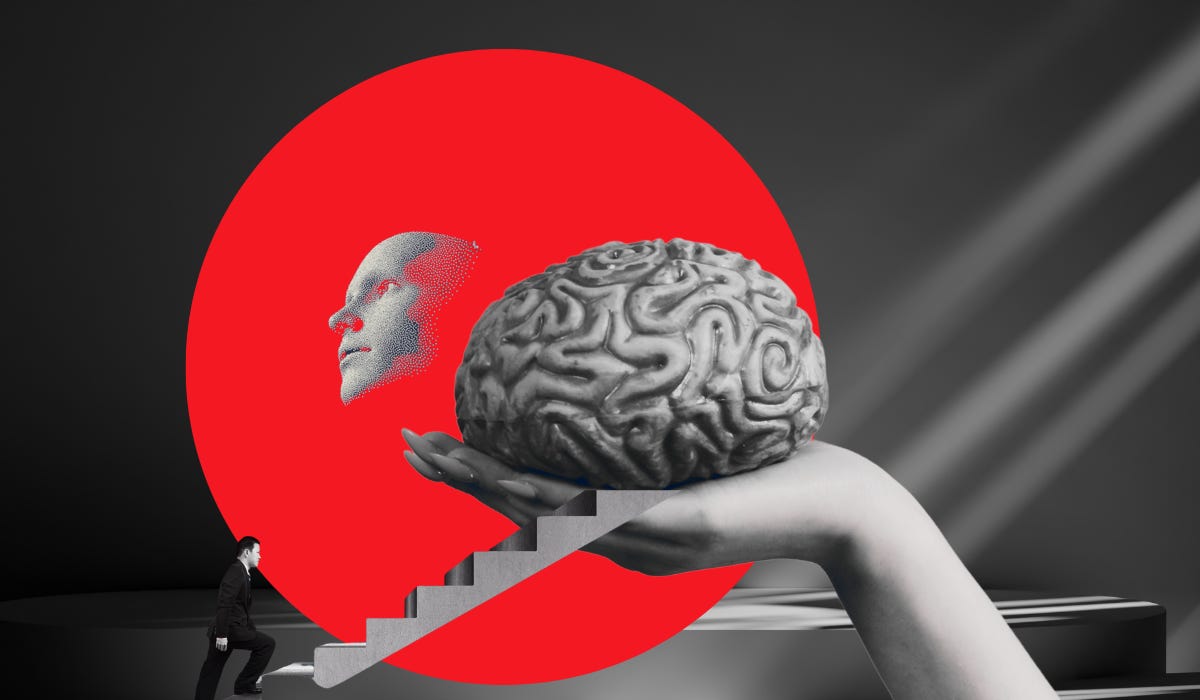
AI as The Next Essential Commodity
Description
Have you ever wondered how things like electricity are so integral to our lives that we barely notice it anymore? Flip a switch, and it’s there—a universal, standardized service that powers our routines without question.
Why AI as a Commodity Matters to You
Now, imagine a world where AI is just as ubiquitous as electricity. Every tool, service, and decision in your life is powered seamlessly by AI—no setup, no learning curve.
This future is closer than you think. AI is on the path to becoming the next essential commodity.
Yet, most of us still see AI as specialized technology, like smartphones or a software—not a standardized resource. But what happens when AI becomes as essential, interchangeable, and accessible as electricity?
Why should you care?
Seeing AI in this light changes everything. I found AI follows the trajectory of commodities like oil and electricity. If it continues on this path, you'll notice significant shifts in how it's priced, standardized, and potentially traded.
But AI is still different—it can think, learn, and could make decisions. Imagine your home adjusting the lights and playing your favorite music, not because you’ve programmed it, but because it’s learned your preferences and anticipates your needs.
So, understanding this potential shift is critical for you to leverage its potential and stay ahead of the curve.
What Exactly Is a Commodity?
What makes something a commodity?
I am referring to basic goods or resources that are interchangeable with others of the same type. This includes various items, from agricultural products like sugar, coffee, and wood to energy resources like oil and even services like electricity.
To understand whether AI would join and become a commodity, you need to understand the common traits among the existing ones.
For starters, commodities rely on standardization. Whether it’s a pound of coffee beans or a barrel of crude oil, certain quality benchmarks must be met to ensure these goods can be traded globally without confusion. This universal consistency makes them reliable and widely accepted.
Another hallmark is their widespread availability, transforming them into a shared global currency. Whether sipping your morning coffee in New York or Taipei, the vast networks of buyers and sellers ensure these commodities remain accessible worldwide.
Commodities also have fundamental usefulness—they meet everyday needs in ways we often take for granted. Sugar sweetens desserts, oil powers cars and factories, and electricity keeps our homes running. These aren’t luxuries anymore; they’re the backbone of modern life.
Their pricing is market-driven, shaped by global supply and demand rather than the whims of any single company or country. A poor cocoa harvest in West Africa, for instance, can send chocolate prices soaring. This transparency allows commodities to be traded on exchanges where their value reflects real-world conditions.
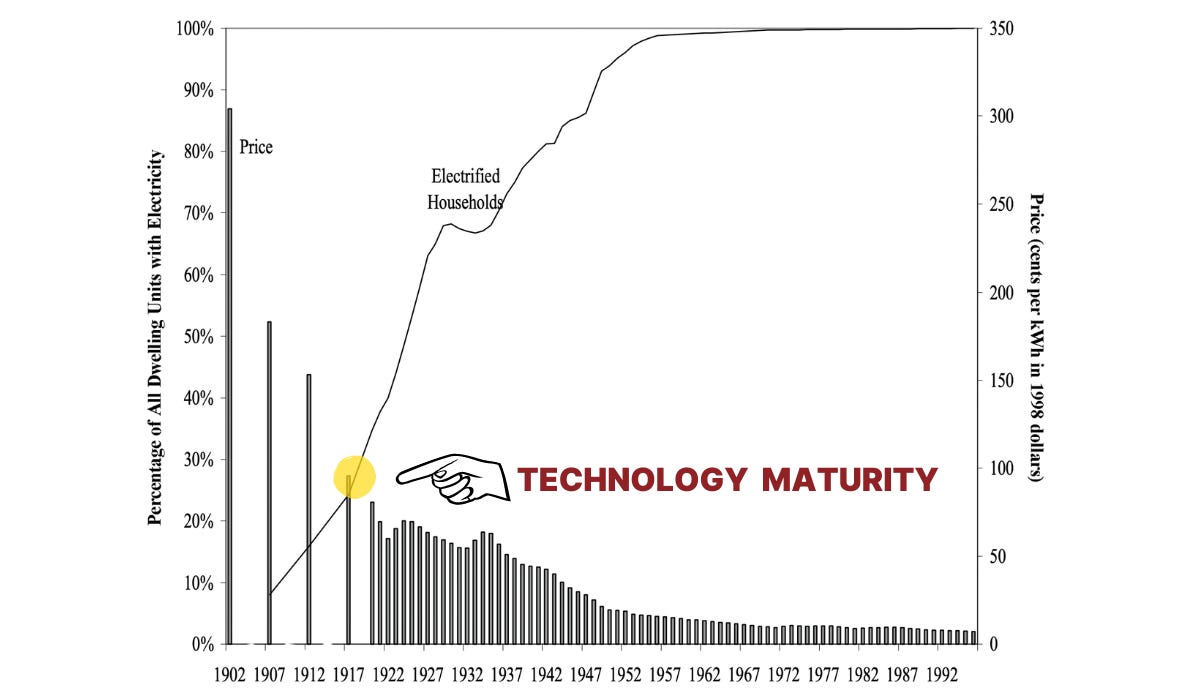
Finally, what makes these goods so dependable is their maturity and reliability. Decades—sometimes centuries—of refining processes and systems have made producing and distributing them predictable and stable. When you flip a light switch, you don’t question whether electricity will work because robust systems ensure it does.
These key turning points often overlap and are not always in a strict sequence, but every step is essential for something to be qualified as a commodity. I see AI today is following a similar path.
Now, let me walk you through the oil and electricity commoditization journey, and you’ll see my argument that AI will likely become the next commodity.
Drawing Parallels: Oil, Electricity, and AI
How the Automobile Turned Oil Into a Global Commodity.
Crude oil had humble beginnings—used by the Sumerians to waterproof buildings and by the Chinese for lighting. For centuries, it remained a niche resource.
That changed in the 1850s with the advent of kerosene, which lit homes more brightly and cleanly than candles or whale oil. But kerosene’s glory was short-lived. The electric light bulb soon eclipsed it, leaving oil refiners like Rockefeller scrambling for a new purpose.
The automobile arrived just in time. By the 1900s, gasoline—a byproduct of oil refining—became the lifeblood of the booming car industry.
As drilling technology advanced and massive reserves in Texas and the Middle East opened up, oil transformed into a global commodity. Its price was no longer set by individual sellers but by market forces on global trading platforms. Oil had become indispensable.
Electricity's Path to Ubiquity
Similarly, electricity wasn't always the universal power source we rely on today.
While Benjamin Franklin uncovered its mysteries in the 1700s, it wasn’t until the late 1800s—with Edison’s invention of the incandescent bulb—that electricity began finding its purpose.
Then, in the ‘War of the Currents,’ Edison backed direct current (DC), while Nikola Tesla championed alternating current (AC). It was about efficiency, distance, and who would power the future.
Tesla’s AC ultimately prevailed, paving the way for electricity to light up cities and towns.
Yet, true accessibility took decades. Programs like the Rural Electrification Act of the 1930s brought power to remote areas, transforming electricity from an urban luxury to an essential service. With competition driving down prices and reliability improving, electricity became a global commodity—so fundamental we scarcely think about it today.
I believe we’re witnessing the early stages of a similar transformation.
Whether you're an office worker, a small business owner, or someone navigating the job market, AI will influence how you work, make decisions, and interact with the world. A commoditized AI will be even more so compared to how it might have already changed how you work today.
AI is a Commodity Not Yet Recognized
Here’s a question: Do you view AI as a specialized technology, like smartphones or laptops?
But what if you shift the perspective and see AI as a commodity like water or electricity?
I highlighted where AI stands in each commonly seen commodity trait below.
AI’s Fundamental Usefulness
AI is no longer confined to research labs. Since 2022, the adoption of end-user AI apps skyrocketed. Think about how AI touches your lives today, e.g., your phones recognize your face, recommend movies, and assist scientists in finding protein folding, like Alphafold.
However, as I mentioned in I Found 120 Years of Stories To Tell You: 99% of AI Apps Are Not ‘Ready’. AI is still not predictable or trustworthy. Issues like bias, errors, and lack of transparency must be resolved before the makers can claim that the tools have brought the ultimate usefulness to the world.
Achieving Standardization
We have seen AI’s standardization in tools.
However, we lack the standardization of infrastructure and regulations. Unlike electricity or oil, AI could significantly impact people's careers, lives, or even the survival of our race.
Establishing ethical guidelines and regulations is crucial to ensure AI is used responsibly. Global standards can help integrate AI smoothly into society.
Advancing Maturity and Reliability
Yes, we have seen how AI has already brought some futuristic fantasy into life, e.g., you could actually have Her.
AI is still maturing. While it's powerful, it's not always reliable.
Sometimes, AI systems make mistakes, or their decisions aren't transparent. Not to mention the most recent comment from Ilya Sutskever:
The results from scaling up pre-training - the phase of training an AI model that uses a vast amount of unlabeled data to understand language patterns and structures - have plateaued.
As these challenges are addressed, AI will become more reliable and trusted, much like how electricity became safer and more dependable over time.
But there’s still a long way to go.
Ensuring Widespread Availability
AI is accessible through cloud services from anywhere with the internet. While there are barriers to implementation and inequality in adoption, these do not diminish an item or resource's status as a commodity. Just because some still can't afford coffee doesn't make it less of a commodity.
Embracing Market-Driven Pricing
As AI tools become standardized and more widely available, competition increases. Companies are starting to compete in price and efficiency.
AI’s price will be driven by energy costs and data center availability.
AI models are currently owned by private companies. However, as the difference between each model gets smaller, assuming that the future model still requires data to train and that there is only this much high-quality data on earth, the AI models wou











 United States
