


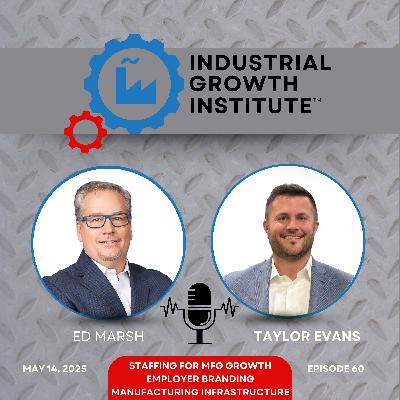
Episode 60 - Taylor Evans on Manufacturing Workforce and the False Binary of Automation vs. Talent
Description
Does Industrial Automation Complement or Compete Against Skilled Trades in Manufacturing? - Taylor Evans on Episode 60 of the Industrial Growth Institute Podcast
Summary
Taylor Evans joins Ed to discuss the current state of manufacturing and workforce development, emphasizing the importance of talent acquisition, employer branding, and the challenges faced in attracting skilled labor.
They explore the evolution of sales and marketing within the manufacturing sector, the significance of building relationships in business development, and the impact of perceptions on manufacturing careers.
The conversation also touches on:
- the future of manufacturing jobs
- the role of MEPs
- broader implications of manufacturing on employment
- the evolving perception of manufacturing
- the role of private equity
- the importance of advocacy in the industry.
Taylor shares insights on investing in local manufacturing, the impact of automation and AI on jobs, and the significance of decisiveness in business decisions. Taylor also explains recruitment process outsourcing and emphasizes the importance of community in business development.
He highlights the potential of podcasts as a business development tool and discusses incentives for hiring veterans, as well as the future of vocational education in the context of a manufacturing renaissance.
Takeaways
- Manufacturing companies often hold themselves back by not applying continuous improvement principles to talent acquisition.
- The ability to hire and retain talent is a significant challenge in manufacturing.
- Employer branding is crucial for attracting talent in manufacturing.
- Building relationships is more effective than traditional sales tactics.
- The Rust Belt identity is evolving, reflecting a manufacturing renaissance.
- Perceptions of manufacturing careers need to change to attract younger generations.
- The skills gap and labor shortage are critical issues for the future of manufacturing.
- Investment in manufacturing resources, like MEPs, is essential for growth.
- Awareness and exposure to manufacturing careers are vital for attracting talent.
- Manufacturing jobs create a ripple effect of employment opportunities in support roles. 85% of people now have a positive view of manufacturing.
- We need to close the gap in manufacturing perception.
- Private equity is evolving to include manufacturing expertise.
- Automation enhances job quality and safety.
- AI will improve productivity in manufacturing.
- RPO offers a strategic partnership for hiring.
- Community engagement drives business development.
- Podcasts can effectively generate business opportunities.
- Incentives exist for hiring veterans in manufacturing.
Takeaway Quotes from Taylor Evans
- "Employer branding remains an untapped market."
- "Automation makes for better jobs"
Check out Taylor's Rust Belt Recruiting website.
LinkedIn: Taylor Evans and Ed Marsh
Twitter: Ed Marsh
Instagram: Rust Belt Recruiting and Ed Marsh
YouTube: @RustBeltRecruiting and @EdMarsh
Chapters
00:00 The State of Manufacturing and Workforce Development
03:00 The Role of Talent Acquisition in Manufacturing
06:04 Sales Education and Entrepreneurial Spirit
08:59 Marketing and Employer Branding in Manufacturing
12:11 Building Relationships in Business Development
15:11 The Rust Belt Identity and Manufacturing Renaissance
17:52 Challenges in Attracting Talent to Manufacturing
21:02 The Future of Manufacturing Jobs
23:49 The Importance of MEPs and Investment in Manufacturing
26:57 Perceptions of Manufacturing Careers
29:56 The Skills Gap and Labor Shortage
33:07 The Broader Impact of Manufacturing on Employment
36:22 The Evolution of Manufacturing Perception
39:25 Advocacy and the Role of Private Equity
42:51 Investing in Local Manufacturing
45:49 Automation and Its Impact on Jobs
51:31 The Role of AI in Manufacturing
56:23 Understanding Recruitment Process Outsourcing
01:01:04 Building Community Through Business Development
01:05:35 Leveraging Podcasts for Business Development
01:08:27 Incentives for Hiring Veterans
01:10:45 The Future of Vocational Education
01:12:20 Workforce Strategy for Manufacturing Renaissance
Too Often, Capital Equipment and Industrial Automation Sales Are Viewed as An Alternative to Skilled Labor
The reality is that they're actually often complementary.
Learn more about why companies often lose capital equipment deals.
#IndustrialAutomation #IndustrialSales #IndustrialManufacturing #IndustrialMarketing #CapitalEquipmentSales #AutomationSales #WorkforceStrategy #SkilledTrades #SkilledTradesShortage #ManufacturingRenaissance #MadeInAmerica #EmployerBranding #VocationalEducation



 United States
