


I Found 120 Years of Stories To Tell You: 99% of AI Apps Are Not ‘Ready’.
Description
Have you ever flipped a switch to turn on the lights and paused to think, "What’s that magic lighting up my bathroom?"
Or drove to work and caught yourself wondering, “What monster is propelling your seats forward? These technologies have become so seamlessly woven into our daily lives that we barely acknowledge their presence… until the moment they break down.
The last time I noticed the lift in my building was when it made cracking noises like it was trying to get my attention. So Klaas and I stood there for a minute, evaluating if we should risk our lives or suck it up and walk nine floors.
This is how I notice that I am using an AI, every day.
Unlike the unnoticed hum of electricity or the steady roar of a train engine, AI feels like an external force that demands my attention. Yes, I’m using AI to help me with ideas, construct outlines, find data, and get references. I also find myself double-checking every single response, feeling the hiccup once every few messages. So I am constantly reminded that this technology is still finding its way into the fabric of everyday life.
Electricity, radios, cars, and so on have reached a point where they operate quietly in the background, becoming invisible threads in our daily routines. In stark contrast, every interaction with AI serves as a reminder of its presence and potential to become as ubiquitous and effortless as the technologies we take for granted today.
This difference shows that the current state of AI is not yet mature enough for most AI applications to achieve product-market fit.
You might say, “Jing, AI is writing my thesis,” or “AI is recommending videos to watch on Amazon!” or “AI is removing backgrounds from my photos.” Ask yourself: How smooth is the experience? How often do you have to try again or scroll further to get what you seek?
While other technologies have become essential and invisible, AI remains a noticeable presence. Understanding this helps us grasp the challenges and opportunities as AI works to become as seamless as the technologies we take for granted.
Technology Maturity vs. Product-Market Fit.
Let’s go back to the early days of cars.
Back in the 1890s, very few people had one. People were still getting around with horses, and while cars seemed exciting, they weren’t something most people could easily use. They were expensive and explosive (yes, you heard it right), and roads were still made for carriages or your legs.
The first-ever organized car race, held in 1894, was more about reliability and endurance than outright speed. The primary challenge was not which car ran faster but whether these vehicles could even finish the race.
The idea of an “auto-mobile” was great, but the technology wasn’t ready yet. This is where technology maturity comes in. The tech (roads, engines, gas stations) needed time to catch up before cars became part of everyday life.
Today, most families in developed countries can afford a car, and we don't have to worry that it breaks down every mile. So we all want and can’t even live w/o one. This is product-market fit. The market (people like you and me) and the product (the car) are in sync.
So, just like with early cars, AI is still in the phase where the idea is exciting, but the tech isn’t quite there yet. Yes, we have ChatGPT, Copilot, and AI writers… but tell me, when was the last time you copy-paste and then done? That’s because the technology maturity isn’t fully developed. We’re in the “at least get to the finish line car race” phase of AI — where the idea is groundbreaking, but the execution still has a way to go.
Let me show you how historical technologies like electricity and the steam engine went through a similar journey — from novelty to necessity — only after years of technological improvements. And that’s where AI is headed… but it’s not quite there yet.
Some of you know how much I love adding mini-games to my articles. Here’s a technology maturity vs. product market fit flip card game:
Technology Maturity vs. Product-Market Fit Flip Card Game
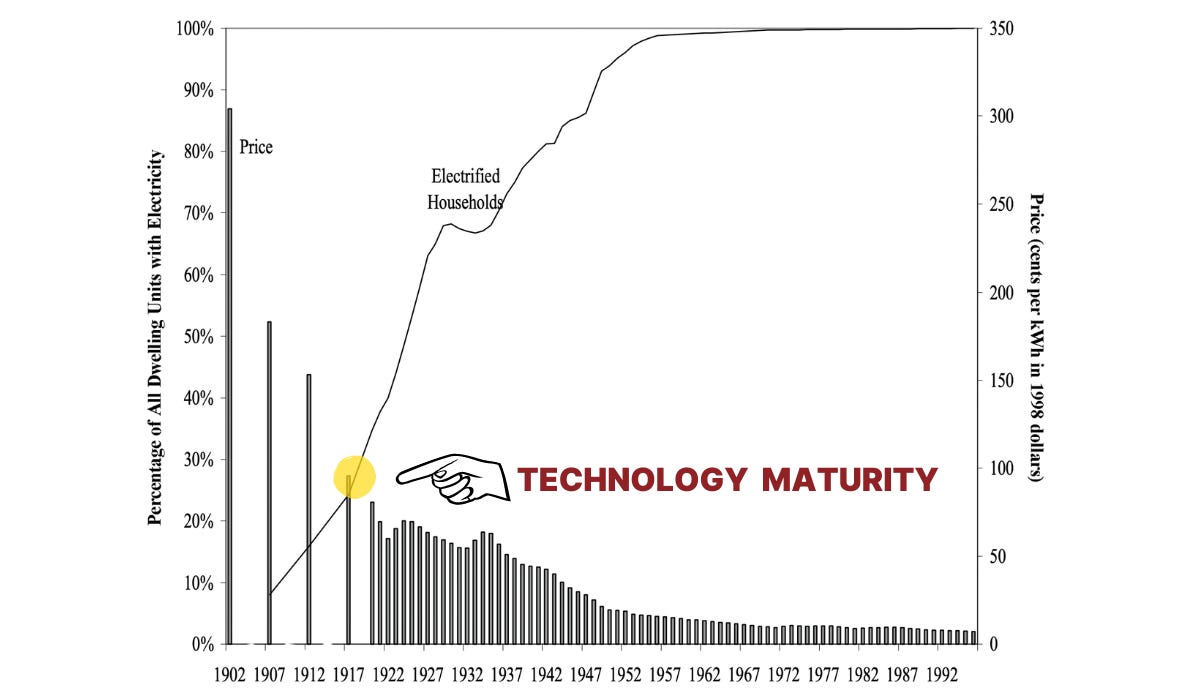
It Can Take Centuries From Tech Maturity To Product-Market Fit
Just like AI today, many of the technologies you and I now take for granted didn’t start as everyday essentials.
They needed time — sometimes decades or even centuries — to develop the necessary infrastructure and improvements before they could really take off.
Electricity: From Discovery to Powering Your Light Bulb
Electricity was discovered in the 1700s.
But at first, it was nowhere near being useful.
It wasn’t until the 1800s that things really started to click.
By the 1870s, Thomas Edison had invented the incandescent light bulb. But Edison’s bright idea came with a catch. His system used Direct Current (DC), which worked fine for short distances but failed in long-distance transport. Enter Nikola Tesla, who proposed Alternating Current (AC) as the solution. Yet, Edison famously resisted, saying:
Fooling around with alternating current’s just a waste of time. Nobody’ll ever use it. Too dangerous!
Well, as you might have guessed, AC won the war. With other inventions/improvements, like replacing carbon with a tungsten filament, incandescence finally became more efficient than gas or kerosene-powered light. Hence, reached the product-market fit.
Automobiles: Early Challenges and Breakthroughs
The first steam engine was invented in the 1710s. Yes, it is the first engine-powered vehicle to appear after 50 years. But it looks like this, and it is slower than your average walking speed.
It wasn’t until another 150 years later that the first wave of automobile entrepreneurs started producing workable cars.
Did you know there was a point in history when there were more electric engines than combustion engines?
By the 1890s, about 38% of automobiles were electric, only 22% were powered by internal combustion engines, and the rest were still running on steam. Of course, there weren’t that many automobiles to start with.
Between steam, electricity, and gasoline (internal combustion), each power source had its moment and presented its challenges.
* Steam engines had great power but were impractical for everyday use. Imagine starting a car that takes 45 minutes; bring liters of water to refill every 20 to 30 miles.
* Electric cars were quiet and clean, perfect for urban areas. But here’s the catch: the 1890s electric cars could only go 30 miles before needing a recharge. And charging stations? You get carriage stables.
* The internal combustion engine brought speed and longer range. But! Early models had to be manually cranked to start — you could also get seriously injured if the crank kicked back.
The turning point came with the famous Ford Model T, and the development of the assembly line drastically lowered production costs. By 1929, 60% of American families owned a car.
The car as a product finally found its product-market fit, but it took time for the technology (engine design, mass production, road networks) AND the production process to mature enough for cars to be part of our daily lives.
Meanwhile, the electric engine — once a dominant force — has only recently slowly made its way back.
The Refrigerator: From Luxury to Kitchen Staple
The idea of refrigeration goes back thousands of years. In ancient Mesopotamia, people built ice houses to store food; in ancient China, about 200 B.C., they built ice cellars.
These early methods were ingenious but relied on ice and snow, limiting their practicality.
Fast forward to the 1750s, a Scottish professor made a breakthrough, using a vacuum pump and ether to absorb heat and cool the air. It was not for another 150 years that General Electric introduced one of the first household gas-powered refrigerators in the 1910s.
The turning point came in the 1930s when safer synthetic refrigerants like Freon were developed. This made refrigerators smaller, cheaper, and more reliable.
When the refrigerator finally achieved product-market fit, it became a must-have in almost every kitchen.
Connecting the Dots with AI
What do all these examples have in common?
They all had the potential to change the world, but it took years — even centuries — of refinement before they became things the general population couldn’t live without.
That’s where AI is right now. It has the big idea — just like the early days of electricity, cars, and fridges — but the technology isn’t quite rea










 United States
