


Pity, Power, and Presence
Description
Welcome again to the Convivial Society. This installment follows relatively quickly on the last, and you may be forgiven for not having yet made your way through that one, which came in at 4,500 words (sorry). But, we have some catching up to do, and this essay is only half as long. Read on.
In her testimony before the Senate, Facebook whistleblower Frances Haugen made an observation that caught my attention.
When asked by Senator Todd Young of Indiana to “discuss the short and long-term consequences of body image issues on these platforms,” Haugen gave the following response, emphasis mine:
The patterns that children establish in their teenage years live with them for the rest of their lives. The way they conceptualize who they are, how they conceptualize how they interact with other people, are patterns and habits that they will take with them as they become adults, as they themselves raise children. I’m very scared about the upcoming generation because when you and I interact in person, and I say something mean to you, and I see wince or I see you cry, that makes me less likely to do it the next time, right? That’s a feedback cycle. Online kids don’t get those cues and they learn to be incredibly cruel to each other and they normalize it. And I’m scared of what will their lives look like, where they grow up with the idea that it’s okay to be treated badly by people who allegedly care about them? That’s a scary future.
There is much that is worth discussing in Haugen’s testimony, but these comments stood out to me because they resonated with themes I’ve been working with for some time. Specifically, I’ve been thinking about the relationship among the virtue of pity, embodied presence, and online interactions, which, it seems to me, is precisely what Haugen has in view here.
Back in May I wrote a short post that speculated about a tendency to become forgetful of the body in online situations. “If digital culture tempts us to forget our bodies,” I wondered, “then it may also be prompting us to act as if we were self-sufficient beings with little reason to care or expect to be cared for by another.”
I wrote those lines with Alasdair MacIntyre’s book, Dependent Rational Animals, in mind. In it, MacIntyre seeks to develop an account of the virtues and virtuous communities that takes our bodies, and thus our dependence, as a starting point. So, for example, he writes,
What matters is not only that in this kind of community children and the disabled are objects of care and attention. It matters also and correspondingly that those who are no longer children recognize in children what they once were, that those who are not yet disabled by age recognize in the old what they are moving towards becoming, and that those who are not ill or injured recognize in the ill and injured what they often have been and will be and always may be.
From this starting point, MacIntyre makes the case for what he calls the virtues of acknowledged dependence, explaining that “what the virtues require from us are characteristically types of action that are at once just, generous, beneficent, and done from pity.” “The education of dispositions to perform just this type of act,” he continues, “is what is needed to sustain relationships of uncalculated giving and graceful receiving.”
Among this list of characteristics, pity was the one that most caught my attention. It is a quality that may strike many as ambivalent at best. The phrase, “I don’t want your pity,” is a common trope in our stories and it is often declared in defiantly heroic cadences. And, indeed, even when the quality has been discussed as a virtue in the tradition, writers have seen the need to distinguish it from counterfeits bearing a surface resemblance but which are often barely veiled expressions of condescension.
MacIntyre, wanting to avoid just this association with condescension, uses instead the Latin word misericordia. Thus MacIntyre, drawing on Aquinas writes, “Misericordia is grief or sorrow over someone else’s distress […] just insofar as one understands the other’s distress as one’s own. One may do this because of some preexisting tie to the other—the other is already one’s friend or kin—or because in understanding the other’s distress one recognizes that it could instead have been one’s own.”
This latter observation suggests the universalizing tendency of the virtue of pity, that it can recognize itself in the other regardless of whether the other is a personal relation or kin or a member of the same tribe. For this reason, pity can, of course, be the source of misguided and even oppressive actions. I say “of course,” but maybe it is not, in fact, obvious. I’m thinking, for instance, of Ivan Illich warning that something like pity turned into a rule or an institutional imperative can eventually lead to bombing the neighbor for his own good. And it’s worth noting that, in MacIntyre’s view, pity must work in harmony with justice, benevolence, and generosity—each of these virtues informing and channeling the others.
Illich, however, says as much in discussing his interpretation of the parable of the good Samaritan. In his view, the parable teaches the freedom to care for the other regardless of whether they are kin or members of the same tribe. Indeed, given the ethics of the day, the Samaritan (Illich sometimes called him the Palestinian to drive the point home to a modern audience) had little reason to care for the Jew, who had been beaten and left by the side of the road. Certainly he had much less reason to do so than the priest and Levite who callously pass him by. And in Illich’s telling, as I read him, it is precisely the flesh-to-flesh nature of the encounter that constitutes the conditions of the call the Samaritan answers to see in the other someone worthy of his attention and care.
Which again makes me wonder about the degree to which pity is activated or called forth specifically in the context of the fully embodied encounter, whether this context is not the natural habitat of pity, and what this means for online interactions where embodied presence cannot be fully realized.
I thought, too, of a wise passage from Tolkien in The Fellowship of the Ring. Many you of will know the story well. For those who don’t, one of the principal characters, Frodo, refers back to a moment, many years in the story’s past, when another character, Bilbo, passed up an opportunity to kill Gollum, who is a complicated character responsible for much mischief.
“What a pity that Bilbo did not stab that vile creature when he had a chance!” Frodo declares in conversation with the wizard Gandalf.
“Pity? It was Pity that stayed his hand. Pity, and Mercy: not to strike without need,” the wizard replies.
The exchange continues thus:
“I am sorry,” said Frodo. “But I am frightened; and I do not feel any pity for Gollum.”
“You have not seen him,” Gandalf broke in.
“No, and I don’t want to,” said Frodo. “I can’t understand you. Do you mean to say that you, and the Elves, have let him live on after all those horrible deeds? Now at any rate he is as bad as an Orc, and just an enemy. He deserves death.”
“Deserves it! I daresay he does. Many that live deserve death. And some that die deserve life. Can you give it to them? Then do not be too eager to deal out death in judgement. For even the very wise cannot see all ends. I have not much hope that Gollum can be cured before he dies, but there is a chance of it. And he is bound up with the fate of the Ring. My heart tells me that he has some part to play yet, for good or ill, before the end; and when that comes, the pity of Bilbo may rule the fate of many — yours not least.”
There are many things worth noting in this exchange but I’ll draw your attention to just three of them.
First, Frodo justifies his lack of pity by explaining that he is afraid. And, indeed, if it were possible to measure such things, I suspect we would find that fear rather than hate is at the root of many of our social disorders. Fear distorts our capacity to see the other well. It frames them merely as a threat and allows us to rationalize our lack of regard for their well-being under the irrefutable sign of self-preservation.
Second, Gandalf seems to believe that Frodo might change his tune once he has seen Gollum. Somehow the sight of Gollum, which depends on their bodily presence before one another, would be conducive to the experience of pity. This is the critical point for my purposes here.
Third, we might say, with MacIntyre in mind, that through Gandalf’s speech Tolkien frames pity not only as a virtue of acknowledged dependence but also as a virtue of acknowledged ignorance. “For even the very wise cannot see all ends.” Perhaps ignorance is merely another form dependence. When we do not know, we must depend on others who do. But it may be worth distinguishing ignorance from dependence. Even the strong can be ignorant. Either the ignorance is acknowledged or it is not. But it is true that in the end failing to acknowledge either our dependence or our ignorance may amount to the same thing: the reckless exercise of what Albert Borgmann has called regardless power.
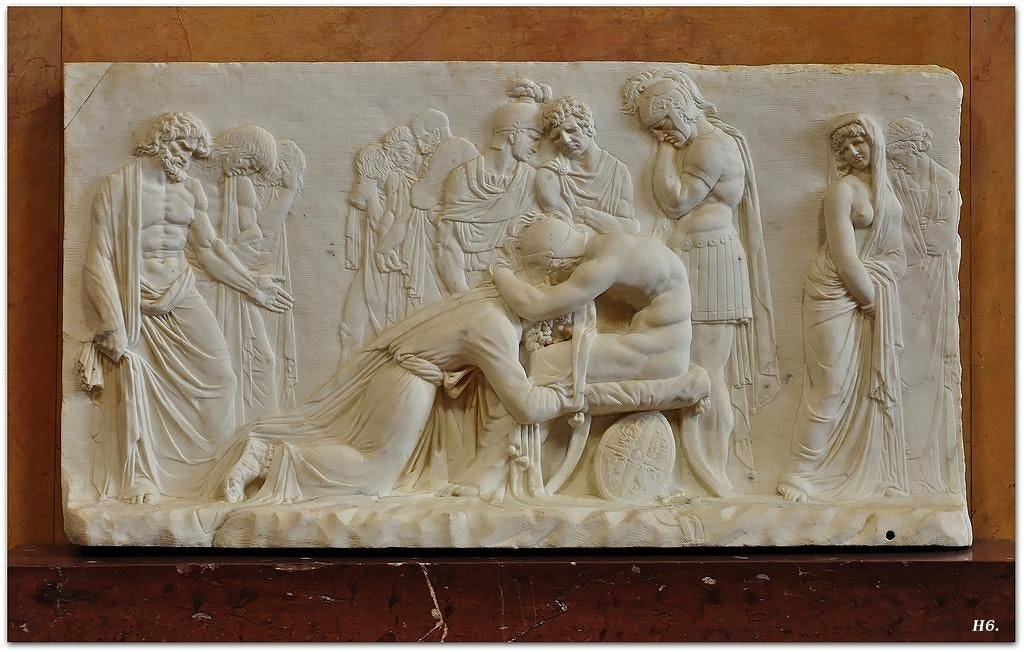
There is one other literary case study of the link between bodies and pity that came to mind. It is found in the Iliad, Homer’s tale of the wrath of Achilles set during the Trojan War. Near the end of the epic, Achilles has allowed his wrath, arising from the killing of his friend Patroclus, to drive him in




















 United States
