



Podcast #221: The Mountaintop at Grand Geneva Director of Golf & Ski Ryan Brown
Description
Who
Ryan Brown, Director of Golf & Ski at The Mountaintop at Grand Geneva, Wisconsin
Recorded on
June 17, 2025
About the Mountaintop at Grand Geneva
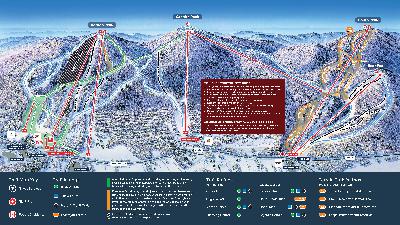
Click here for a mountain stats overview
Owned by: Marcus Hotels
Located in: Lake Geneva, Wisconsin
Year founded: 1968
Pass affiliations: None
Closest neighboring U.S. ski areas: Alpine Valley (:23), Wilmot Mountain (:29), Crystal Ridge (:48), Alpine Hills Adventure Park (1:04 )
Base elevation: 847 feet
Summit elevation: 962 feet
Vertical drop: 115 feet
Skiable acres: 30
Average annual snowfall: 34 inches
Trail count: 21 (41% beginner, 41% intermediate, 18% advanced)
Lift count: 6 (3 doubles, 1 ropetow, 2 carpets)
Why I interviewed him
Of America’s various mega-regions, the Midwest is the quietest about its history. It lacks the quaint-town Colonialism and Revolutionary pride of the self-satisfied East, the cowboy wildness and adobe earthiness of the West, the defiant resentment of the Lost Glory South. Our seventh-grade Michigan History class stapled together the state’s timeline mostly as a series of French explorers passing through on their way to somewhere more interesting. They were followed by a wave of industrial loggers who mowed the primeval forests into pancakes. Then the factories showed up. And so the state’s legacy was framed not as one of political or cultural or military primacy, but of brand, the place that stamped out Chevys and Fords by the tens of millions.
To understand the Midwest, then, we must look for what’s permanent. The land itself won’t do. It’s mostly soil, mostly flat. Great for farming, bad for vistas. Dirt doesn’t speak to the soul like rock, like mountains. What humans built doesn’t tell us a much better story. Everything in the Midwest feels too new to conceal ghosts. The largest cities rose late, were destroyed in turn by fires and freeways, eventually recharged with arenas and glass-walled buildings that fail to echo or honor the past. Nothing lasts: the Detroit Pistons built the Palace of Auburn Hills in 1988 and developers demolished it 32 years later; the Detroit Lions (and, for a time, the Pistons) played at the Pontiac Silverdome, a titanic, 82,600-spectator stadium that opened in 1976 and came down in 2013 (37 years old). History seemed to bypass the region, corralling the major wars to the east and shooing the natural disasters to the west and south. Even shipwrecks lose their doubloons-and-antique-cannons romance in the Midwest: the Great Lakes most famous downed vessel, the SS Edmund Fitzgerald, sank into Lake Superior in 1975. Her cargo was 26,535 tons of taconite ore pellets. A sad story, but not exactly the sinking of the Titanic.
Our Midwest ancestors did leave us one legacy that no one has yet demolished: names. Place names are perhaps the best cultural relics of the various peoples who occupied this land since the glaciers retreated 12,000-ish years ago. Thousands of Midwest cities, towns, and counties carry Native American names. “Michigan” is derived from the Algonquin “Mishigamaw,” meaning “big lake”; “Minnesota” from the Sioux word meaning “cloudy water.” The legacies of French explorers and missionaries live on in “Detroit” (French for “strait”), “Marquette” (17th century French missionary Jacques Marquette), and “Eau Claire” (“clear water”).
But one global immigration funnel dominated what became the modern Midwest: 50 percent of Wisconsin’s population descends from German, Nordic, or Scandinavian countries, who arrived in waves from the Colonial era through the early 1900s. The surnames are everywhere: Schmitz and Meyer and Webber and Schultz and Olson and Hanson. But these Old-Worlders came a bit late to name the cities and towns. So they named what they built instead. And they built a lot of ski areas. Ten of Wisconsin’s 34 ski areas carry names evocative of Europe’s cold regions, Scandinavia and the Alps:
I wonder what it must have been like, in 18-something-or-other, to leave a place where the Alps stood high on the horizon, where your family had lived in the same stone house for centuries, and sail for God knows how many weeks or months across an ocean, and slow roll overland by oxen cart or whatever they moved about in back then, and at the end of this great journey find yourself in… Wisconsin? They would have likely been unprepared for the landscape aesthetic. Tourism is a modern invention. “The elite of ancient Egypt spent their fortunes building pyramids and having their corpses mummified, but none of them thought of going shopping in Babylon or taking a skiing holiday in Phoenicia [partly in present-day Lebanon, which is home to as many as seven ski areas],” Yuval Noah Harari writes in Sapiens his 2015 “brief history of humankind.” Imagine old Friedrich, who had never left Bavaria, reconstituting his world in the hillocks and flats of the Midwest.
Nothing against Wisconsin, but fast-forward 200 years, when the robots can give us a side-by-side of the upper Midwest and the European Alps, and it’s pretty clear why one is a global tourist destination and the other is known mostly as a place that makes a lot of cheese. And well you can imagine why Friedrich might want to summon a little bit of the old country to the texture of his life in the form of a ski area name. That these two worlds - the glorious Alps and humble Wisconsin skiing - overlap, even in a handful of place names, suggests a yearning for a life abandoned, a natural act of pining by a species that was not built to move their life across timezones.
This is not a perfect analysis. Most – perhaps none – of these ski areas was founded by actual immigrants, but by their descendants. The Germanic languages spoken by these immigrant waves did not survive assimilation. But these little cultural tokens did. The aura of ancestral place endured when even language fell away. These little ski areas honor that.
And by injecting grandiosity into the everyday, they do something else. In coloring some of the world’s most compact ski centers with the aura of some of its most iconic, their founders left us a message: these ski areas, humble as they are, matter. They fuse us to the past and they fuse us to the majesty of the up-high, prove to us that skiing is worth doing anywhere that it can be done, ensure that the ability to move like that and to feel the things that movement makes you feel are not exclusive realms fenced into the clouds, somewhere beyond means and imagination.
Which brings us to Grand Geneva, a ski area name that evokes the great Swiss gateway city to the Alps. Too bad reality rarely matches up with the easiest narrative. The resort draws its name from the nearby town of Lake Geneva, which a 19th-century surveyor named not after the Swiss city, but after Geneva, New York, a city (that is apparently named after Geneva, Switzerland), on the shores of Seneca Lake, the largest of the state’s 11 finger lakes. Regardless, the lofty name was the fifth choice for a ski area originally called “Indian Knob.” That lasted three years, until the ski area shuttered and re-opened as the venerable Playboy Ski Area in 1968. More regrettable names followed – Americana Resort from 1982 to ’93, Hotdog Mountain from 1992 to ’94 – before going with the most obvious and least-questionable name, though its official moniker, “The Mountaintop at Grand Geneva” is one of the more awkward names in American skiing.
None of which explains the principal question of this sector: why I interviewed Mr. Brown. Well, I skied a bunch of Milwaukee bumps on my drive up to Bohemia from Chicago last year, this was one of them, and I thought it was a cute little place. I also wondered how, with its small-even-for-Wisconsin vertical drop and antique lift collection, the place had endured in a state littered with abandoned ski areas. Consider it another entry into my ongoing investigation into why the ski areas that you would not always expect to make it are often the ones that do.
What we talked about
Fighting the backyard effect – “our customer base – they don’t really know” that the ski areas are making snow; a Chicago-Milwaukee-Madison bullseye; competing against the Vail-owned mountain to the south and the high-speed-laced ski area to the north; a golf resort with a ski area tacked on; “you don’t need a big hill to have a great park”; brutal Midwest winters and the escape of skiing; I attempt to talk about golf again and we’re probably done with that for a while; Boyne Resorts as a “top golf destination”; why Grand Geneva moved its terrain park; whether the backside park could re-open; “we’ve got some major snowmaking in the works”; potential lift upgrades; no bars on the lifts; the ever-tradeoff between terrain parks and beginner terrain; the ski area’s history as a Playboy Club and how the ski hill survived into the modern era; how the resort moves skiers to the hill with hundreds of rooms and none of them on the trails; thoughts on Indy Pass; a










 United States
