


The Illusion of Autocracy
Description
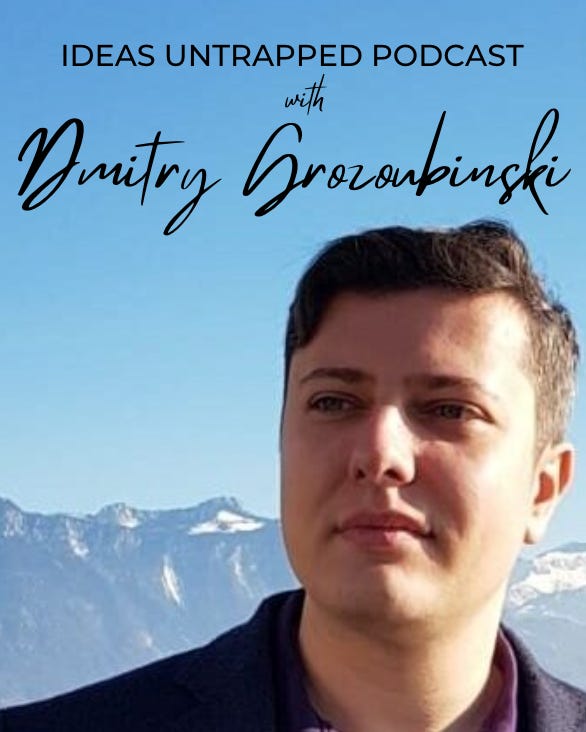
Welcome to Ideas Untrapped. My guest today is Vincent Geloso who is a professor of economics at George Mason University. He studies economic history, political economy, and the measurement of living standards. In today's episode, we discuss the differences between democracies and dictatorships, and their relative performance in socioeconomic development. The allure of authoritarian governance has grown tremendously due to the economic success of countries like China, Korea, and Singapore - which managed to escape crippling national poverty traps. The contestable nature of democracies and the difficulty many democratic countries have to continue on a path of growth seems to many people as evidence that a benevolent dictatorship is what many countries need. Vincent challenges this notion and explains many seemingly high-performing dictatorships are so because their control of state resources allows them direct investments towards singular objectives - (such as winning Olympic medals or reducing infant mortality) but at the same time, come with a flip side of unseen costs due to their lack of rights and economic freedom. He argues that the benefits of dictatorships are not as great as they may seem and that liberal democracies are better able to decentralize decision-making and handle complex multi-variate problems. He concludes that while democracies may not always be successful in achieving certain objectives, the constraints they place on political power and rulers mean that people are better off in terms of economic freedom, rights, and other measures of welfare.
TRANSCRIPT
Tobi;
You made the point that dictatorships usually optimise, not your words, but they optimise for univariate factors as opposed to multiple factors, which you get in democracy. So, a dictatorship can be extremely high performing on some metric because they can use the top-down power to allocate resources for that particular goal. Can you shed a bit more light on that? How does that mechanism work in reality?
Vincent;
Yeah, I think a great image people are used to is the USSR, and they're thinking about two things the USSR did quite well: putting people in space before the United States and winning medals at Olympics. Now, the regime really wanted to do those two things. [That is], win a considerable number of medals in [the] Olympics and win the space race. Both of them were meant to showcase the regime's tremendous ability. It was a propaganda ploy, but since it was a single objective and they had immense means at their disposal, i. e. the means that coercion allows them, they could reach those targets really well. And it's easy to see the Russians putting Sputnik first in space, the Russians putting Laika first in space. We can see them winning medals. It's easy to see. The part that is harder to see, the unseen, is the fact that Russians were not enjoying rapidly rising living standards, they were not enjoying improvements in medical care that was commensurate with their level of income, they were not enjoying high-quality education. You can pile all the unseens of the ability of the USSR as a dictatorship to allocate so much resources to two issues, [which] meant that it came with a flip side, which is that these resources were not available for people to allocate them in ways that they thought was more valuable. So, the virtue of a liberal democracy, unlike a dictatorship, is that a liberal democracy has multiple sets of preferences to deal with. And in a liberal democracy, it's not just the fact that we vote, but also that people have certain rights that are enshrined and which are not the object of political conversation. I cannot seize your property, and it's not okay for people to vote with me to seize your property. And in these societies, the idea is that under a liberal democracy, you are better able to decentralize decision-making, and people can find ways to deal with the multiple trade-offs much better. Whereas a dictatorship can just decide, I care about this. I am king, I am president, I am first secretary of the party, I decide this and we'll do this regardless of how much you value other things that I value less than you do.
Tobi;
Two things that I want you to shed more light on. Depending on who you talk to or what they are criticizing, people usually selectively pick their dictatorships. If someone is criticizing, say, for example, capitalism, they always point to the Cuban health care system in contrast to the American health care system. How the American system is so terrible, and how capitalism makes everything worse because of the profit motive. And how we can do better by being more like Cuba.
On the other end of that particular spectrum, if you're talking about economic development, critics of democracy like to point to China. China is not a democracy. And look at all the economic growth they've had in the last 40 years, one of the largest reductions in human poverty we’ve ever seen in history. I mean, from these two examples, what are the shortcomings of these arguments?
Vincent;
Let's do Cuba first, then we can do China. So, the Cuban example is really good for the case I'm making. Because the case I'm making is essentially that the good comes with the bad and you can't remove them. So, people will generally say with Cuba, “yes, we know they don't have political rights, they don't have economic freedom, but they do have high-quality health care.” And by this they don't mean actually health care, they mean low infant mortality or high life expectancy at birth. My reply is, it's because they don't have all these other rights and all these other options [that] they can have infant mortality that is so low. That's because the regime involves a gigantic amount of resources to the production of healthcare. Cuba spends more than 10% of its GDP on health care. Only countries that are seven or ten times richer than Cuba spend as much as a proportion of GDP on health care. 1% of their population are doctors. In the United States, it is a third of that, 0.3% of the population are doctors. So, it's a gigantic proportion. But then when you scratch a bit behind, doctors are, for example, members of the army. They are part of the military force. The regime employs them as the first line of supervision. So, the doctors are also meant to report back what the population says on the ground. So, they're basically listening posts for the dictatorship. And in the process, yeah, they provide some health care, but they're providing some health care as a byproduct of providing surveillance.
The other part is that they're using health care here to promote the regime abroad. And that has one really important effect. One of those is that doctors have targets they must meet, otherwise they're penalized. And when I mean targets, I mean targets for infant mortality. [If] they don't meet those targets, the result is they get punished. And so what do you think doctors do? They will alter their behaviour to avoid punishment. So in some situations, they will reclassify what we call early neonatal death. So, babies who die immediately after exiting the womb to seven days after birth, they will reclassify many of those as late fetal deaths. And late fetal deaths are in-utero deaths or delivery of a dead baby so that the baby exits the womb dead. Now, if a mortality rate starts with early neonatal death [and] not late fetal ones, so if you can reclassify one into the other, you're going to deflate the number total. And the reason why we can detect this is that the sources of both types of mortality are the same,[they] are very similar, so that when you compare them across countries, you generally find the same ratio of one to the other. Generally, it hovers between four to one and six to one. Cuba has a ratio of twelve to 17 to one, which is a clear sign of data manipulation. And it's not because the regime does it out of, like, direct intent. They're not trying to do it directly. It'd be too easy to detect. But by changing people's incentives, doctors’ incentives, in that case, that's what they end up with.
There are also other things that doctors are allowed to do in Cuba. One of them is that patients do not have the right to refuse treatment. Neither do they have the right to privacy, which means that doctors can use heavy-handed methods to make sure that they meet their targets. So in Cuba, you have stuff like casa de mata nidad, where mothers who have at-risk pregnancies or at-risk behaviour during pregnancy will be forcibly incarcerated during their pregnancy. There are multiple cases of documented, pressured abortions or literally coerced abortions. So not just pressured, but coerced. Like, the level is that the person wants to keep the infant, the doctor forces an abortion to be made. Sometimes, it is made without the mother's knowledge until it is too late to anything being done. So you end up with basically the infant mortality rate, yes, being low, but yes, being low because of data manipulation and changes in behaviour so that the number doesn't mean the same thing as it does in rich countries. And now the part that's really important in all I'm saying is [that] what people call the benefits for Cuba is relatively small. My point is that, yeah, maybe they could be able to do it. But the problem is that the measures that allow this to happen, to have a low infant mortality rate are also the measures that make Cubans immensely poor. The fact that the regime can deploy such force, use doctors in such a way, employ such extreme measures, it's the reason why Cubans also don't have property rights, don't have strong economic freedom, don't have the liberty to trade with others. Which means that on other dimensions, their lives are worse off. That means that, for example, t













 United States
