


Writing Free: Romance Author Jennifer Probst On A Long-Term Author Career
 1
1Description
Why do some romance authors build decades-long careers while others vanish after one breakout book? What really separates a throwaway pen name and rapid release strategy from a legacy brand and a body of work you’re proud of? How can you diversify with trad, indie, non-fiction, and Kickstarter without burning out—or selling out your creative freedom? With Jennifer Probst.
In the intro, digital ebook signing [BookFunnel]; how to check terms and conditions; Business for Authors 2026 webinars; Music industry and AI music [BBC; The New Publishing Standard]; The Golden Age of Weird.
<figure class="wp-block-image">
 </figure>
This podcast is sponsored by Kobo Writing Life, which helps authors self-publish and reach readers in global markets through the Kobo eco-system. You can also subscribe to the Kobo Writing Life podcast for interviews with successful indie authors.
This show is also supported by my Patrons. Join my Community at Patreon.com/thecreativepenn
<figure class="aligncenter size-full">
 </figure>
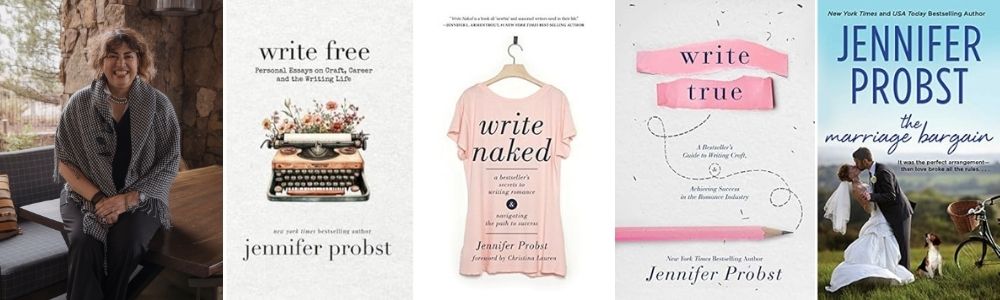
Jennifer Probst is a New York Times, USA Today, and Wall Street Journal bestselling author of over 60 books across different kinds of romance as well as non-fiction for writers. Her latest book is Write Free.
You can listen above or on your favorite podcast app or read the notes and links below. Here are the highlights, and the full transcript is below.
Show Notes
- How Jennifer started writing at age 12, fell in love with romance, and persisted through decades of rejection
- A breakout success — and what happened when it moved to a traditional publisher
- Traditional vs indie publishing, diversification, and building a long-term, legacy-focused writing career
- Rapid-release pen names vs slow-burn author brands, and why Jennifer chooses quality and longevity
- Inspirational non-fiction for writers (Write Naked, Write True, Write Free)
- Using Kickstarter for special editions, re-releases, courses, and what she’s learned from both successes and mistakes – plus what “writing free” really means in practice
- How can you ‘write free'?
You can find Jennifer at JenniferProbst.com.
Transcript of interview with Jennifer Probst
Jo: Jennifer Probst is a New York Times, USA Today, and Wall Street Journal bestselling author of over 60 books across different kinds of romance as well as non-fiction for writers. Her latest book is Write Free. So welcome, Jennifer.
Jennifer: Thanks so much, Joanna. I am kind of fangirling. I'm really excited to be on The Creative Penn podcast. It's kind of a bucket list.
Jo: Aw, that's exciting. I reached out to you after your recent Kickstarter, and we are going to come back to that in a minute. First up, take us back in time.
Tell us a bit more about how you got into writing and publishing.
Jennifer: This one is easy for me. I am one of those rarities. I think that I knew when I was seven that I was going to write. I just didn't know what I was going to write.
At 12 years old, and now this will kind of date me in dinosaur era here, there was no internet, no information on how to be a writer, no connections out there. The only game in town was Writer’s Digest. I would go to my library and pore over Writer’s Digest to learn how to be a writer.
At 12 years old, all I knew was, “Oh, if I want to be a famous writer, I have to write a book.” So I literally sat down at 12 and wrote my first young adult romance. Of course, I was the star, as we all are when we're young, and I have not stopped since.
I always knew, since my dad came home from a library with a box of romance novels and got in trouble with my mum and said, basically, “She's reading everything anyway, just let her read these,” I was gone. From that moment on, I knew that my entire life was going to be about that.
So for me, it wasn't the writing. I have written non-stop since I was 12 years old. For me, it was more about making this a career where I can make money, because I think there was a good 30 years where I wrote without a penny to my name.
So it was more of a different journey for me. It was more about trying to find my way in the writing world, where everybody said it should be just a hobby, and I believed that it should be something more.
Jo: I was literally just going back in my head there to the library I used to go to on my way home from school. Similar, probably early teens, maybe age 14. Going to that section and… I think it was Shirley Conran. Was that Lace? Yes, Lace books. That's literally how we all learned about sex back in the day.
Jennifer: All from books. You didn't need parents, you didn't need friends. Amazing.
Jo: Oh, those were the days. That must have been the eighties, right?
Jennifer: It was the eighties. Yes. Seventies, eighties, but mostly right around in the eighties. Oh, it was so…
Jo: I got lost about then because I was reminiscing. I was also the same one in the library, and people didn't really see what you were reading in the corner of the library. So I think that's quite funny.
Tell us how you got into being an indie.
Jennifer: What had happened is I had this manuscript and it had been shopped around New York for agents and for a bunch of publishers. I kept getting the same exact thing: “I love your voice.”
I mean, Joanna, when you talk about papering your wall with rejections, I lived that. The only thing I can say is that when I got my first rejection, I looked at it as a rite of passage that created me as a writer, rather than taking the perspective that it meant I failed.
To me, perspective is a really big thing in this career, how you look at things. So that really helped me. But after you get like 75 of them, you're like, “I don't know how much longer I can take of this.”
What happened is, it was an interesting story, because I had gone to an RWA conference and I had shopped this everywhere, this book that I just kept coming back to. I kept saying, “I feel like this book could be big.”
There was an indie publisher there. They had just started out, it was an indie publisher called Entangled. A lot of my friends were like, “What about Entangled? Why don't you try more digital things or more indie publishers coming up rather than the big traditional ones?”
Lo and behold, I sent it out. They loved the book. They decided, in February of 2012, to launch it. It was their big debut. They were kind of competing with Harlequin, but it was going to be a new digital line. It was this new cutting-edge thing.
The book went crazy. It went viral. The book was called The Marriage Bargain, and it put me on the map. All of a sudden I was inundated with agents, and the traditional publishers came knocking and they wanted to buy the series. It was everywhere. Then it hit USA Today, and then it spent 26 weeks on The New York Times.
Everybody was like, “Wow, you're this overnight sensation.” And I'm like, “Not really!” That was kind of my leeway into everything. We ended up selling that series to Simon & Schuster because that was the smart move for then, because it kind of blew up and an indie publisher at that time knew it was a lot to take on.
From then on, my goal was always to do both: to have a traditional contract, to work with indie publishers, and to do my own self-pub. I felt, even back then, the more diversified I am, the more control I have. If one bucket goes bad, I have two other buckets.
Jo: Yes, I mean, I always say multiple streams of income. It's so surprising to me that people think that whatever it is that hits big is going to continue.
So you obviously experienced there a massive high point, but it doesn't continue


 United States
