


An Economic Geography of Complicity and Control
Description
Hello Interactors,
I’m back! After a bit of a hiatus traveling Southern Europe, where my wife had meetings in Northern Italy and I gave a talk in Lisbon. We visited a couple spots in Spain in between. Now it’s time to dive back into our exploration of economic geography.
My time navigating those historic cities — while grappling with the apps on my phone — turned out to be the perfect, if slightly frustrating, introduction to the subject of the conference, Digital Geography.
The presentation I prepared for the Lisbon conference, and which I hint at here, traces how the technical optimism of early desktop software evolved into the all-encompassing power of Platform Capital. We explore how digital systems like Airbnb and Google Maps have become more than just convenient tools. They are the primary architects of urban value.
They don’t just reflect economic patterns. They mandate them. They reorganize rent extraction by dictating interactions with commerce and concentrating control. This is the new financialized city, and the uncomfortable question we must face is this: Are we leveraging these tools toward a new beneficial height, or are the tools exploiting us in ways that transcends oversight?
CARTOGRAPHY’S COMPUTATIONAL CONVERGENCE
I was sweating five minutes in when I realized we were headed to the wrong place. We picked up the pace, up steep grades, glissading down narrow sidewalks avoiding trolley cars and private cars inching pinched hairpins with seven point turns. I was looking at my phone with one eye and the cobbled streets with the other.
Apple Maps had led us astray. But there we were, my wife and I, having emerged from the metro stop at Lisbon’s shoreline with a massive cruise ship looming over us like a misplaced high-rise. We needed to be somewhere up those notorious steep streets behind us in 10 minutes. So up we went, winding through narrow streets and passages. Lisbon is hilly. We past the clusters of tourists rolling luggage, around locals lugging groceries.
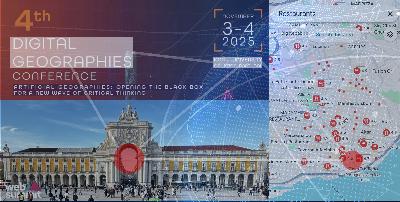
I had come to present at the 4th Digital Geographies Conference, and the organizers had scheduled a walking tour of Lisbon. Yet here I was, performing the very platform-mediated tourism that the attendees came to interrogate. My own phone was likely using the same mapping API I used to book my AirBnB. These platforms were actively reshaping the Lisbon around us. The irony wasn’t lost on me. We had gathered to critically examine digital geography while simultaneously embodying its contradictions.
That became even more apparent as we gathered for our walking tour. We met in a square these platform algorithms don’t push. It’s not “liked”, “starred”, nor “Instagrammed.” But it was populated nonetheless…with locals not tourists. Mostly immigrants. The virtual was met with reality.
What exactly were we examining as we stood there, phones in hand, embodying the very contradictions we’d gathered to critique?
Three decades ago, as an undergraduate at UC Santa Barbara, I would have understood this moment differently. The UCSB geography department was riding the crest of the GIS revolution then. Apple and Google Maps didn’t exist, and we spent our days digitizing boundaries from paper maps, overlaying data layers, building spatial databases that would make geographic information searchable, analyzable, computable. We were told we were democratizing cartography, making it a technical craft anyone could master with the right tools.
But the questions that haunt me now — who decides what gets mapped? whose reality does the map represent? what work does the map do in the world? — remained largely unasked in those heady days of digital optimism.
Digital geography, or ‘computer cartography’ as we understood it then, was about bringing computational precision to spatial problems. We were building tools that would move maps from the drafting tables of trained cartographers to the screens of any researcher with data to visualize. Marveling at what technology might do for us has a way of stunting the urge to question what it might be doing to us.
The field of digital geography has since undergone a transformation. It’s one that mirrors my own trajectory from building tools and platforms at Microsoft to interrogating their societal effects. Today’s digital geography emerges from the collision of two geography traditions: the quantitative, GIS-focused approach I learned at UCSB, and critical human geography’s interrogation of power, representation, and spatial justice. This convergence became necessary as digital technologies escaped the desktop and embedded themselves in everyday urban life. We no longer simply make digital maps of cities and countrysides. Digital platforms are actively remaking cities themselves…and those who live in them.
Contemporary digital geography, as examined at this conference, looks at how computational systems reorganize spatial relations, urban governance, and the production of place itself. When Airbnb’s algorithm determines neighborhood property values, when Google Maps’ routing creates and destroys retail corridors, when Uber’s surge pricing redraws the geography of urban mobility — these platforms don’t describe cities so much as actively reconstruct them. The representation has become more influential or ‘real’ than the reality itself.
This is much like the hyperreality famously described by the French cultural theorist Jean Baudrillard — a condition where the simulation or sign (like app interfaces) replaces and precedes reality. In this way, the digital map (visually and virtually) has overtaken the actual territory in importance and impact, actively shaping how we perceive and interact with the real world.
As digital platforms become embedded in everyday life, we are increasingly living in a simulation. The more digital services infiltrate and reconstitute urban systems the more they evade traditional governance. Algorithmic mediation through code written to influence the rhythm of daily life and human behavior increasingly determines who we interact with and which spaces we see, access, and value. Some describe this as a form of data colonialism — extending the logic of resource extraction into everyday movements and behaviors. This turns citizens into data subjects. Our patterns feed predictive models that further shape people, place…and profits. These aren’t simple pipes piped in, or one-way street lights, but dynamic architectures that reorganize society’s rights.
LISBON LURED, LOST, AND LIVED
The scholars gathered in Lisbon trace precisely how digital platforms restructure housing markets, remake retail ecologies, and reformulate the rights of humans and non-humans. Their work, from analyzing platform control over cattle herds in Brazil to tracking urban displacement, exemplifies the conference’s focus: making visible the often-obscured mechanisms through which platforms reshape space.
Two attendees I met included Jelke Bosma (University of Amsterdam), who researches Airbnb’s transformation of housing into asset classes, and Pedro Guimarães (University of Lisbon), who documents how platform-mediated tourism hollows out local retail. At the end of the tour, when a group of us were looking to chat over drinks, Pedro remarked, “If you want a recommendation for an authentic Lisbon bar experience, it no longer exists!”
Yet, even as I navigated Lisbon using the very interfaces these scholars’ critique, I was reminded of this central truth: we study these systems from within them. There is no outside position from which to observe platform urbanism. We are all, to varying degrees, complicit subjects. This reflection has become central to digital geography’s method. It’s impossible to claim critical distance from systems that mediate our own spatial practices. So, instead, a kind of intrinsic critique is developed by understanding platform effects through our own entanglements.
Lisbon has become an inadvertent laboratory for this critique. Jelke Bosma’s analysis of AirBnB reveals how the platform has facilitated a shift from informal “home sharing” to professionalized asset management, where multi-property hosts control an increasing share of urban housing stock. His research shows “professionally managed apartments do not only generate the largest individual revenues, they also account for a disproportionate segment of the total revenues accumulated on the platform”.
This professionalization is driven by AirBnB’s business model and its investment in platform supporting “asset-based professionalization,” which primarily benefits multi-listing commercial hosts. He further explains that AirBnB’s algorithm “rewards properties with high availability rates,” creating what he calls “evolutionary pressures” on hosts to maximize their listings’ availability. This incentivizes them to become full-time tourist accommodations, reducing the competitiveness of long-term residential renting.
The complexity of this ecosystem was also apparent during our Barcelona stop. What I booked as an “Airbnb” was a Sweett property — a competitor platform that operates through AirBnb’s APIs. This apartment featured Bluetooth-enabled locks and smart home controls inserted into an 1800s building. Sweett’s model demonstrates how platform infrastructure not only becomes an industry standard but is leveraged and replicated by competitors in a kind of coopetition based on the pricing algorithms AirBnB normalized.
In Lisbon, my rental sat in a building where every door was marked w










 United States
