


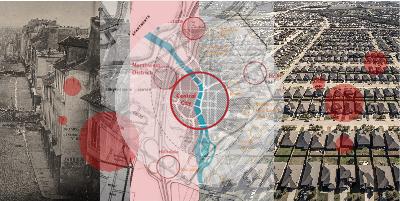
Between Urban Order and Emerging Meanings
Description
Hello Interactors,
Cities are layered by past priorities. I was just in Overland Park, Kansas, where over the last 25 years I’ve seen malls rise, fall, and shift outward as stores leave older spaces behind.
When urban systems shift — due to climate, capital, codes, or crisis — cities drift. These changes ripple across scales and resemble fractal patterns, repeating yet evolving uniquely.
This essay traces these patterns: past regimes, present signals, and competing questions over what's next.
URBAN SCRIPTS AND SHIFTING SCALES
As cities grow, they remember.
Look at a city’s form — the way its streets stretch, how its blocks bend, where its walls break. These are not neutral choices. They are residues of regimes. Spatial decisions shaped by power, fear, belief, or capital.
In ancient Rome, cities were laid out in strict grids. Streets ran along two axes: the cardo and decumanus. It made the city legible to the empire — easy to control, supply, and expand. Urban form followed the logic of conquest.
As cartography historian, O. A. W. Dilke writes,
“One of the main advantages of a detailed map of Rome was to improve the efficiency of the city's administration. Augustus had divided Rome into fourteen districts, each subdivided into vici. These districts were administered by annually elected magistrates, with officials and public slaves under them.”
In medieval Europe, cities got messy. Sovereignty was fragmented. Trade replaced tribute. Guilds ran markets as streets tangled around church and square. The result was organic — but not random. It reflected a new mode of life: small-scale, interdependent, locally governed.
In 19th-century Paris, the streets changed again. Narrow alleys became wide boulevards. Not just for beauty — for visibility and force. Haussmann’s renovations made room for troops, light, and clean air. It was urban form as counter-revolution.
Then came modernism. Superblocks, towers, highways. A form that made sense for mass production, cheap land, and the car. Planning became machine logic — form as efficiency.
Each of these shifts marked the arrival of a new spatial calculus — ways of organizing the built environment in response to systemic pressures. Over time, these approaches came to be described by urbanists as morphological regimes: durable patterns of urban form shaped not just by architecture, but by ideology, infrastructure, and power.
The term “morphology” itself was borrowed from biology, where it described the structure of organisms. In urban studies, it originally referred to the physical anatomy of the city — blocks, plots, grids, and streets. But today the field has broadened. It’s evolved into more of a conceptual lens: not just a way of classifying form, but of understanding how ideas sediment into space. Today, morphology tracks how cities are shaped — not only physically, but discursively and increasingly so, computationally.
Urban planning scholar Geoff Boeing calls urban form a “spatial script.” It encodes decisions made long ago — about who belongs where, what gets prioritized, and what can be seen or accessed.
Other scholars treated cities like palimpsests — a term borrowed from manuscript studies, where old texts were scraped away and overwritten, yet traces remained. In urban form, each layer carries the imprint of a former spatial logic, never fully erased.
Michael Robert Günter (M. R. G.) Conzen, a British geographer, pioneered the idea of town plan analysis in the 1960s. He examined how street patterns, plot divisions, and building forms reveal historical shifts. Urban geographer and architect, Anne Vernez Moudon brought these methods into contemporary urbanism. She argued that morphological analysis could serve as a bridge between disciplines, from planning to architecture to geography.
Archaeologist Michael E. Smith goes further. Specializing in ancient cities, Smith argues that urban form doesn’t just reflect culture — it produces it. In early settlements, the spatial organization of plazas, roads, and monuments actively shaped how people understood power, social hierarchy, and civic identity. Ritual plazas weren’t just for ceremony — they structured the cognitive and social experience of space.
Urban form, in this sense, is conceptual. It’s how a society makes its world visible. And when that society changes — politically, economically, technologically — so does its form. Not immediately. Not neatly. But eventually. Almost always in response to pressure from the outside.
INTERVAL AND INFLECTION
Urban morphology used to evolve slowly. But today, it changes faster — and with increasing volatility. Physicist Geoffrey West, and other urban scientists, describes how complex systems like cities exhibit superlinear scaling: as they grow, they generate more innovation, infrastructure, and socio-economic activity at an accelerating pace. But this growth comes with a catch: the system becomes dependent on continuous bursts of innovation to avoid collapse. West compares it to jumping from one treadmill to another — each one running faster than the last.
What once took centuries, like the rise of industrial manufacturing, is now compressed into decades or less. The intervals between revolutions — from steam power to electricity to the internet — keep shrinking, and cities must adapt at an ever-faster clip just to maintain stability. But this also breeds instability as the intervals between systemic transformations shrink. Cities that once evolved over centuries can now shift in decades.
Consider Rome. Roman grid structure held for centuries. Medieval forms persisted well into the Renaissance. Even Haussmann’s Paris boulevards endured through war and modernization. But in the 20th century, urban morphology entered a period of rapid churn. Western urban regions shifted from dense industrial cores to sprawling postwar suburbs to globalized financial districts in under a century — each a distinct regime, unfolding at unprecedented speed.
Meanwhile, rural and exurban zones transformed too. Suburbs stretched outward. Logistics corridors carved through farmland. Industrial agriculture consolidated land and labor. The whole urban-rural spectrum was redrawn — not evenly, but thoroughly — over a few decades.
Why the speed?
It’s not just technology. It’s the stacking of exogenous shocks. Public health crises. Wars. Economic crashes. Climate shifts. New empires. New markets. New media. These don’t just hit policy — they hit form.
Despite urbanities adaptability, it resists change. But when enough pressure builds, it breaks and fragments — or bends fast.
Quantitative historians like Peter Turchin describe these moments as episodes of structural-demographic pressure. His theory suggests that as societies grow, they cycle through phases of expansion and instability. When rising inequality, elite overproduction, and resource strain coincide, the system enters a period of fragility.
The ruling class becomes bloated and competitive, public trust erodes, and the state’s ability to mediate conflict weakens. At some point, the social contract fractures — not necessarily through revolution, but through cumulative dysfunction that demands structural transformation.
Cities reflect that process spatially. The street doesn’t revolt. But it reroutes. The built environment shows where power has snapped or shifted. Consider Industrial Modernity. Assuming we start in 1850, it took roughly 100 years before the next regime took shape — the Fordist-Suburban Expansion starting in roughly 1945. It took around 30-40 years for deregulation to hit in the 80s. By 1995 information, communication, and technology accelerated globalization, financialization, and the urban regime we’re currently in — Neoliberal Polycentrism.
Neoliberal Polycentricism may sound like a wonky and abstract term, but it reflects a familiar reality: a pattern of decentralized, uneven urban growth shaped by market-driven logics. While some scholars debate the continued utility of the overused term 'neoliberalism' itself, its effects on the built environment remain visible. Market priorities continue to dominate and reshape spatial development and planning norms.
It is not a wholly new spatial condition. It's the latest articulation of a longer American tradition of decentralizing people and capital beyond the urban core. In the 19th century, this dynamic took shape through the rise of satellite towns, railroad suburbs, and peripheral manufacturing hubs. These developments were often driven by speculative land ventures, private infrastructure investments, and the desire to escape the regulatory and political constraints of city centers.
The result was a form of urban dispersal that created new nodes of growth, frequently insulated from municipal oversight and rooted in socio-economic and racial segregation. This early polycentricism, like fireworks spawning in all directions from the first blast, set the stage for later waves of privatized suburbanization and regional fragmentation. Neoliberalism would come to accelerate and codify this expansion.
It came in the form of edge cities, exurbs, and special economic zones that proliferated in the 80s and 90s. They grew not as organic responses to demographic needs, but as spatial products of deregulated markets and speculative capital. Governance fragmented. Infrastructure was often privatized or outsourced. As Joel Garreau’s 1991 book Edge City demonstrates, a place like Tysons Corner, Virginia — a highway-bound, developer-led edge city — embodied this shift: planned by commerce, not civic vision. A decade later, planners tried to retrofit that vision — adding transit, density, and walkability — but progress has been uneven, wi












 United States
