


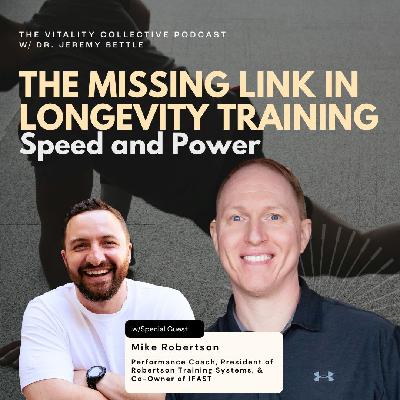
EP 47 - The Missing Link In Longevity Training: Speed and Power with Mike Robertson
Description
Episode Summary
In this conversation, Dr. Jeremy Bettle sits down with Mike Robertson, President of Robertson Training Systems and co-owner of IFAST, one of America's top gyms. Mike shares insights from his career coaching everyone from NBA players to octogenarians, focusing on the often-forgotten elements of speed and power in training programs. They explore why power is the first physical quality that declines with age, the critical difference between slow strength training and adding speed back into movements, and why tissues need careful preparation before jumping into plyometrics. The conversation covers movement phases, impact forces, progression timelines that are much longer than people expect, and real-world applications including an 80-year-old woman's nine-month journey from basic stability work to drop jumps that improved her bone density. Mike explains how his team successfully implements power training across all populations, from professional basketball players to an 87-year-old using a walker, and why maintaining explosive qualities is essential for fall prevention, bone health, brain function, and continuing the activities you love throughout life.
Guest Bio
Mike Robertson is one of the most highly sought-after coaches, consultants, speakers and writers in the fitness industry today. Known for his "no-nonsense" approach to coaching and program design, Mike has made a name for himself as a go-to resource for professional athletes from every major sport, but especially in the world of basketball. Mike is the President of Robertson Training Systems and the co-owner of Indianapolis Fitness and Sports Training (IFAST) in Indianapolis, Indiana. IFAST has been named one of the Top 10 Gyms in America by Men's Health magazine six times in total. Last but not least, Mike is a devoted husband to his wife Jessica, and father to his children Kendall and Kade, his dog Finn, and his cat Steve.
Links
-
Website: robertsontrainingsystems.com
-
Instagram: @RobTrainSystems
Three Actionable Takeaways
-
Be honest about where you're starting from and be okay with it. The first step is getting a real baseline of your current capabilities without ego or judgment. If you know where you truly are and where you want to go, you can reverse engineer the right program to get there safely.
-
Start with a smart foundational program that ramps up intensity gradually. If you haven't trained in years, don't test your max effort box jump or sprint time on day one. Build the foundation with slower strength work first, then progress through lower-intensity power activities like jump rope or medicine ball throws before advancing to higher-impact movements.
-
If power training is important for your longevity and vitality, you need to train it forever. Don't let this be a two-week experiment. Find ways to incorporate power work into your program every week for months, years, and decades, because maintaining this quality is essential for doing the activities you love as you age.
10 Takeaways
-
Power, defined as the ability to use strength quickly, is the first physical quality that declines with age, making it every bit as important to train than pure strength for longevity
-
Before adding speed or explosive elements to training, tissues must be prepared through a foundation of slower strength work that builds connective tissues, tendons, ligaments, and joint surfaces
-
The progression from foundational strength to explosive power typically takes much longer than people expect. Double whatever timeline you're thinking, especially if you haven't done elastic explosive activities in 10-20 years
-
Movement phases can be simplified into three components: breaking/loading phase (storing energy, Eccentric), amortization/transfer phase (the zero point, isometric), and propulsive/release phase (expressing force, concentric)
-
Impact forces scale dramatically with jump height and landing distance. Stepping off a 12-inch box creates completely different demands than a 36-inch box, requiring careful progression management
-
Movement competency must be maintained across different speeds and loads. Looking good in a slow bodyweight squat doesn't guarantee safe mechanics when adding a barbell or performing explosive movements
-
Power training doesn't need to look the same for everyone. An 87-year-old throwing a volleyball while seated in a walker and an NBA player doing depth jumps are both doing appropriate power training for their level
-
Reducing gravity (lying down vs. standing) and adding external support (suspension trainers, racks) are two key strategies for regressing exercises to match individual capabilities
-
Power training has neurological benefits for brain health and builds confidence in navigating a reactive world where bumps, trips, and unexpected forces are constant threats
-
The gym isn't the end goal. People train to maintain their ability to do activities they love, whether that's hiking, gardening, playing pickup basketball, or simply not falling down













 United States
