


Episode 25: Working On Your Business NOT In Your Business
Description
Dr. Deb shares what it takes to set structure to your business for growth and success.
Do not miss these highlights:
02:16 Your business is not your life, You personally should not define yourself by your business
03:49 If your business cannot earn revenue without you being present, you don't really have a business, you have a job
05:32 When and how much time you should spend seeing your clients
07:32 Create a model that's going to provide consistent value to your clients, your employees, and to any people that are going to help your business grow
10:18 Walk through your practice as though you are a client
11:28 Document all the work that you do and all the processes that you do in either a video and or written manual
12:50 Your clients should be greeted the exact same way by every single person in your office every single time
14:09 Provide consistent value, think about the value of what you're providing, not only the value of what you're charging them
15:51 The best compliment that we could get as a provider is to have our patients trust us with their family and friends
18:15 Your operations manual is your repository of documentation that describes your company's “How To” guide
19:56 Why you should set guidelines about the dress code
Resources Mentioned: Join Us in the FMBI Mastermind Group on Facebook. You can find the Group at https://www.facebook.com/groups/5461914567153276/
<figure class="wp-block-image size-large">
 </figure>
Transcript of Episode #25:
0:01
You're listening to the Functional Medicine Business Podcast featuring Dr. Deb, one of the most creative functional medicine business practitioners in her industry. She shares the wisdom and knowledge that she has gained over 25 years of functional medicine, a pioneer in functional medicine, scheduling, leadership and Practice Management. Dr. Devin has a wealth of knowledge and he's eager to share to help functional medicine become more productive, and for the practitioners and patients to live better lives. Our podcast shares the good and the bad of our industry because Dr. Deb knows the pain you live every day building a functional medicine practice with practical tools of how to manage money, taxes and patient care. She will discuss it all with you.
0:54
Hello, hello. Welcome back to FMBI podcast. I'm your host, Dr. Deb and today I want to talk to you about working on your business not in your business. At FMBI we understand how it feels created by medical professionals for medical professionals, are you racing from one patient to the next, skipping lunch and not sure how you're going to show up to your kids events? Not quite sure what that P&L sheet really means to your practice? And are you struggling to find the right partners in your business? Our program is based on the values of efficiency organization and prioritization. The FMBI 15k a day program will help you discover how to run an efficient operation and introduce healthy generating therapies for more income. Our business roadmap will help you scale your functional medicine practice using proven business approaches, we would like to invite you today to book a free discovery call with our founder Dr. Deb, simply go to our website at functionalmbi.com/book-free-call and schedule your time today. You see, it's really critical that you understand that your business is not your life. And you personally should not define yourself by your business. We need to be separate entities, right? You need to be yourself your person, Susie, Joe, Mary, the wife, the mother, the grandmother, the biker, the hiker, the football player, the tennis player, that's you, but your business should be separate of you. Now most of us in business aren't like that will lead with what we do, not who we are. And it's really important for you to separate you from your business. You know, at best, I think it's something for you to be a part of you, rather than be you. And the business needs its own rules, it needs its own purpose. You know, it needs to perform its sole function, and keep its clients and keep everything without you believe it or not. And I'm gonna say that again, because your business needs to function without you being the sole person to make it work. Otherwise, we don't have a business and you've heard me say this before. If your your clinic or your telemedicine practice, whatever it is you're doing, cannot earn revenue without you being present. You don't really have a business, you have a job. And there are two different things and there's not anything wrong to either one of them. You just need to know which one you have, and where you're going to go.
4:05
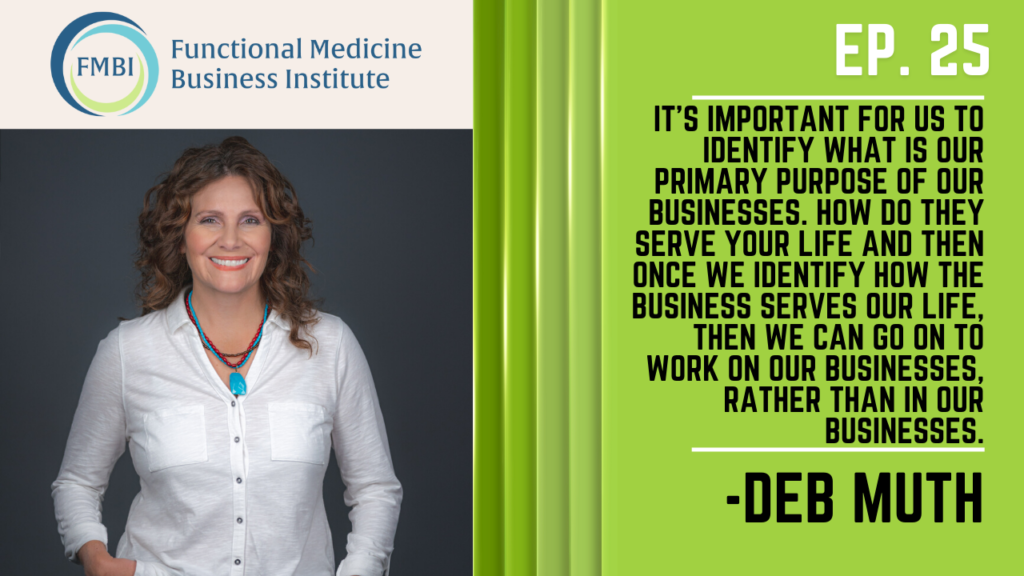
So I also think it's important for us to identify what is our primary purpose of our businesses? How do they serve your life. And then once we identify how the business serves our life, then we can go on to work on our businesses, rather than in our businesses. Now with a full understanding of why that's necessary, we're gonna go through a couple of things. Now, you can think of this model a little bit like a franchise model or a prototype model. And we're not really looking for the idea of franchise or prototype. There's not a problem if you'd like to do that. Or if you want to do that down the road with your business. Regardless of whether you're planning on doing that. You have to have some of the same mindsets in place. Because if you cannot create a business that somebody can and follow without you being there and without you directing them, again, you don't have a business, you just have a place that you're working. And it's going to consume way too much of your time and your energy to continue to do that for long periods of time. So when we're working on our business, rather than in our business, it becomes the central theme of our daily activity. It is the catalyst to drive everything that we do to move our businesses forward. Now, I'm not saying that when you're seeing clients, that you shouldn't do that anymore, I think everybody should I still see clients. And I like to have the finger on the pulse of what's going on. But I also take time away from seeing clients these days to actually work on growing my business. Otherwise, in the past, I was so busy seeing clients every single day, all day, that I didn't have the time to actually work on growing the business. And it took me a lot longer to get where I needed to go because I didn't dedicate that time and set it aside to work on growth of the business. So I encourage everybody, if you're seeing clients, to pick a half a day or a day a week that you work on your business, and during that time is when you're going to focus on that growth of the business itself. Don't focus on doing labs or answering messages to your clients, none of that, that stays out, the only thing you focus on is that growth of the business itself.
6:39
Now, I want you to pretend that your business that you own or you want to own is a prototype for let's say, 5000 other clinics, that might be a little overwhelming, maybe, let's say 50 clinics, and in for you to have to make a prototype of this business, you have to know how your business runs and operates, you have to know why and how your business is successful or is going to be successful. So I want you to pretend like you're going to franchise your business. And I want you to think of this a little bit like a game like the franchise game. And understand there's rules that we have. And we should follow these if we're going to win. So we want to create a model that's going to provide consistent value to your clients, your employees, your suppliers, any lenders that you have, and any people that are going to help your business grow. So we want to a consistent model that looks like that the model is going to operate by people with the skill set that's necessary. Now I say that, because in other businesses, their thought process is that we're going to hire people to do a job with the lowest skill set possible.
8:13
Now there's two ways to think about this. The first way to think about this is that you're just hiring people who don't really care that aren't going to cost you a lot of money. And they're just fly by night, okay? In our industry, we don't have the time to train people with that thought process. So we need qualified people. Now, to think about this, when you're documenting things, though, you want to think about documenting in terms of somebody with the lowest skill, because we have to presume that who you're documenting this for, doesn't know what you know, it's very easy for us having been in the business having been in the industry to skip over things and assume that everybody that we're working with knows what we know. And I'm going to tell you that is the farthest thing from the truth. Like I have been burned so many times assuming that somebody that works for me know something that I know, lik






 United States
