


Episode 33: What Journey Does Your Potential Client Go Through?
Description
The experience that your client/patient goes through at your office can make a difference between attracting and maintaining a client. Does your client see a nice clean and polished office, nice staff or crabby staff? Do they hear gossip and rude conversation or is your staff wonderful and engaging about health and wellness?
Take a tour of your office through your client's eyes. Really pay attention to the details because we overlook them often.
What digital footprint are you leaving behind? Do you have social content in multiple forms; video, blogs, pictures, and social posts? Do you educate your clients or are you always looking to get paid for your knowledge?
Let people get to know you before they book an appointment with you by being on video. According to Google if you are trying to sell a high-ticket item people need to spend at least 7 hours with you.
Do not miss these highlights:
01:17 It was the outside that gave that first impression, so it’s important to pay attention to the look and the ambiance of the building.
04:27 It’s very important for us to plan the experience that we want our clients to have instead of just leaving it to chance.
07:04 Make sure there's a very clear call to action even on your social media.
10:18 So it's really important to make sure that you have content out there, that's helping you connect to people. You need to consistently be producing content. So people know you love you. And like you. And they trust you.
11:43 Have a dabbling of things on every platform, so if one goes down, the other one can stay active, and you can pivot quickly.
13:05 Make sure that your client's journey is fully on digital assets as well.
Resources MentionedJoin Us in the FMBI Mastermind Group on Facebook. You can find the Group at https://www.facebook.com/groups/5461914567153276/
<figure class="wp-block-image size-large">
 </figure>
Transcript of Episode #33:
Debra Muth 0:01
You're listening to The Functional Medicine Business podcast featuring Dr. Deb, one of the most creative functional medicine business practitioners in her industry. She shares the wisdom and knowledge that she has gained over 25 years of functional medicine, a pioneer in functional medicine, scheduling, leadership and Practice Management. Dr. Devin has a wealth of knowledge and he's eager to share to help functional medicine become more productive, and for the practitioners and patients to live better lives. Our podcast shares the good and the bad of our industry. Because Dr. Deb knows the pain you live every day building a functional medicine practice with practical tools of how to manage money, taxes and patient care. She will discuss it all with you.
Debra Muth 0:55
Welcome back to the Functional MBI podcast. I'm your host, Dr. Deb. And today I want to talk about what journey does your potential client go through? You know, I think it's important for us to consider the experience that our clients go through when they're spending time and money with us. So from time to time, what we'll actually do in my practice, is walk through the journey of the client, literally from driving into the parking lot. Looking around our parking lot, what do they see? How does our parking lot? Look? Is it inviting? Is it dirty? Is their garbage sitting around? Do we have dead plants in our area around the building? Is there paint coming off of the building? Do we have Miss painted areas? What is our signage look like? Is it visible? Is it faded? Is there a tree branch hanging in front of it? So I think it's always important to look at every little one of these aspects. Now for many of us, we think this doesn't make a big deal for patients or clients. But I will tell you, it makes a huge first impression. So when you have that first impression of your business, and it's shabby and dirty, and there's no place to park, patients notice that.
Debra Muth 2:19
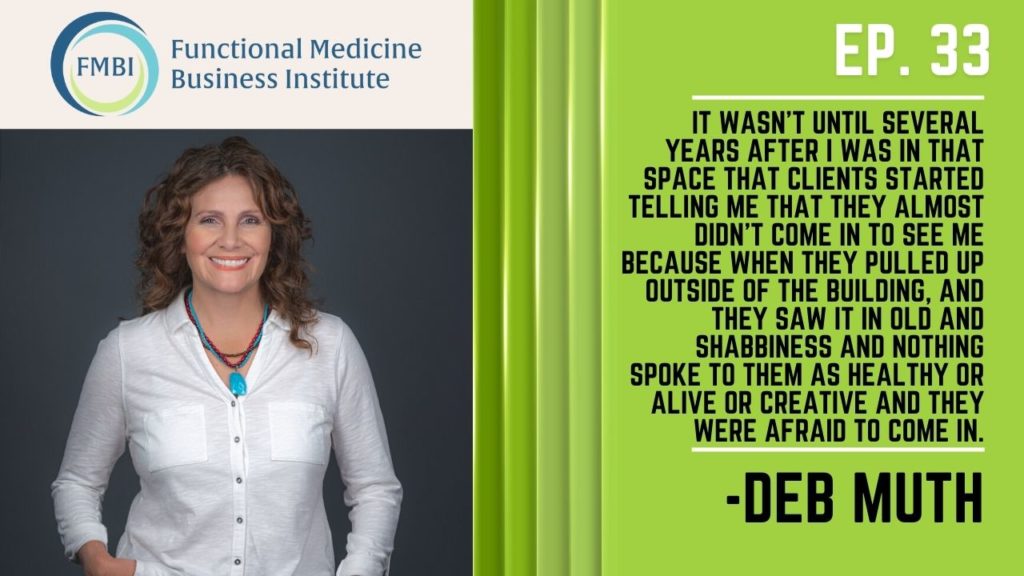
When I started out, I was in a building that was very old. And when you walked into the lower level, it smelled musty and it was very dark and there was paneling on the walls. And there was a carport over the front door which made it nice when it was raining. But a lot of people thought the building was created as a funeral parlor originally because of this carport drive that we had. And it really wasn't it never was that it was just how the building was made. But that's how they thought. And it wasn't until several years after I was in that space that clients started telling me that they almost didn't come in to see me because when they pulled up outside of the building, and they saw it in old and shabbiness, not disrepair, but it was just shabby. And it was in an older neighborhood. And nothing spoke to them as healthy or alive or creative or anything like that it was just kind of dingy and dreary, that they didn't want to come in, they were afraid to come in. And then when they walked in the lower level, and they had this musty smell in the building that turns them off even more. And so I had the potential and I'm sure I did lose many clients simply because of the look and the feel of the building. And then once we have the opportunity to remodel the building, and we made it look fresh and exciting and inviting inside, we didn't pay attention to the outside and it was the outside that really gave that first impression.
Debra Muth 4:03
So pay attention to those kinds of things. It's super important, you know, then walk into your office and look around, see what's in your waiting area. See how your waiting area is laid out. Watch where your eye goes to and see what your clients see see your office through your clients eyes, not through your eyes. You know, it's we have the opportunity to leave things to chance or to plan them out. And I think it's super important for us to plan the experience that we want our clients to have instead of just leaving it to chance. What's the experience that your clients get once you're receptionists invite them in and engage them. Is it positive? Is it negative? Is it with a smile? Is it with an irritation? They're being addressed. All of those things really matter how long they wait in your waiting room, and what they listened to in your waiting room. So if they're sitting in your waiting room for five or 10 minutes, and they're hearing every conversation of your employee, and your employees are talking about what they did on the weekend, versus talking about something health and wellness related, makes a big difference and makes a big impact on that patient experience. I'm a big proponent of moving my people out of my waiting room, and into the exam room, where they're not open to hearing that conversation from your team. They're not open to hearing conversations with other clients on the phone. And in my waiting room, I have different magazines, we run soft, relaxing music, so that they can rest if they want to. We give them access to Wi Fi in case they want to work on emails for work, or they want to make private phone calls. We have some marketing materials in our waiting room, we have a large poster on the wall that is kind of like a menu of services. That explains a little bit about what it is we do. So as people are sitting there, they can look at this menu of services and see if there's anything that we offer that a they didn't know we offered, or be that maybe we offer a service that could help someone that they know. And I can tell you at least six times a week at minimum, that I have clients waiting for me, someone will say, Hey, I know a person that has this condition. Can you do that? I see that you guys do that on here. Or I didn't realize that you offered IV services. I didn't realize you guys did this? Or that? How can that affect me? How does that have service that could benefit from me? So it's really important to put yourself out there and put your information out there so people know what it is that you do. You know, I think it's really important to when you're looking at social media, that I guess you could use this for social media and in your office with marketing, you want to make sure there's a very clear call to action. So for instance, my menu Service Board in my office, what purpose am I doing with that? What am I asking my clients to do? Well, my call to action for them is to look at that board of services, and see if there are services that we could be of assistance to them for so that they don't have to go someplace else, because they didn't know we offered it. And how can these services help them. So we want to engage them in that conversation. Now, if you were on social media, your call to action for a menu of services like that may be that you want them to call your office to ask or schedule an appointment about these surfaces. That is a very clear call to action. You know, Google discovered that for very high value purchases like $3,000 or more, that people on average n







 United States
