


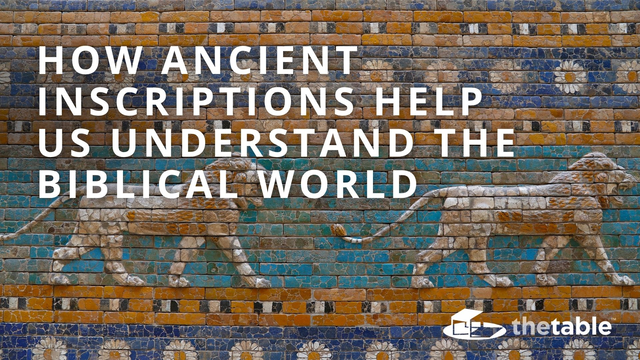
How Ancient Inscriptions Help Us Understand the Biblical World (Classic)
Description
Darrell Bock:
Welcome to the Table where we discuss issues of God and culture. I'm Darrell Bock, Executive Director for Cultural Engagement at The Hendricks Center at Dallas Theological Seminary.
And our topic today is we'll take your pick either Ephesus or Artemis or both and the relationship that they have to one another. We're going to talk about the background to one of the epistles in the New Testament, the book of Ephesus, and then what that means for the way in which passages in the New Testament get read.
And my guests today are Gary Hoag, who is a visiting professor at a variety of schools, and also does work with relation to finances and stewardship with global trust partners where he's CEO. And Sandra Glahn, who is a fellow colleague here at Dallas, who is professor of what? Media.
Sandra Glahn:
Media Arts and Worship.
Darrell Bock:
Media Arts and Worship. I never get it in the right order. I want to start with worship, and then go to media and arts.
Sandra Glahn:
That's not a bad priority.
Darrell Bock:
But that's okay, anyway. And we're discussing really the background to a book that Sandra has written called Nobody's Mother. That title is intriguing because I have a mom and you have a mom, and Gary has a mom. So, that's interesting. Artemis of the Ephesians.
So, I'm going to dive in. So, the first question to ask always in a topic like this is because this involves stuff like papyri and things like that which people handle on an everyday basis. And so, how did nice people like you get into a gig like this? Gary, I'm going to start with you. How did you become interested in Ephesus and the things surrounding Ephesus? Because Ephesus is a long way away.
Gary Hoag:
I appreciate the invitation to be on today. And to answer that question, I wanted to pursue my PhD on wealth in ancient Ephesus in the first layer to Timothy because I simply wanted to know what did Paul want Tim to understand about handling riches in God's house? And so, that's how I got connected to wanting to research the social and cultural world of Ephesus.
Darrell Bock:
Okay. And so, you dove in and got started. And I'm assuming it took you to some of these resources that we're going to be talking about. Is that what happened?
Gary Hoag:
It did. Here's how it went. In my first year, I was studying under Phil Towner. And if you can imagine, he released the NICNT commentary in 2006. And six weeks after he released it, he agreed to be my advisor. And so, in the first year he said, "I want you to read all the secondary literature on the passages where riches were in view." I came back at the end of that year and said, "Wow." I said, "The debate swirls around rare language."
So, he says to me, "Go to Yale in year two." He says, "Go to Yale, sit down with Abraham Malherbe and ask him how he unlocked the medical imagery of Paul." And so, how I got deep into Ephesus and the Ephesian inscriptions and Artemis was I spent two years looking at tons of primary material. And significant among that was Ephesian inscriptions.
Darrell Bock:
Interesting. So, Phil Towner, who by the way, I did my doctoral studies at Aberdeen, and Phil I think overlapped my last year there. So, that name goes way, way back for me. So, Sandra, how did you get involved with Ephesus and Artemis?
Sandra Glahn:
In my PhD program, which was aesthetic studies, I had three prongs, history, art and philosophy. And my history element, I could choose anywhere in the world for a 200-year period. So, I chose 100 BC to 100 AD in Ephesus.
Darrell Bock:
And that pulled you into all the same materials.
Sandra Glahn:
That pulled me into all the same materials, lots of overlap, yup.
Darrell Bock:
Okay. And I take it you guys ended up being in contact with each other, is that right? Or, I mean, we were chatting about that earlier. But…
Sandra Glahn:
Not until our dissertations were done.
Darrell Bock:
Really?
Sandra Glahn:
Actually, yeah. I'll let Gary tell it.
Gary Hoag:
Yeah, I think what it was, was, it was one of those cases where our research was happening in parallel tracks, like simultaneously. So, we might've been looking at similar material. Whereas, what I was looking at was epigraphic. So, I looked at the inscriptions of Ephesus, and by the way, because the year I was researching, I'm holding up the copy. I have one of the only sets of the Inscription von Ephesus. Blumberg offers or asks to borrow one sometimes.
But I basically immersed myself in the inscriptions because Malherbe said, "Gary…" He said, "Don't search ancient material. Everybody searches it, but they make one fatal error. They think they're searching everything available." And so, I started with epigraphic, then I went to numismatic. And then, I went to literary and I found lots of stuff that wasn't necessarily in the Greek English lexicons. And so, for me, it was like spending two or three years reconstructing the world of Ephesus based on all this really cool evidence. And so, I found it absolutely fascinating.
Darrell Bock:
Interesting. We'll come back to these categories in a second. So…
Sandra Glahn:
And one day he walks into my office and said, "We need to meet." We are apparently doing parallel research. And I had no idea.
Gary Hoag:
She published an article, right?
Sandra Glahn:
Yeah. Bibliotheca Sacra, run a two-article series.
Darrell Bock:
And so, what years are we talking about here?
Sandra Glahn:
We were trying to decide, I think 2014, '15-ish maybe because we were both… I don't know…
Gary Hoag:
Right around in, yeah.
Darrell Bock:
Interesting. So, let's go through the categories, inscriptions, epigraphy, numismatics. Okay, these are not words people use in their everyday speech, so let's help them with this. Inscriptions, I'll let you… We'll alternate.
Gary Hoag:
So, let's start with epigraphic.
Darrell Bock:
Okay.
Gary Hoag:
Epigraphic evidence, which is inscription evidence. Ephesus gives us second or third to maybe Rome and Athens. Ephesus gives us thousands of inscriptions.
Sandra Glahn:
Massive amounts, yeah.
Gary Hoag:
And when I was going through them, I noticed that basically they helped me understand the social and cultural rules, the expectations of people, the different patterns of behavior. It's like they provided snapshots of what life was like, and they even included names of different characters. For example, Towner said to me when he agreed to be my advisor, he said, "I want you to do one thing. I want you to unmask the opponents of Paul."
And by the time I'm working through it, I said, "Oh, well, I can find all these characters that Paul says to watch out for. And 1 and 2 Timothy, I can show you where they appear in all the different inscriptions." And he says to me, "Wait, how did you do that?" And I said, "Only because I spent years studying these different lists and these different inscriptions that all of a sudden these characters came to life for me." And the reality is, in the inscription evidence, nobody's reading it, Darrell. Nobody's…
Darrell Bock:
Yeah, that's right. They sit there.
Gary Hoag:
Because they're not digitized, so no one's actually looking at them.
Darrell Bock:
Right, fair enough.
Sandra Glahn:
Right.
Darrell Bock:
So, what's in these inscriptions? Or what kind of variety do you see in inscriptions when you read them? In other words, what are you reading?
Gary Hoag:
Okay, I'll rattle off a few things, and then have Sandra comment.
Darrell Bock:
Okay.
Gary Hoag:
One, you see benefaction inscriptions, so all praise be to Celsus, for out of his great goodness gave us this library for everybody to enjoy.
Darrell Bock:
Okay, so benefactor is someone who, sorry, I'm going to be translating all the way through this.
Sandra Glahn:
So, you don't have income taxes…
Darrell Bock:
Right, right.
Sandra Glahn:
… and you get a rich person to underwrite the gymnasium or the coliseum or the whatever…
Gary Hoag:
There you go.
Sandra Glahn:
But then, they get their name.
Darrell Bock:
It's like a patron, right?
Sandra Glahn:
It is a patron with big lettering.
Darrell Bock:
Yeah, and that's a big deal in ancient society. The role of the benefactor is a huge deal.
Sandra Glahn:
Right, right, right.
Darrell Bock:
So, I'm sorry, I'll probably be doing this all the way through.
Sandra Glahn:
No, it's okay.
Darrell Bock:
Go ahead.
Gary Hoag:
Sure, sure. We don't even realize it because we were in that world.
Darrell Bock:
I understand, yeah.
Gary Hoag:
Second example would be honorific inscriptions. In other words, not necessarily for benefactors, but to honor certain people for their roles in society. Another one would be like tombstones where we would learn about their faith, or…
Sandra Glahn:
Theodora was a good wife.
Gary Ho














 United States
