


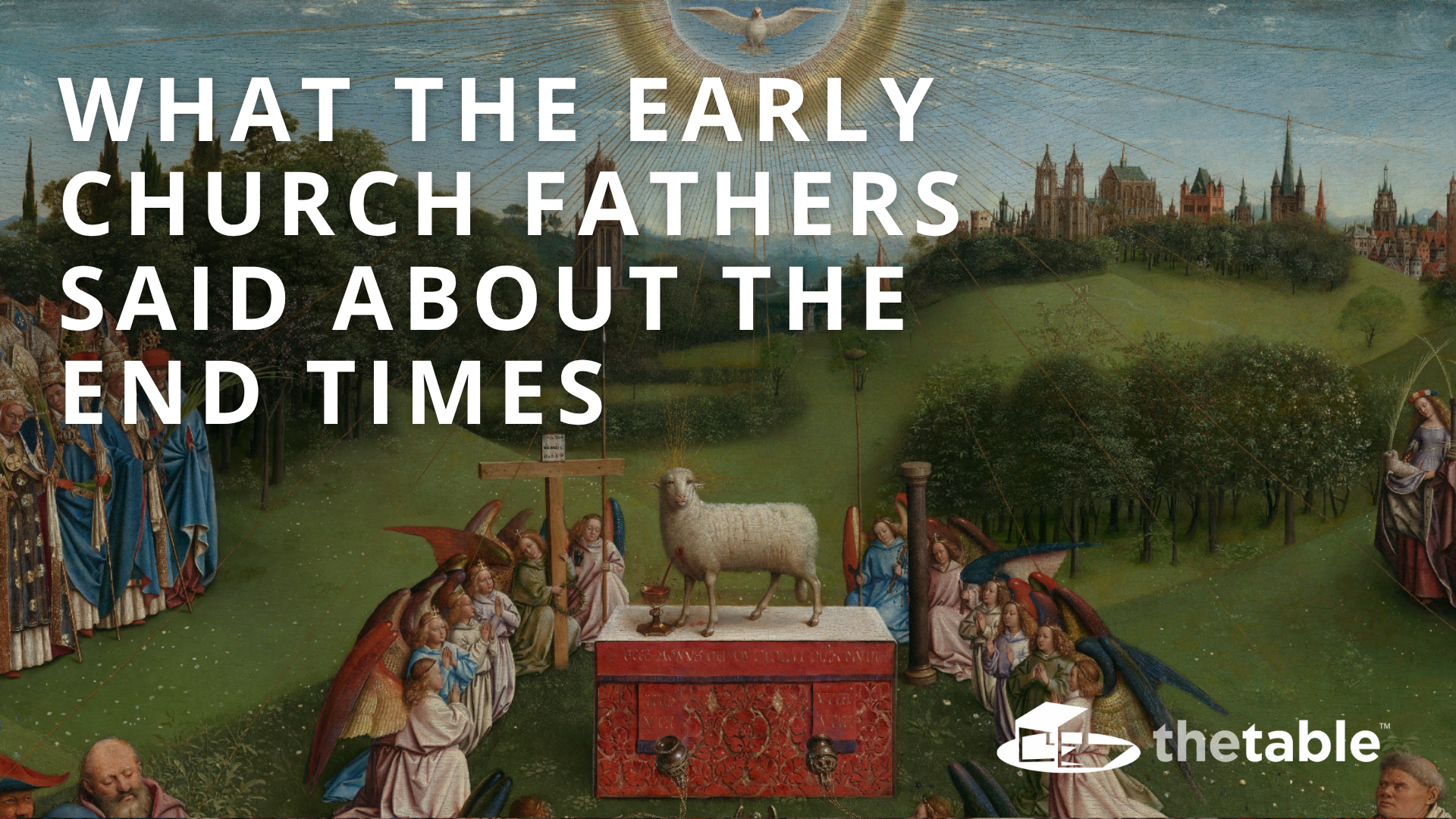
What the Early Church Fathers Said About the End Times
Description
Kymberli Cook:
Welcome to The Table Podcast where we discuss issues of God and culture. My name is Kymberli Cook and I'm the assistant director of the Hendrick Center. And today we are talking about what the early father said about the end times, and we are joined by two eminently qualified scholars who have dedicated their lives to the text of Scripture, Drs. Michael Svigel and Dr… well not Drs., there's just one of him. Dr. Michael Svigel.
Michael Svigel:
Thank goodness.
Paul Weaver:
But in writing you do put doctors.
Kymberli Cook:
And Dr. Paul Weaver, it's good to have you all here. Thanks for joining us at The Table.
Michael Svigel:
Thanks for having us.
Paul Weaver:
It's great to be here.
Kymberli Cook:
So to let our listener get to know each one of you a little bit better, would you mind telling us a bit about yourself and how you ended up thinking about the Bible and the end times and Dr. Svigel for you, particularly the early fathers. So let's start with you though, Dr. Weaver.
Paul Weaver:
Sure. I have been here at Dallas Seminary for five years. I did my ThM here. Then I spent 18 years with Word of Life Bible Institute. I was the director of the Bible Institute in Hungary for many years. Then five years academic dean at the campus in New York and then Dallas picked me off and it's been great to be here. I continue to teach internationally and I love Bible and theology, all things Bible and theology.
Kymberli Cook:
Awesome. And then Dr. Svigel.
Michael Svigel:
Yeah. I've been teaching here at Dallas Seminary for 18 years, theological studies. We do systematic theology and church history. From about the first year on, I've been teaching eschatology, which is a required course here and it's a good combination of my interest in theology as well as patristic studies, which is study of the church fathers and with a particular interest in what they believed and taught about end times events, eschatology, the technical term for that, and then how they understand Scripture.
Kymberli Cook:
Okay, very cool. Yes, I was first introduced to church history and eschatology in my internship with Dr. Svigel when he made me go find some, it was either resources or basically you knew what you were talking about and you said, I need you to go find these sources because they say this, I just need the page number essentially.
Michael Svigel:
Sounds like something I would do.
Paul Weaver:
It's nice to have those students.
Michael Svigel:
That's right.
Kymberli Cook:
But it was so good. I loved it. It was so fun. It was a great assignment, but I never knew anything about John Darby or any of that until I worked on that article. So that's a little bit about you with eschatology. Dr. Weaver, how did you end up thinking about the end times and dwelling in that space with biblical interpretation as well?
Paul Weaver:
Sure. So I did teach in Hungary. I taught Bible and theology, so I taught bible Exposition courses. I didn't mention this, but of course I'm in the Department of Bible Exposition. So currently I teach typically the three New Testament courses we teach. So the Gospels, Acts and Pauline Epistles and Hebrews to Revelation. So it touches on all of that prophecy. I also teach a course on the book of Daniel internationally and different campuses. So I do love eschatology. I do think it's significant and it's downplayed in most churches and seminaries as well. So it's an important part of our curriculum here at Dallas Seminary.
Kymberli Cook:
And you're with all of those Bible classes, you're like knee-deep in all of that. You can't help but run into eschatology. All right, so let's turn to the matter at hand. We've got a combination between early fathers and eschatology and the end times that we see in Scripture. And so both of those are actually, we could even do separate podcasts on them because they're pretty deep cuts into the biblical studies and biblical theology and to a degree abstract topics. So before we go too far, I want us to help our listener understand why does a conversation about the early fathers and specifically what they even thought about the end times, why would that have any impact or how does it have an impact on their life right now? How should it have an impact on their life right now? Dr. Svigel, you want to go first?
Michael Svigel:
Yeah, I think if anybody starts to even look into this at an even informal level, just watch YouTube videos or hear sermons or read books on end times. They will learn really quickly that there are a lot of different views on this. It can get very confusing very quickly and a lot of people, they say, "Well, there's about 10 views on this issue and 24 views of the 24 elders and different views on the millennium, and so therefore there's no way I'm going to be able to figure this out." So people get exasperated very quickly.
Taking a look at how the earliest church, the New Testament, as well as those who were overlapping those New Testament authors in that earliest consensus, the way they kind of viewed things together might clear away a little bit of the fog, I think, that's my approach. And it gives us a little bit clearer picture on, "Okay, there are some constraints." I mean people read these symbolic images and all of these things and they read all kinds of things into it and they come up with all kinds of wild interpretations and there's a need to kind of place a couple of guardrails I think on this and it helps encourage people to say, "Look, no, maybe we can, maybe not understand all the details of it, but at least we can understand the big picture in the way that the original apostles left to the original church."
Kymberli Cook:
So it's almost like serves as a search engine filter where it's like all of the different YouTube videos and then you allow the early fathers and the earliest communities and how they understood all of this to inform that. And so then all of a sudden, "Oh, I only have to watch 1500 YouTube videos instead of 22,000."
Paul Weaver:
And not all YouTubers are equal either.
Michael Svigel:
That's right? That's right.
Kymberli Cook:
Absolutely not. What would you add, Dr. Weaver?
Paul Weaver:
Well, I would just start by saying eschatology is important, right? If we could back up to that to say it was important to God, I know it is certainly important to Paul as we think of the earliest writings Paul the Apostle gave, depending on whether you take Galatians early or not, it's the second and third epistle written by Paul. So early writings and Paul even alludes to when he was in Thessalonica that he told them these things about the day of the Lord. So the tribulation was in his three-week visit to Thessalonica. So it's important to God, certainly important to Paul early on and it's motivational, right? It's knowing God's plans and purposes for the future as John says, when we know that when he appears we'll become like him and see him as he is.
I think even looking upon the glorified state of Christ, we're transformed into our glorified bodies. And then John goes on to say, "Therefore purify yourselves as see as pure." So eschatology has a motivational implication for us today, and as Paul writes in First Thessalonians, "While we're watching and waiting, we're serving." They turned from worshiping pagan idols to the living God, to do what? To serve and to wait for the return of Christ. So it's very motivational. Then as it relates to we'd expect, we believe the Bible is the absolute authority on these matters. We want to do a careful exegesis of these biblical texts, but we would expect that the first and second century, the disciples of the disciples would have views that relate to this if our view is correct, right?
Michael Svigel:
So kind of like checking our math a little bit, right?
Paul Weaver:
It is. Yes. Yeah. So it's confirmatory, it's helpful. And I know Fathers on the Future by Dr. Svigel does that very thing.
Kymberli Cook:
Yeah, I feel like eschatology even from the earliest times, but definitely in Scripture it kind of gives or it shows you not as much gives, but it shows you the cosmic stakes of what it is that we're living, like this truth and the gospel and all of this and down to choosing to do the righteous thing rather than the unrighteous thing. When I'm at the coffee shop, there really are cosmic stakes and this is important in how we live and it's a part of God's whole story. And so it very much impacts our daily life. We just might not be aware that it is. And we actually talked a little bit more about this in a different podcast called What You Believe About the End Shapes How You Live Now.
So if this is interesting to you or if we haven't convinced you that it's worth your time, go listen to that podcast and then come back. So let's talk about those earliest Christian communities that we have referenced a couple times, what was involved especially, so Dr. Weaver, let's start with you. Can you talk a little bit about what it looked like when certain biblical books were being written and especially the eschatological books and what was in the mind of the authors at that time when it was being written, when those texts were being written, especially New Testament? I know Old Testament's very important in this conversation as well, but for the New Testament ones.
Paul Weaver:
Yeah. Well the earliest church was a Jewish church, right? In Acts we see the development of the growth of the church in Jerusalem and then Judea Samaria then to the ends of the earth as the Apostle Paul then becomes the apostle to the Gentil












 United States
