


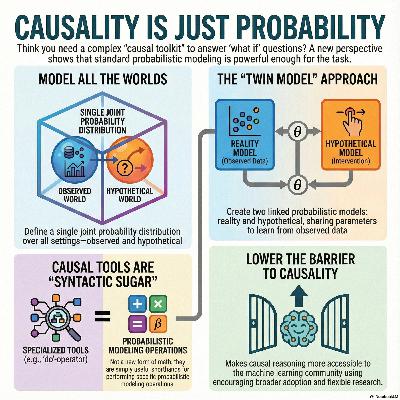
Position: Probabilistic Modelling is Sufficient for Causal Inference
Description
This paper argues that probabilistic modelling is sufficient for causal inference, challenging the belief that specialized causal notations like the "do-operator" are strictly necessary. By advocating for a "write down the probability of everything" approach, the authors demonstrate that interventional and counterfactual questions can be solved using standard **Bayesian Networks** and joint distributions. They reinterpret traditional causal tools, such as **Structural Causal Models**, as useful syntactic shorthands rather than distinct mathematical requirements. The text suggests that the perceived gap between statistics and causality stems from a **semantic confusion** that unnecessarily narrows the definition of statistical inference. Ultimately, the authors promote a **unified framework** where causal reasoning is treated as a flexible application of existing probabilistic principles.











 United States
