


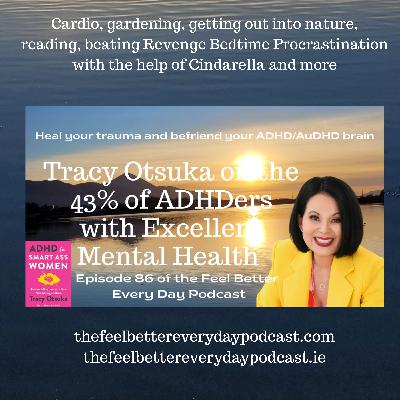
Tracy Otsuka on the 43% of ADHDers with Excellent Mental Health
Description
Welcome to the Feel Better Every Day Podcast! Today I’m thrilled to share my conversation with Tracy Otsuka, host of the ADHD for Smart Ass Women podcast and author of the book by the same name.
Get your free weekly journal prompts and more here
Tracy was one of the first voices I discovered on my own ADHD journey, and her strengths-based, neuro-affirming approach has been truly transformative. She’s a former lawyer who boldly celebrates the brilliance often overlooked in ADHD while being refreshingly honest about the challenges.
In this episode, we explore:
- Why ADHD is an identity problem, not just a productivity issue
- Exercise supporting and sometimes replacing medication for managing symptoms
- The power of finding your “sweet spot” where executive function challenges disappear
- Revenge Bedtime Procrastination and the most creative solution I’ve come across
- The 43% of ADHDers with excellent mental health that nobody talks about
Whether you’re newly diagnosed, long-time ADH or supporting someone who is, this conversation is full of practical wisdom and hope. Enjoy!
Chapters
0:00 – Introduction to Tracy Otsuka and her work
2:51 – Personal impact of Tracy’s podcast and book
4:02 – Finding Tracy and her programmes
4:41 – ADHD as an identity problem and building on strengths
5:46 – Ideal self-care practices
6:19 – Exercise and medication experiences
8:13 – Morning routines and dopamine
11:26 – Reading, hyperfocus, and slow dopamine
12:13 – Gardening, tapping, and somatic practices
13:12 – Sleep and managing bedtime resistance (Revenge Bedtime Procrastination)
15:20 – Strategies for easier evening routines
18:55 – Advice for younger self and understanding ADHD
21:07 – Self-expertise and navigating medications
23:42 – Following interests and creating meaningful work
24:51 – Music, piano, cello, and doing things your way
26:25 – Singing, family, and supporting creativity
27:29 – How you can find Tracy
FULL TRANSCRIPT
I can’t wait to introduce today’s guest. She’s someone who has helped me enormously on my own ADHD and now AuDHD journey. Hers was one of the first podcasts I found when I started going down that rabbit hole.
The very fantabulous Tracey Otsuka, host of the ADHD for Smart Ass Women podcast and author of the book ADHD for Smart Ass Women.
Her podcast is really working with the brilliance that is often overlooked with ADHD. She’s very bold, very dynamic, former lawyer, and really confident, honest about the challenges, honest about the disabling aspects, but really it’s probably one of the most strengths-based neuro-affirming approaches I’ve heard.
And I just love her guests. She is wanting to draw awareness to the 43% of ADHDers with excellent mental health. So I hope you enjoy our interview.
I’m really looking forward to talking to her. And I hope that without any kind of toxic positivity, without any negating of the struggles, you too will be able to own your challenges, know that you deserve support for your challenges and make space for your brilliance. Let me know what you think.
Welcome to Episode 85 of the Feel Better Every Day Podcast. Every Tuesday, I share new episodes helping trauma survivors, ADHDers and AuDHDers take better care of yourself, create a life you don’t need to retreat from, and help build a world in which everyone feels safe, welcome, and loved, able to thrive. So literally working with your nervous system, your energy, and it’s a very holistic approach.
You can subscribe if you haven’t already, and you’re very welcome to share. I do a lot of free content because I know not everyone can afford one-to-one work. I’ve got another group event coming up, and there’s always the Sole to Soul Circle.
But if you check out selfcarecoaching.net, there’s information about the book, more about the podcast, loads of free resources around different areas and conditions. And you can also visit the www.thefeelbettereverydaypodcast.com. I hope you enjoy today’s episode, and thank you for listening and watching whatever you’re choosing to do. So welcome, Tracy Otsuka.
I can’t believe I’m talking to you because you are such a huge influence on me befriending my own ADHD and now I understand AuDHD brain. This is the first time we’ve spoken, like we’ve just had a brief chat now, but I’ve listened to so many of your episodes, your book, and I recommend it to so many people. I mentioned it in the Irish Journal of Counselling and Psychotherapy, an article I did about late diagnosis, and I love your strengths-based approach.
I love that you don’t gloss over the challenges, like you’re human, we’re all human, but even the idea that, is it 43% of ADHD is experienced good mental health?
No, no, not good, not good. Excellent. Excellent mental health. And no one ever talks about that. Why have I never heard or read about this other than that one article? Actually, there’s a few articles on that one study.
Yeah, I absolutely love it. So I’m so grateful for your work. Where can people find you and what are you working on at the moment?
Probably the easiest place that they can find me is on our brand new app called AOK Mind, and you can find it in the App Store or Google Play.
Wonderful.
And there’s tons of free resources there, so a lot of the trainings that I’ve done over the years are in there.
You also have your patented programme. Do you want to mention that?
I do have my six-step patented programme. We call it Your ADHD Brain is AOK. I think my camera’s a little crooked. And so I don’t believe that ADHD is a productivity problem. I believe it is an identity problem. We’ve spent our entire life trying to be who they want us to be at the expense of figuring out who we really are. And so the reason why this is so important is if you can build that foundation of what is it exactly that you value? What’s truly important to you? What are the strengths that are just natural born? You can’t help but practice them. You’re practicing them now. What are the talents that you’ve built skills around and turned into superpowers? What of the many passions? Because that is one of our challenges. We have sparkly syndrome where we try this, we try that, we try little bit of this, then we go down here and try more of that. And so it can make us feel like we’re all over the place. And then of course, our purpose. So if you can figure out what that sweet spot is, that is your foundation and do work in that sweet spot.
You will have none, if not very, very few of the executive function challenges that you have in most other areas.
Yeah, wonderful. And if you were to think, because I know you’re a great proponent of the things that you talk about exercise and the things we can control, even when they might be more challenging, what would be your ideal self-care practices, both in terms of like basic self-care and that uppercase S, the highest, wisest, truest part in your spiritual practices, and also collective care? You’ve mentioned your group, but what would be your ideal? So my ideal and I try my, there’s certain things that are non-negotiables and you know, the number one for me is exercise. Unfortunately, and I know I have developed this reputation. I’m not sure how that I am against medication. I am not against medication at all. Are you kidding me? If I could use medication for the things that are difficult for me to get done, like anything to do with numbers or frankly, memorising anything, I would use medication in a heartbeat. It does not work for me, however. And so when things don’t work for you, you have to develop other workarounds.
And so I’m so appreciative that medication didn’t work for me because if it did, I may not have gone out and developed the other workaround. So what we know, number one, my number one strategy is OK. 20 minutes of exercise at 70% of your high heart rate studies have been done about this is as effective as a course of Adderall and Prozac. Even if you are taking medication, it is going to make your medication work better and there are no side effects. So I work out every morning. I used to work out in the evenings.
I’ve always worked out. There was something that my brain just knew I felt better. Um, so I’ve always worked out, but I used to work out in the evening.
And when I discovered that I had ADHD, I realised, OK, I need to change this up because I feel like my brain is like an airplane on a runway and I need to get it off the runway. And what gets it off the runway first thing in the morning is dopamine. That’s, you know, what’s going on with our brains.
We don’t know is that we make, we don’t make enough of it, or is it that we process it differently? They don’t know for 100% certainty what it is. And so I know I’ve got to get that dopamine up in the morning. And if I can do that, everything is better throughout the day.
The first thing I do is I literally get up. It was hard initially, but at this point I have trained my brain (neuroplasticity) to the point that I get up in the morning and I’m like a robot. I never thought in my head, I don’t want to do this. It’s cold. It’s, it’s just so odd, but I think it’s because I know this is my medication and if I don’t do it, I’m going to feel bad.
I would say it’s that, and then getting it out in nature. So I will do, we have two dogs, Teddy and Mo and I will take a walk with my husband. And then if I get up early enough, I really like to do some sort of reading in the morning rather than picking up my phone and scrolling, y




 United States
