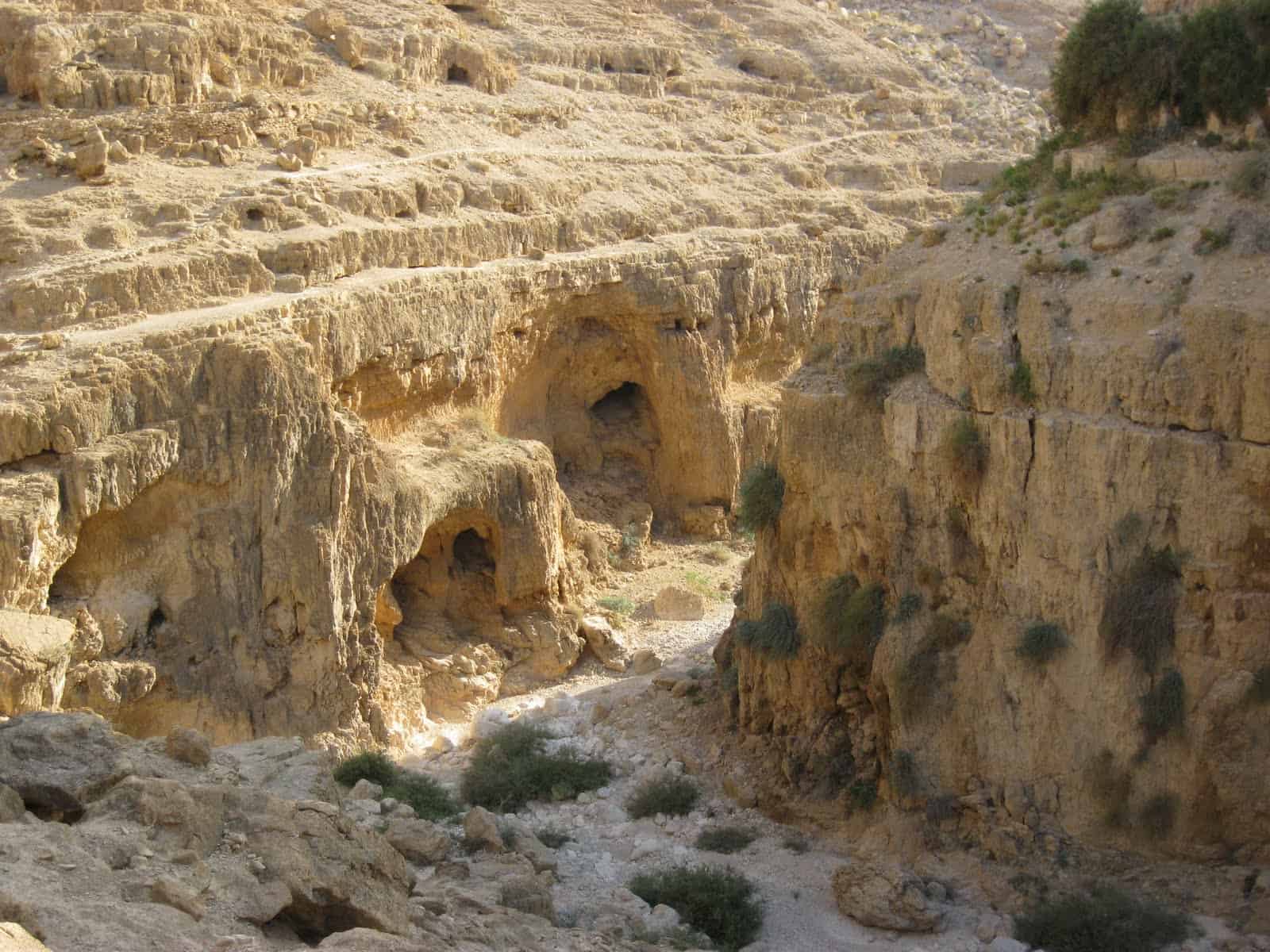
This week’s episode is titled “
Hermits.”A few episodes back when I introduced Athanasius, I mentioned the religious hermits he visited in the wilderness near Alexandria in Egypt, bringing them food. As a young man, Athanasius honored these men who'd forsaken the ease of city life to pursue an undistracted but difficult life of devotion to God.Who were these
hermits, and what moved them to such a radical departure from the lifestyle modeled by Jesus and the Apostles?While the theology of monks & monasteries evolved over many generations, its earliest foundation rested on the example of John the Baptist, the forerunner of Christ who was something of an
ascetic. His normal haunt was the Judean wilderness where it intersected the Jordan River. He wore a less than a fashion-conscious wardrobe and ate a strict organic diet grudgingly provided by the wilderness.The earliest hermits put great weight in Jesus's counsel to the rich young ruler to sell his possessions, giving it all to the poor, & following the Lord. They embraced the New Testament’s frequent idiom that the flesh is in a battle with the spirit & vice versa. They concluded flesh & spirit are irreconcilable. Hermits literally
renounced the world by leaving the cultured life of the city to live in a primitive setting in the wilderness. This lifestyle of deprivation and discomfort was regarded as the truest route to unhindered communion with God by the hermits and a growing number of their admirers.The first time we see a written expression of this emerging mindset is in
the Shepherd of Hermas about AD 140. This early Christian document defines a higher & lower route believers can take in their devotion to God. Faith, hope, & love are the
lower route required of
all Christians. But for those who aspire to
closer intimacy with God,
self-denial is required. This denial of the self took many forms with celibacy & renouncing marriage one of the more radical, yet popular.The practice of penance became common with believers moved to dramatic acts of charity and bravery in order to prove their devotion to God. When persecution was a frequent threat, Christians used penance as a way to
compensate for moments of weakness & fear. And of course, the martyrs were
luminous heroes even some
pagans admired! But with the
repeal of persecution, the Church needed
new heroes & found them in the hermits who engaged in extreme acts of self-denial.The earliest
monks were hermits; individuals who took refuge in the desert, hinting at where they got their start; in Egypt, where the desert is plentiful outside the fertile strip of land along the Nile. The word or
hermit comes from the Greek word for
desert.About AD 250, a 20-year-old named
Anthony took Jesus’ command to the rich young ruler to sell his possessions & follow him --
literally. Anthony sold everything & went to live in an abandoned tomb. Legends quickly grew up about his battles with temptation that took visible form in attacks by demons, seductive women, & wild beasts. Anthony emerged from each battle with a greater sense of devotion to God that inspired others to follow his ascetic example. Soon, hundreds made their way to the wilderness to pursue a life of rigid self-denial. Anthony was Athanasius’ favorite. Since Anthony lived to be over a hundred, he was alive when the future bishop of Alexandria was taking supplies to the desert monks. Athanasius wrote a biography of Anthony, which became widely popular. This book, more than any other factor helped boost the esteem & appeal of the hermetic life.
Monasticism grew apace with the new-found imperial favor under Constantine and his successors. It's not difficult understanding why the number of ascetics
jumped & monasticism became popular at the same time the Church & State were buddying up. Being a Christian was no longer dangerous, so the sincerity of many new members declined. When people realized belonging to a church was a social & political
plus, the sincerity factor dipped even further.
Genuine believers noted the sagging quality of faith among so many of the church’s fair-weather friends & chose responded by embracing
a more rigorous path. The
models of that era were the monks; those standout Christian heroes who’d attained an honor similar to that given the martyrs of the previous era-and hey! I don't have to get my head chopped off. Cool.So the monks of this time weren't so much
fleeing the world as they were
protesting a
worldly church.Part and parcel of the hermetic life was an isolated individualism that stands in contrast to the communal life modeled by Jesus and the Apostles and urged in the New Testament. You don’t have much of a
Body of Christ when it’s just one guy in a cave. Hermits found refuge in the wilderness an easy way to avoid the temptations of the
external world but what of the
far more dangerous inner temptations of the soul = things like pride & envy?The temptation to
pride is obvious. After all, it was easy for the desert ascetics who'd taken the supposed “
higher path” to consider themselves
better than others. But how could
envy be a problem when they lived alone? Well, they lived
alone but they had plenty of
visitors. Pilgrims made their way out to meet them and catch a few moments with those considered
living saints. As these pilgrims made the rounds of several hermits, they reported to each hermit the extreme acts of penance and piety
of the others. Not wanting to be outdone in a show of devotion, hermits endeavored to outdo each other. They went on extreme fasts, ate bizarre foods, lived in trees, on tops of pillars, & refused to bathe. As their acts became more bizarre, their fame grew & soon
thousands flocked to see them. One hermit named
Simon Stylites was so put out by the crowds who came to see him, he erected a pillar he lived on the top of for 30 years. People sent up food via a rope & basket.As with any extreme, it didn't take long before a calmer and more reasoned way challenged the decidedly non-biblical ultra-individualism of the desert hermits. About AD 320, someone remembered Genesis
2:18 à People shouldn’t be
alone. Hey, maybe these hermits we’ve made into living saints aren’t really hitting the mark after all.An ex-soldier named the
Pachomius formed the first
monastery. It was a place where Christians could pursue devotion to God in a
communal setting. Instead of each monk deciding for himself how to live and what to do, drawing on his experience as a soldier, Pachomius set rules for the community. All members wore the same uniform, engaged in similar manual labor, and kept the same schedule.While Pachomius’ monastery was the first we know of
for men, women
already had their own version of communal life. This had been necessary since women were
not allowed to be hermits. Their isolation would've made them a tempting target for criminals and brutes.
Nonnus is the feminine form of the word
monk so the women who pursued the communal life were called
nuns; their cloistered commune was a
convent.The monastic movement spread north out of Egypt into Syria, then West into Asia Minor which at that time was the most spiritually dynamic region of the Faith. Once monasteries took root in Asia Minor they spread rapidly across Europe.When Athanasius died in the Spring of 373, 3 bishops from Cappadocia in Asia Minor picked up and continued to carry the standard of loyalty to the Nicaean Creed. Basil, Gregory of Nazianzus, and Gregory of Nyssa. These 3 greatly promoted the monastic movement. Basil was especially important as he authored the
Rule of Discipline that framed monastic life for generations after and does to this day in the Eastern Orthodox Church.Throughout the 4
th & 5
th Centuries, monasticism gained popularity and infiltrated every level of society. The communal life of the monks re-infused the Church with a sense of purpose and a return to the piety that had marked the Church’s early years. Martyrdom was replaced by a whole-hearted devotion to God thru renouncing a career of worldly success in favor of one lived in the imitation of Christ. In order to obtain this ideal within the context of communal life, monks took vows of
obedience, poverty, &
chastity. These were attempts to limit the battle-line of temptation and sin by renouncing possessions, self-will, & the sexual urge. Monasteries helped put an end to the problems common to the earlier hermits: idle








 United States
