


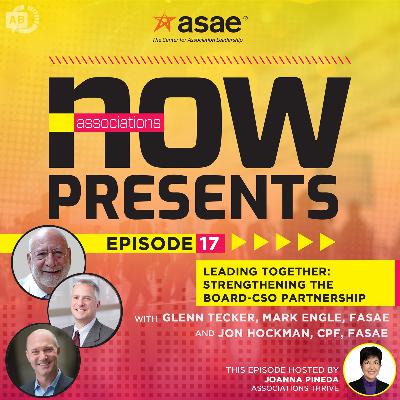
Leading Together: Strengthening the Board-CSO Partnership
Description
In this episode of Associations NOW Presents, guest host Joanna Pineda speaks with governance experts Glenn Tecker, Mark Engle, DM FASAE, and Jon Hockman, CPF, FASAE about the essential partnership between the board and chief staff officers (CSOs). Together, they break down how these roles differ, why their relationship is inherently interdependent, and how expectations shift across different types of associations. The conversation explores the competencies leaders need today, the role of trust and communication, and how associations can navigate rapid change—from the disruptions of COVID-19 to the growing impact of AI. The guests also offer practical strategies for fostering strong board–executive dynamics and close with reflections on what they hope to achieve personally and professionally in 2026.
Check out the video podcast here:
Associations NOW Presents is produced by Association Briefings.
Transcript
Joanna Pineda: [00:00:00 ] Welcome to this month's episode of Associations NOW Presents, an original podcast series from the American Society of Association Executives. I'm Joanna Pineda, CEO, and Chief Troublemaker at Matrix Group International, a digital agency to associations. I'm also host of the podcast Associations Thrive.
Today we are excited to welcome Glenn Tecker, founder of Tecker International, Mark Engle, principal at Association Management Center, and Jon Hockman, chief practice officer at McKinley Advisors. Our topic today is the imperative of a healthy relationship between the chief volunteer officer and the chief staff officer.
Gentlemen, welcome to the show. To make sure that we are all on the same page, I'm gonna ask you all this question. Who are the chief volunteer officers and the chief staff officers? Glenn, maybe you [00:01:00 ] can define that for us.
Glenn Tecker: The chief staff officer is the paid individual who is responsible for overall leadership and direction of the organization.
The chief elected officer often goes by a variety of different names. A board chair, sometimes they're called president, sometimes they are called chief mucky muck. It really depends upon the history and the culture of the organization. Similarly, the titles of chief staff executive can change depending upon the history of the organization as well.
Sometimes they're called executive director, sometimes chief executive Officer, sometimes president, oftentimes President, and CEO. So depending upon the history of the organization and the model of nomenclature, it's using the terms and the credentials can be different.
Joanna Pineda: Okay, so how would you describe the relationship between [00:02:00 ] the chief staff officer and the chief volunteer officer?
What should be the relationship?
Glenn Tecker: It's based upon the expectations that member leadership has for the relationship with their chief staff executive. There are subtle but real differences. The expectations that the volunteer leaders of trade associations have for their chief staff executive versus the expectations that the volunteer leaders of professional societies have for their chief staff executives.
Again versus, or different than the expectations that the volunteer leaders of cause related or philanthropic organizations have for their CEO. So there really is no one who earns that. You can put all of the answers to the question you've asked into
Joanna Pineda: John. Maybe you can explain how are the expectations different between say, a professional society or a [00:03:00 ] trade association.
Jon Hockman, CPF, FASAE: The depiction that I would bring forward here. The pair between the chief staff and chief volunteer is the epicenter of leadership in the organization. Not exclusively, but it's the epicenter. And I think of it as a Venn diagram where those two roles have distinct responsibilities, but there's also places where they overlap.
And we oftentimes talk about the metaphor of a bicycle. And the front wheel is where you set direction. And the back wheel is where the chain connects and powers the board chair, the volunteers at that front wheel. With the board setting course for the organization, the CEO, the staff committees, all the other ways that members are organized sit at that back wheel and power things forward.
And so those are just very different roles, but they're obviously symbiotic to make it work.
Joanna Pineda: Mark, if I'm running say a charity, a nonprofit, maybe a disease related organization versus A CEO, who's running a trade association, are the expectations different of my role and of the relationship. [00:04:00 ]
Mark Engle, DM FASAE: I think the expectations are different, but they're based in competencies, and the competencies in those two areas are very different.
The trade association execs are often a public face, so I was CEO of several trade associations. Actually, when we went to the Hill, we were leading the charges. The chief staff executive, I was, my title was president. We had a board chair, and they were the backup because they did not want to be on display for their companies necessarily.
As for the industry. Whereas for a professional society, it's almost the reverse element of it where the CEO is the one who's putting in place the right ambassadors to represent the organization. So the competencies are aligned very differently on that basis. And again, with philanthropic organizations or public organizations that are out there raising money or trying to combat disease, for instance, they're trying to open doors, they're trying to support financially.
The organization and moving it forward. So the competencies are [00:05:00 ] very different from what you're looking for a CEO in those VAs.
Joanna Pineda: Wow. Our topic today is the imperative of a healthy relationship, so why the word imperative?
Glenn Tecker: There's probably nothing more germane to the continuing success of a CEO than the relationship they have with their board of directors.
That relationship in large measure is a model of the relationship that the chief staff executive and chief volunteer officer or chief elected officer has. It becomes the model of how the two will work together. What we have found over time is the successful relationships tend to be defined by a subtle but real understanding.
That is that on the complex and often controversial issues that boards and [00:06:00 ] senior staff will face together, it's critical to understand which body of knowledge needs to be the primary driver of the selection of the solution strategy. If the body of knowledge is that's held by members who are sitting on the board, then staff needs to defer to the view of the members on the board.
If the body of knowledge that's essential is the body of knowledge held by the staff in association management, then board members need to defer to the opinions and expertise of the staff. Asking the question, which expertise is needed for us to make a confident decision is probably the best start that you can had to sustaining that relationship over time.
Mark and John will both agree. I am sure. That the relationship between a board and the CEO is as much [00:07:00 ] a personality that differs from combination to combination as it is in fact based upon a set of dispensable competencies that both the staff leader and the elected leader need to exhibit in their work together.
Jon Hockman, CPF, FASAE: Yeah. If I could just build on Glen's point. Completely agree. As he predicted, and. If the culture of the organization is such that supports that sort of recognition that the body of knowledge sits at the board, that's where we go. If the body of knowledge sits at the staff, that's where we go. The core culture supports that.
Great. Often it doesn't, and that's where things break down or get mucky, is navigating the way through that. It could be really a wild ride.
Joanna Pineda: Can we go a little bit deeper with this?
Jon Hockman, CPF, FASAE: Of course.
Joanna Pineda: I was on Facebook recently in one of the discussion groups where a lot of association execs hang out and somebody said, I'm in hell right now because my board chair is [00:08:00 ] micromanaging everything.
That sounds like a situation where maybe the chief staff exec is thinking, this is my domain. The staff have knowledge here, but the board chair is causing trouble, if you will. How do you set the expectation about whose domain should be respected in what situations? Like the choice of an annual convention venue versus a position that you're gonna take on a government policy, for example.
Mark Engle, DM FASAE: We try to move it through a policy base, if you will, so things like routine items, and I know conventions are important and people have a lot of emotion tied up into where that goes. If you can put that into a policy format, it reduces the effect development making a decision on that basis. And that really then becomes more staff driven if the board sets the parameters for it.
So providing that clarity is helping define the line between board role and staff role. And that's where it comes down to the competencies. The staff has the competencies to [00:09:00 ] determine the profitability and the aims of that. Conference, if you will. If it's framed at the board level, then they don't have to get in that decision making loop every time and make what becomes an emotional decision.
Joanna Pineda: Is that something that you teach your clients, for example, to ask the question, who's got the knowledge to be able to answer this question or provide guidance





 United States
