


Don Juan's Most Beautiful Love
Description
The Elephant Island Chronicles
Presents
Don Juan's Most Beautiful Love
By Jules Barbey d'Aurevilly
Translated by Gio Marron
Translation Note
This translation of Jules Barbey d'Aurevilly's "Le plus bel amour de Don Juan" represents a collaborative effort between myself, Gio Marron, with assistance from AI language models including Claude, ChatGPT, and Perplexity.
The translation process involved multiple iterations, with initial drafts produced through AI assistance, followed by substantial literary refinement to capture the nuanced tone, style, and period-appropriate language of Barbey d'Aurevilly's distinctive prose. As primary translator, I focused on preserving the original's ornate, decadent literary style while ensuring readability for contemporary English-speaking audiences.
Special attention was given to maintaining the psychological complexity and subtle irony that characterize Barbey d'Aurevilly's work, particularly the supernatural elements that transform this tale from a conventional seduction narrative into something more metaphysical and profound.
The translation aims to serve both general readers interested in 19th-century French literature and scholarly audiences familiar with the Decadent movement and the evolution of the Don Juan archetype in European literary tradition.
Gio Marron May 2025
Don Juan's Most Beautiful Love
By Jules Barbey d'Aurevilly
In this masterpiece of psychological insight and irony, Jules Barbey d'Aurevilly transforms the Don Juan legend into a tale of supernatural suggestion. When a aging seducer recounts his "most beautiful love" to a circle of aristocratic women, the revelation subverts all expectations—proving that the most powerful conquests happen in the realm of imagination rather than the bedchamber. A brilliant exploration of innocence, corruption, and the mystical dimensions of desire from one of 19th-century France's most provocative writers.
I
The devil's finest delicacy is an innocence. (A.)
So he still lives, that old scoundrel?
"By God, indeed he lives! — and by God's decree, Madame," I added, checking myself, for I remembered she was devout, and from the parish of Sainte-Clotilde no less—the parish of dukes! "The king is dead! Long live the king!" they used to say under the old monarchy before it shattered like Sèvres porcelain. Don Juan, democracy be damned, remains a monarch who will never be broken.
"Indeed, the devil is immortal!" she remarked, as if confirming something to herself.
"He has even—"
"Who? The devil?"
"No, Don Juan... supped, three days ago, in high spirits. Guess where?"
"At your dreadful Maison-d'Or, no doubt."
"Fie, Madame! Don Juan no longer goes there... nothing there to fricassee for his grandeur. Lord Don Juan has always been somewhat like that famous monk of Arnaud de Brescia who, according to the Chronicles, lived solely on the blood of souls. That's what he likes to tint his champagne with—and such fare hasn't been found in courtesans' cabarets for quite some time!"
"I suppose," she resumed with irony, "he must have supped at the Benedictine convent with those ladies..."
"Of Perpetual Adoration, yes, Madame! For the adoration that devil of a man once inspired seems to me to last in perpetuity."
"For a Catholic, I find you rather profane," she said slowly, though visibly tense, "and I ask you to spare me the details of your harlots' suppers, if speaking of Don Juan tonight is merely your invented way of reporting on their activities."
"I'm inventing nothing, Madame. The harlots of the supper in question, if harlots they are, aren't mine... regrettably..."
"Enough, Monsieur!"
"Allow me to be modest. They were—"
"The mille e tre?" she asked, curiosity rekindling her almost-amicable manner.
"Oh! not all of them, Madame... Only a dozen. That's already quite respectable..."
"And disreputable too," she added.
"Besides, you know as well as I that not many can fit into Countess de Chiffrevas's boudoir. Grand things may have transpired there, but the boudoir itself is decidedly small..."
"What?" she exclaimed, surprised. "So it was in the boudoir that they supped?"
"Yes, Madame, in the boudoir. And why not? Men dine on battlefields. They wanted to give an extraordinary supper to Lord Don Juan, and it was worthier of him to offer it in the theater of his glory, where memories bloom in place of orange trees. A lovely notion, tender and melancholic! It wasn't the victims' ball; it was their supper."
"And Don Juan?" she asked, as Orgon says "And Tartuffe?" in the play.
"Don Juan received the affair splendidly and supped magnificently,
He, alone, before them all!
in the person of someone you know... none other than Count Jules-Amédée-Hector de Ravila de Ravilès."
"Him! He is indeed Don Juan," she said.
And, though she had outgrown the age of reverie, this sharp-beaked, sharp-clawed devotee began to dream of Count Jules-Amédée-Hector—of that man of the Juan bloodline—that ancient, eternal Juan lineage, to whom God has not given the world, but has permitted the devil to bestow it upon him.
II
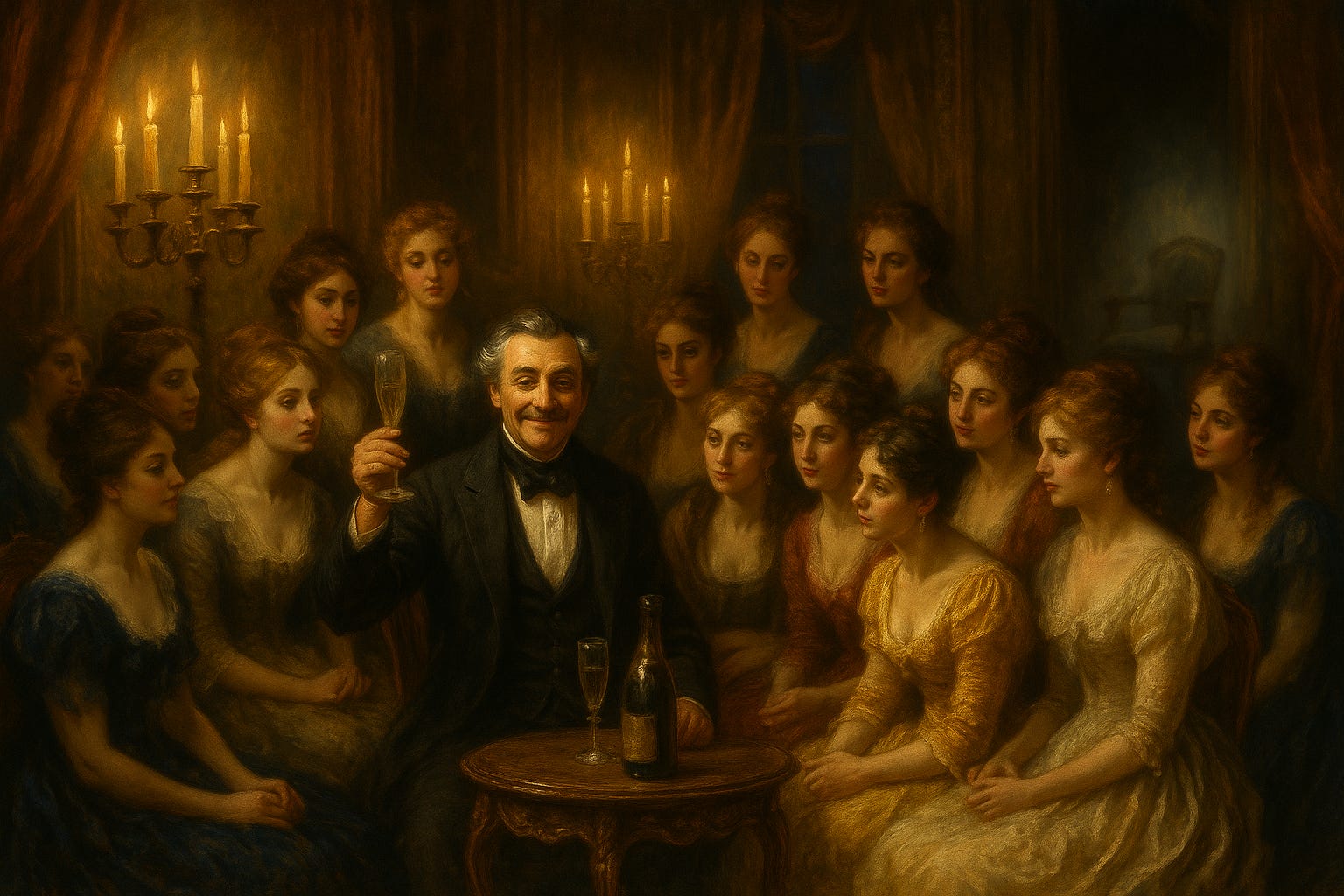
What I had just told the old lady was the unvarnished truth. Barely three days had passed since a dozen women of the virtuous Faubourg Saint-Germain (rest assured, I shall not name them!) who, all twelve, according to the dowagers' gossip, had been on the most intimate terms (a charming old expression) with Count Ravila de Ravilès, had conceived the singular idea of offering him supper—with him as the only man—to celebrate... what? They didn't say. Such a supper was bold, but women, cowardly individually, are audacious in groups. Perhaps not one of this feminine banquet would have dared to offer it at her home, tête-à-tête, to Count Jules-Amédée-Hector; but together, bolstering one another, they had not feared to form the chain of Mesmer's tub around this magnetic and compromising man, Count de Ravila de Ravilès...
"What a name!"
"A providential name, Madame... Count de Ravila de Ravilès, who, incidentally, had always obeyed the imperatives of this commanding name, was indeed the incarnation of all seducers spoken of in novels and history. Even the Marquise Guy de Ruy—that discontented old woman with cold, sharp blue eyes, though less cold than her heart and less sharp than her wit—herself admitted that in these times, when the woman question daily loses importance, if anyone could recall Don Juan, surely it was he! Unfortunately, it was Don Juan in the fifth act. Prince de Ligne could never comprehend how Alcibiades might reach fifty. Yet in this respect too, Count de Ravila would forever remain Alcibiades. Like d'Orsay, that dandy carved from Michelangelo's bronze who remained handsome until his final hour, Ravila possessed that beauty peculiar to the Juan race—that mysterious lineage which proceeds not from father to son like others, but which appears sporadically, at certain intervals, among humanity's families.
It was true beauty—insolent, joyful, imperial, Juanesque beauty; the word says everything and dispenses with description. And—had he made a pact with the devil?—he retained it still... Only, God was exacting his due; life's tiger claws were beginning to score his divine brow, crowned with the roses of so many lips, and on his broad impious temples appeared the first white hairs announcing the approaching barbarian invasion and the Empire's end... He wore these, moreover, with the impassivity of pride intensified by power; but the women who had loved him sometimes regarded them with melancholy. Who knows? Perhaps they were reading the hour striking for themselves upon that brow. Alas, for them as for him, it was the hour of that terrible supper with the cold Commander of white marble, after which comes only hell—the hell of old age, until the real one arrives! And that is perhaps why, before sharing this bitter and final supper with him, they thought to offer him theirs, crafting it into a masterpiece.
Yes, a masterpiece of taste, delicacy, patrician luxury, refinement, and exquisite conception; the most charming, delicious, dainty, intoxicating, and above all most original of suppers. Original! Consider—usually joy and the thirst for amusement inspire a supper; but here, it was memory, regret, almost despair—though despair in evening dress, concealed beneath smiles or laughter, still craving this final feast or folly, this last escapade toward youth returned for an hour, this final intoxication before bidding it farewell forever!
The Amphitryonesses of this incredible supper, so incongruous with the trembling customs of their society, must have experienced something akin to Sardanapalus on his pyre, when he heaped upon it his women, slaves, horses, jewels—all his life's opulence to perish with him. They too heaped at this burning supper all their own opulence, bringing everything they possessed of beauty, wit, resources, adornment, and power, to pour it all, at once, into this supreme conflagration.
The man before whom they draped themselves in this final flame meant more to their eyes than all Asia did to Sardanapalus. They were coquettish for him as no women had ever been for any man—let alone for one seated among twelve—and this coquetry they inflamed with that jealousy normally hidden in society, yet which they needn't conceal, for they all knew this man had belonged to each of them, and shame shared is shame dispelled... Among them all, each competed to engrave her epitaph deepest in his heart.
He, that night, savored the satiated, sovereign, nonchalant, connoisseur's voluptuousness of both the nuns' confesso












 United States
