


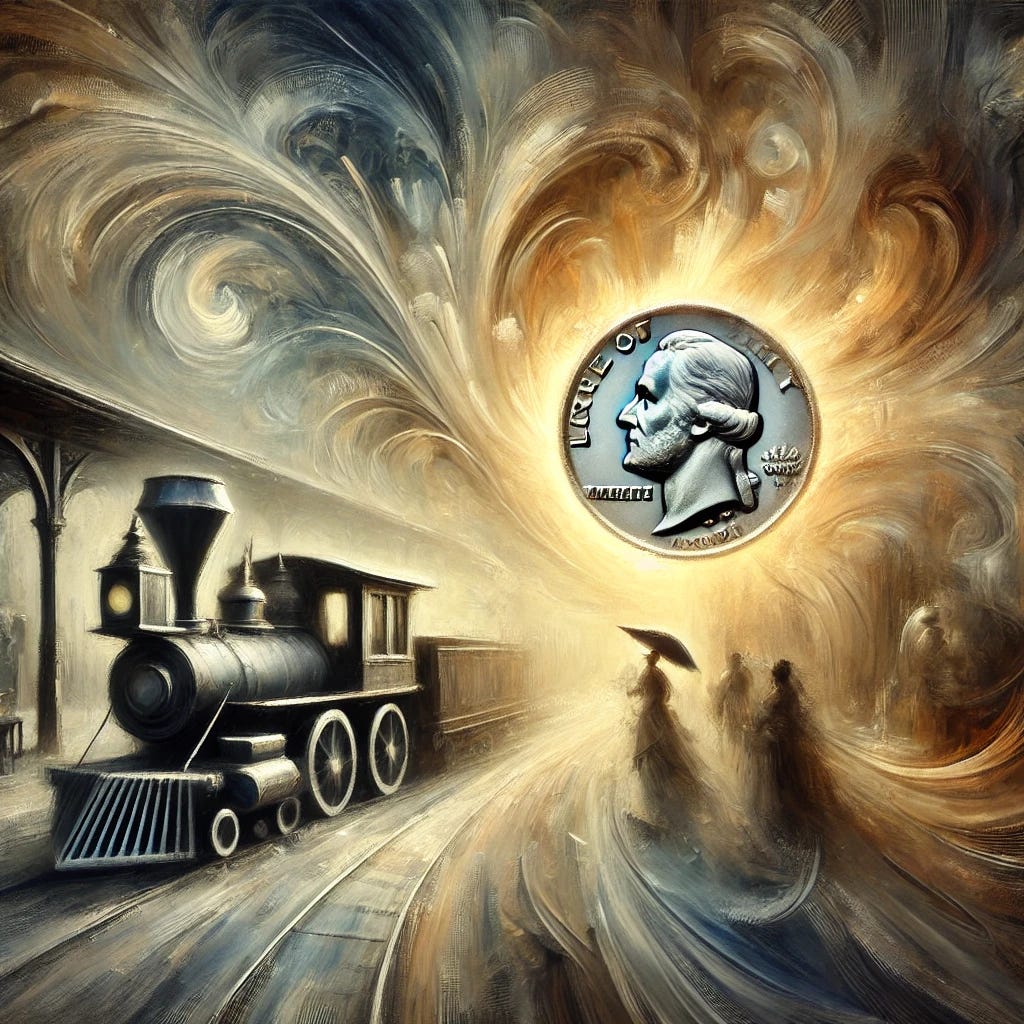
The Red-Hot Dollar
Description
The Elephant Island Chronicles
Presents
THE RED-HOT DOLLAR
By H. D. UMBSTAETTER
Narration by Eleven Labs
Foreword by Gio Marron
When The Red-Hot Dollar first appeared in the pages of The Black Cat magazine in October 1895, it captured readers' imaginations with its unique blend of humor, intrigue, and social commentary. Written by H. D. Umbstaetter, a pioneer of popular short fiction, this story exemplifies the era's fascination with everyday mysteries and their potential to unravel extraordinary truths. In it, a simple silver dollar, by design and defect, becomes the linchpin of a high-stakes narrative involving chance, persistence, and justice.
Set against the backdrop of a rapidly modernizing late 19th-century America, The Red-Hot Dollar reflects a time when the nation's currency system was still evolving, and fears of counterfeiting were both real and pervasive. Umbstaetter masterfully taps into these anxieties, using the counterfeit coin not merely as a plot device but as a symbol of the period's larger concerns about integrity, trust, and the price of deception.
The story also reveals much about the author’s style and his magazine’s mission to deliver stories that were, as the editor put it, "worth telling." Umbstaetter's pacing and sharp observations keep the reader engaged, while his wit ensures the tale is both entertaining and thought-provoking. Through the character of Ansel Hobart, we are reminded that even the smallest, most seemingly insignificant objects can hold the key to unraveling much larger mysteries.
More than a century later, The Red-Hot Dollar still resonates, not just as a clever piece of detective fiction but as a window into the values and concerns of its time. As you read, consider how the story intertwines human curiosity, moral choices, and the inexorable pull of fate. It remains a testament to how great storytelling can make even the most ordinary of objects extraordinary.
H. D. Umbstaetter invites us into a world where chance meetings and sharp minds collide, crafting a narrative that feels as fresh and relevant today as it did over a hundred years ago. May this tale and the enigmatic coin at its center remind you that sometimes, the most unexpected paths lead to the most remarkable destinations.
Gio
THE RED-HOT DOLLAR
By H. D. UMBSTAETTER
It lacked three minutes of five by the big clock in the tower when the east-bound Chicago express rumbled into the station at Buffalo. The train had not yet come to a standstill when a hatless man jumped from the platform of the rear sleeping-car and ran across the tracks into the depot restaurant. A few minutes later he reappeared, carrying a cup of coffee in one hand and a small paper bag in the other.
With these he hurriedly made his way back to the car through a straggling procession of drowsy tourists, who were taking advantage of the train's five minutes' stop to breathe the crisp morning air. The last of these had already resumed his seat when the man without a hat again appeared at the lunch counter, returned the borrowed dishes, and ordered coffee for himself. He had just picked up the cup and was raising it to his lips when the conductor's "All aboard" rang through the station.
Leaving the coffee untouched, he thrust a five-dollar bill at the attendant, grabbed his change, and started in pursuit of the moving train. He had almost reached it when an unlucky stumble sent the coins in his hand rolling in all directions along the floor. Quickly recovering himself and paying no heed to his loss, he redoubled his efforts, and, though losing ground at every step, kept up the hopeless chase to the end of the station. There he stopped, panting for breath. The slip had proved fatal. He had missed the train!
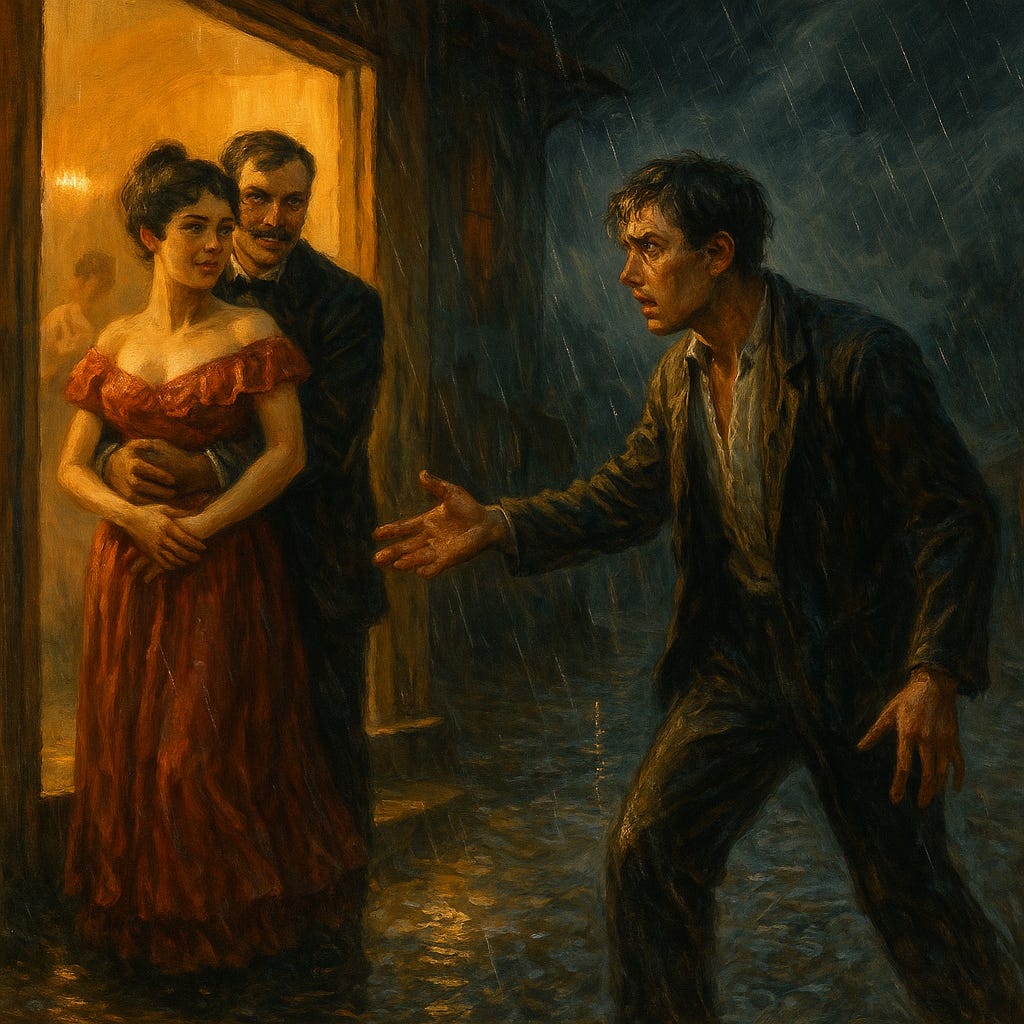
As he stood staring wildly through the clouds of dust that rose from the track, a young woman, evidently deeply agitated, suddenly appeared in the doorway of the vanishing car. Upon seeing him, she made frantic attempts to leap from the platform, when she was seized by a man and pulled back into the car. When the door had closed upon the two the bareheaded man in the station faced about and philosophically muttered:—
"It's fate!"
Then, after pausing a few moments, as if to collect his thoughts, he slowly retraced his steps to the scene of his mishap and began calmly searching for his lost change. Circling closely about, his eyes scanning the floor, he succeeded in recovering first one and then another of the missing coins, until finally, after repeated rounds, he lacked only one dollar of the whole amount. At this point he paused, clinked the recovered coins in his hand, looked at his watch, and then started on a final round. As this failed to reveal the missing piece, he gave up the search, transferred the contents of his hands to his trousers' pocket, and started in the direction of the telegraph office.
He had proceeded perhaps twenty paces when it occurred to him to turn about and cast one more look along the floor. As he did so his eye fell upon a shining object lodged in an opening between the rail and planked floor, a few feet from where he stood. He stooped to examine it, and, seeing that it was the missing coin, reached for it, but found the opening too narrow to admit his fingers. He tried to recover the piece with his pocket-knife, and, failing in this attempt, took his lead-pencil, with which, after repeated attempts, he succeeded in tossing it upon the floor.
With an air of subdued satisfaction, he walked away, and was about to convey the coin to his pocket when a sudden impulse led him to examine it. Holding it up before his eyes, he stopped, scrutinized every detail, and as he turned it over and over the puzzled look on his face changed to one of rigid astonishment. For fully a minute he stood as if transfixed; then, rousing himself and looking anxiously about as if to see if any one had observed him, he hurried to the cashier's desk in the restaurant, and, producing the bright silver dollar, asked the girl if she happened to remember from whom she received it.
She didn't remember, but would exchange it for another, she said, if he wished. Politely declining the offer and apologizing for having troubled her, he said that, as the coin he held in his hand was separating a loving wife from her husband, he wished very much to find some trace of its former owner. The girl looked up, thought for a moment, then, pulling out the cash drawer, and examining its contents, said she might have received it from the conductor of the Lake Shore express which had left for Cleveland at 3.15. She now recalled that when she came on duty at midnight there was no silver dollar among the change in the cash drawer, and that the only one she remembered receiving was from Sleeping-Car Conductor Parkins.
The man thanked her and hastened to the telegraph office, where he sent this message:—
"Conductor, East Bound Chicago Express,Utica, N. Y.
"Please ask lady in section seven of sleeping-car Catawba to await her husband at Delavan House, Albany.
"A. J. Hobart."
After requesting the operator to kindly rush the despatch, he proceeded to the ticket office, procured a seat in the 5.45 fast mail for Cleveland, and, with his hand clutching the coin in his pocket and his eyes fixed upon the floor, meditatively paced up and down the platform, waiting for the train to arrive.
As he did so he was disconcerted to find himself the object of wide-spread curiosity; even the newsboys with the morning papers favored him with an inquiring stare as they passed. Wondering what was amiss, he suddenly put his hand to his head, which furnished an instant explanation. He was hatless.
Looking at the big clock, he saw that it lacked ten minutes of train time, and, hastily crossing over to the farther track, he disappeared through the west end of the station.
Among the passengers who boarded the 5.45 fast mail for Cleveland when it thundered into the station, ten minutes later, was the bareheaded gentleman of a few minutes ago, now wearing a stylish derby. Once in the train, he settled himself in his seat with a sigh of relief and satisfaction. Not until then did the really remarkable character of the situation dawn upon him. On the very day which he had hailed as one of the happiest of his life he was traveling at the rate of about sixty miles an hour away from the girl he loved devotedly and to whom he had been married just seventeen hours. A queer opening of his honeymoon! In his anxiety to get a cup of coffee for his wife, he had lost his hat, then lost his change, and, lastly, lost the train.
Why did he not follow his bride at once? What mysterious spell had come upon this seventeen-hour bridegroom that he should fly from her as swiftly as the fast express could carry him? His hand held the solution of the problem—simple, yet unexplainable—a silver dollar! It held the secret he must unravel before he could return to her; it was not then that he loved her less, but that this bit of precious metal had suddenly developed an occult power that had turned their paths, for the present, in opposite directions.
At the first stopping place he sent another message, which read as follows:—
"Mrs. A. J. Hobart, Delavan House,Albany, N. Y.
"Cannot possibly reach Albany before to-morrow morning.
"Ansel."
With his brain filled with excited thoughts, the young man entered the sleeping-car office at Cleveland four hours later and asked for Conductor Parkins. He was told that this official would not be on duty before night, though possibly he might be at his home on St. Clair Street.
To the address given him the indefatigable young man repaired at once, and found the genial gentleman for whom he sought breakfasting with his family. He kindly gave audience
















 United States
