


Three Miles Out
Description
Three Miles OutBy Gio Marron
Voice-over provided by Eleven Labs
The Ship
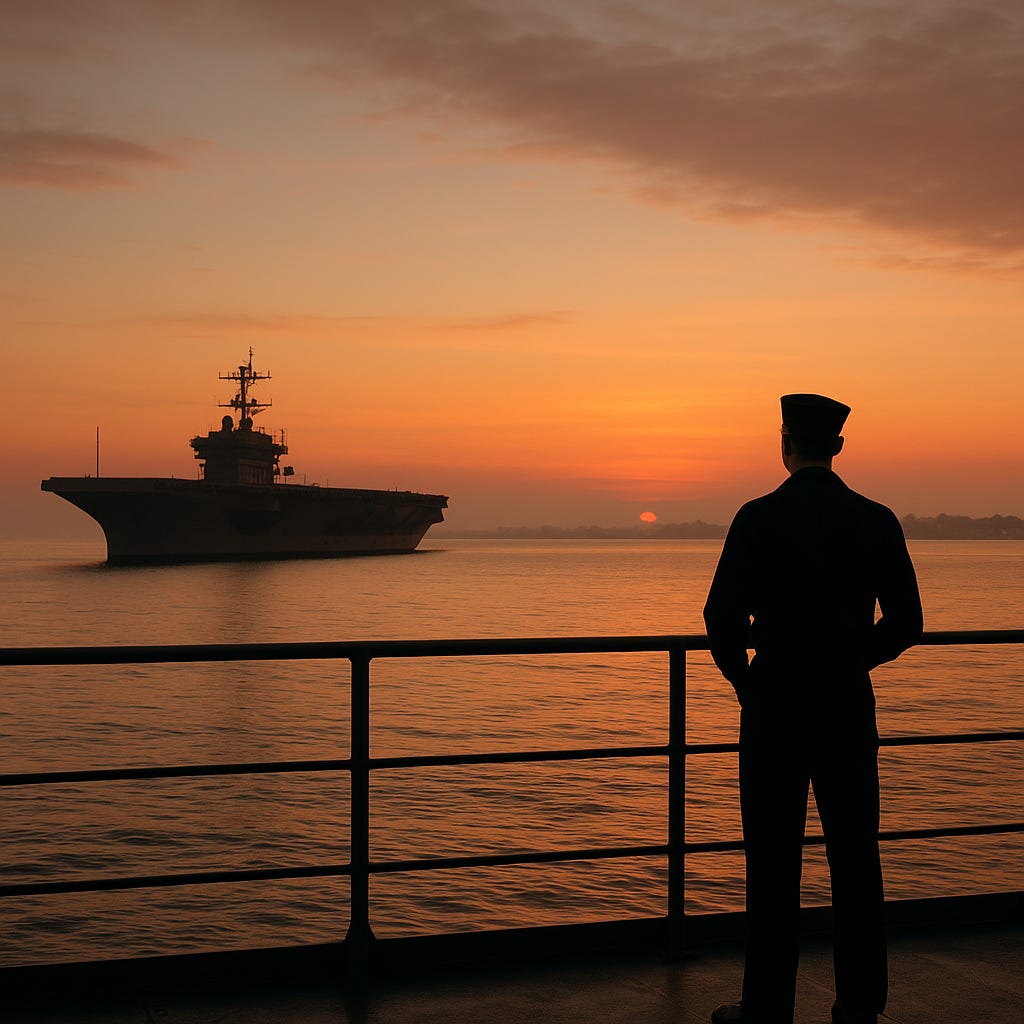
The USS Theodore Roosevelt dropped anchor three miles off the coast of Virginia, hull cutting a stark silhouette against the dawn sky. Not far enough to forget land, not close enough to touch it. Virginia Beach shimmered on the horizon like a mirage—real, but out of reach. Petty Officer Third Class Michael Reese stood motionless at the port side rail, the salt-heavy air filling his lungs after months of desert sand.
The Hopeful Voice: He stood at the rail in the pale light of early morning, watching the coastline sharpen as the day began. Home. Not metaphorical—actual, American home. The scent of boardwalk fries and saltwater taffy seemed to drift across the water. That was the moment. The crossing back. Six months of carrier ops in the Persian Gulf dissolved into this single point of return. He'd made it. The war was behind him now, three miles of calm water separating then from now.
The Realist Voice: No, it wasn't a return. It was a holding pattern. A bureaucratic pause designed by people who'd never had to wait. Like someone put a bookmark in his life and forgot to come back to it. The ship hung in the water like a question with no answer—not there, not here. Just suspended. The land looked almost painted onto the horizon, unreal and mocking.
He counted jet skis, speedboats, gulls. Anything that moved. Everything moved—except the ship. Fifteen jet skis. Twenty-three gulls. Four fishing boats. He counted because counting was control, and control was all he had left.
"Hey, Reese," someone called behind him. Collins approached, that familiar half-smile on his face. "Beautiful view, right? Almost like we're home."
"Almost," Reese replied, the word hollow.
Collins leaned against the rail. "I could make that swim," he said, nodding toward shore. "Bet you fifty I could make that swim."
"Save your money, Collins." Reese managed a short laugh but it wasn't funny. Nothing about being stuck in sight of home was funny.
The Hopeful Voice: He imagined the swim. Not as escape—but arrival. A baptism, almost. A way to feel the distance with his body instead of pretending it didn't matter. He'd done tougher swims in training. Three miles was nothing compared to what he'd already accomplished. He'd cut through the water, each stroke carrying him closer to solid ground, to reality, to a life where the horizon didn't always hide threats.
The Realist Voice: He imagined the swim because it was the only way he could believe he'd ever reach shore. The Navy had brought him to war and nearly brought him back—but not all the way. Three miles might as well have been three hundred. The water between ship and shore wasn't just water—it was time, it was protocol, it was everything that separated what he'd become from what he'd been. And nobody was building a bridge across that gap.
The Hopeful Voice: Of course they'd notice if he tried. You don't just slip off a carrier unnoticed. The watch would spot him. They'd probably laugh, understand the impulse. Maybe even cheer him on a little before fishing him out. The guys in his division would never let him hear the end of it— "Remember when Reese tried to swim home?"—but it would be a good story. Something to tell at reunions.
The Realist Voice: But would they stop him? Or would they just watch, the way everyone watches everything out here—with detached professional interest, marking coordinates, reporting position, never actually engaging. He knew the regs better than most. Man overboard. Full stop. Retrieval protocols. But he wondered sometimes if anyone would really care beyond the paperwork it would generate.
He stayed there a long time, gripping the rail like it held him to the world, the metal warm under his palms. He told himself he was just watching the coastline wake up. He told himself he wasn't angry. He told himself a lot of things.
The Hopeful Voice: He'd come back changed. Everyone says that about deployment. But really—he'd just come back aware. Aware of the absurdity of time and distance. Aware of how much he'd taken for granted before. Aware of the nearness of things, and how unreachable they could still be. It was a good kind of awareness—the kind that made you appreciate small moments. The kind that would make civilian coffee taste better, civilian beds feel softer.
The Realist Voice: He came back knowing the war would always arrive faster than the welcome. That's what they didn't tell you in the recruitment office or the deployment briefs. They talked about readjustment periods and decompression time. They didn't mention the way the world splits into before and after, or how sometimes you get stuck in the space between, watching both sides from a distance. They didn't tell you that coming home was its own kind of deployment—uncertain, dangerous in ways you couldn't prepare for.
Pier, No Trumpets
They finally brought the ship in two days later. Norfolk Naval Station, Pier 12 North. The gangway lowered with the usual hydraulics and yelling, nothing ceremonial about it. The Chief bellowing orders. Sailors in dress whites scrambling to make fast the lines. It was bright, stupidly bright. Concrete and sea spray and sun in his eyes. And people—God, so many people crowded against the barriers, a wall of color and noise after months of khaki and steel.
The Hopeful Voice: They came for their sons, husbands, brothers, and fathers. The crowd waited like something sacred was about to happen. Balloons twisted in the breeze. Camcorders catching every moment. Some of the signs had glitter on them, sparkling in the morning light—"Welcome Home Daddy," "My Hero Returns," "Finally Complete Again." People whooped when the first sailors hit the pier, a sound of pure joy that seemed to lift everyone higher. This was what homecoming looked like. This was the moment they'd all dreamed about during midnight watches and long deployments.
The Realist Voice: Not for him. There was no sign. No one waiting. Just a wall of other people's joy that he had to navigate through, shoulders squared, eyes forward. He scanned the crowd anyway. Some reflex you can't turn off, like checking corners when you enter a room or counting exits in a restaurant. But there was nothing to find. No familiar face in the sea of strangers celebrating reunions that weren't his.
"Heading straight out, Reese?" Lieutenant Jameson stopped beside him, sea bag in hand.
"Yes, sir. Flight leaves in three hours."
The Lieutenant nodded. "Good deployment, Reese. Get some real rest."
"Thank you, sir." The brief exchange felt both normal and strange—like speaking a language he was rapidly forgetting.
He adjusted his cover, slung his sea bag over his shoulder, and walked. One foot after another. Move tactically through the minefield of embracing couples and crying children. Don't make eye contact. Don't get caught in someone else's moment.
The Hopeful Voice: He was tired, yes. But not broken. He'd done his part—six months of catapult launches, mine watches, midnights in full gear for drills that always felt a little too real. One hundred and twelve days without setting foot on solid ground. He didn't need a parade. Just a cab and a bed and maybe a beer that hadn't been stored in a ship's hold. He'd earned that much, at least. And there was something dignified about walking off alone, handling his own homecoming in his own way.
The Realist Voice: He needed something. Someone to say, "There you are." Someone to look like they'd been watching the horizon for him every day since he left. But the crowd opened around him like he wasn't there. He was just another uniform walking past the real reunions, the ones that mattered. The ones with beginnings and middles and ends, like proper stories.
He paused at the edge of the pier where the cement met the first stretch of actual land. People were hugging, crying, lifting toddlers in the air. One woman clung to her husband like she was afraid he'd disappear again if she loosened her grip. A little girl wore a t-shirt that said "Half my heart has been in the Persian Gulf." He watched it like TV, like something happening to other people in other lives.
The Hopeful Voice: He smiled at that. That's the stuff you remember. That's the good part. Not the long watches or the midrats in the galley or the endless briefings. But this—people finding each other again. He smiled because it meant something was still working right in the world. And because next time, maybe there'd be someone waiting for him too. Maybe he'd call Rebecca when he got to a phone. They'd left things "on pause" before deployment, but maybe now...
The Realist Voice: He didn't smile. Not really. What his face did was something else—a reflexive tightening of muscles that had nothing to do with joy. He adjusted his grip on the sea bag until the strap cut into his shoulder, a discomfort to focus on. It was all fine. No one owed him anything. He'd volunteered, after all. Signed the papers. Taken the oath. He repeated that to himself until he believed it for a full three seconds.
A yellow cab pulled up at the pickup point, and he raised a hand. The driver didn't even get out to help with the bag. Just popped the trunk with a lever and waited, meter already running.
Cab Ride
The cab smelled faintly of cigarettes and old coffee, upholstery worn thin by thousands of nameless passengers. The driver didn't say much, just checked the mirror once—taking in the uniform, the close-cropped hair, the sea bag—and pulled out from the curb, merging into the traffic crawling away from the piers.
"Airport?" the driver asked, voice thick with an accent Reese couldn't place.
"Yeah. Norfolk Inter




















 United States
