


The Castaway
Description
The Elephant Island ChroniclesPresents
The CastawayRabindranath Tagore
Narration by Eleven Labs
Foreword
In The Castaway, Rabindranath Tagore harnesses the quiet violence of human longing and the moral ambiguities of kindness to deliver one of his most psychologically intricate and emotionally potent stories. Set against the monsoon-churned banks of the Ganges, the story begins with a literal storm—yet the real turbulence brews within a household, beneath the surface of affection, class, duty, and misunderstanding.
Tagore presents Nilkanta not as a simple waif but as a symbol of the precarious outsider—the emotionally rich but socially disposable figure whose very presence unsettles the structures of domestic comfort. Through him, the author interrogates how quickly charity can curdle into suspicion, and how affection, unmoored from comprehension, can drift into tragedy. That Nilkanta is both a source of joy and a catalyst for quiet ruin is no accident. Tagore writes him with a tenderness that never slips into sentimentality and with a critique that never hardens into cruelty.
Kiran, the woman whose sympathy becomes the fulcrum of the boy’s fate, is not simply a “nurturing presence.” She is something more complex: a person capable of both great warmth and great blindness. Her kindness is instinctive, but it is not always just. Her protectiveness, though sincere, lacks understanding of the deeper conflicts swelling within the boy she has unwittingly mothered, idealized, and misread.
Tagore understood well the quiet wars of the heart—the ways in which loneliness, adolescence, jealousy, and misplaced love can twist a moment of impulse into a life-shaping event. What makes The Castaway endure is its refusal to resolve that tension. Nilkanta is not vindicated, nor is he condemned. He disappears, leaving behind not a lesson but a wound—one that reminds us of how easily love can misfire when wielded without full attention to the soul it tries to save.
Written with restraint and irony, The Castaway remains one of Tagore’s most haunting pieces. It resists closure, denies the reader a villain, and instead invites us to consider our own roles in the lives of those we claim to care for. In doing so, it speaks not only to the social mores of colonial Bengal, but to timeless truths about the costs of misunderstanding and the limits of even the most well-meaning compassion.
Gio Marron
The Castawayby Rabindranath Tagore
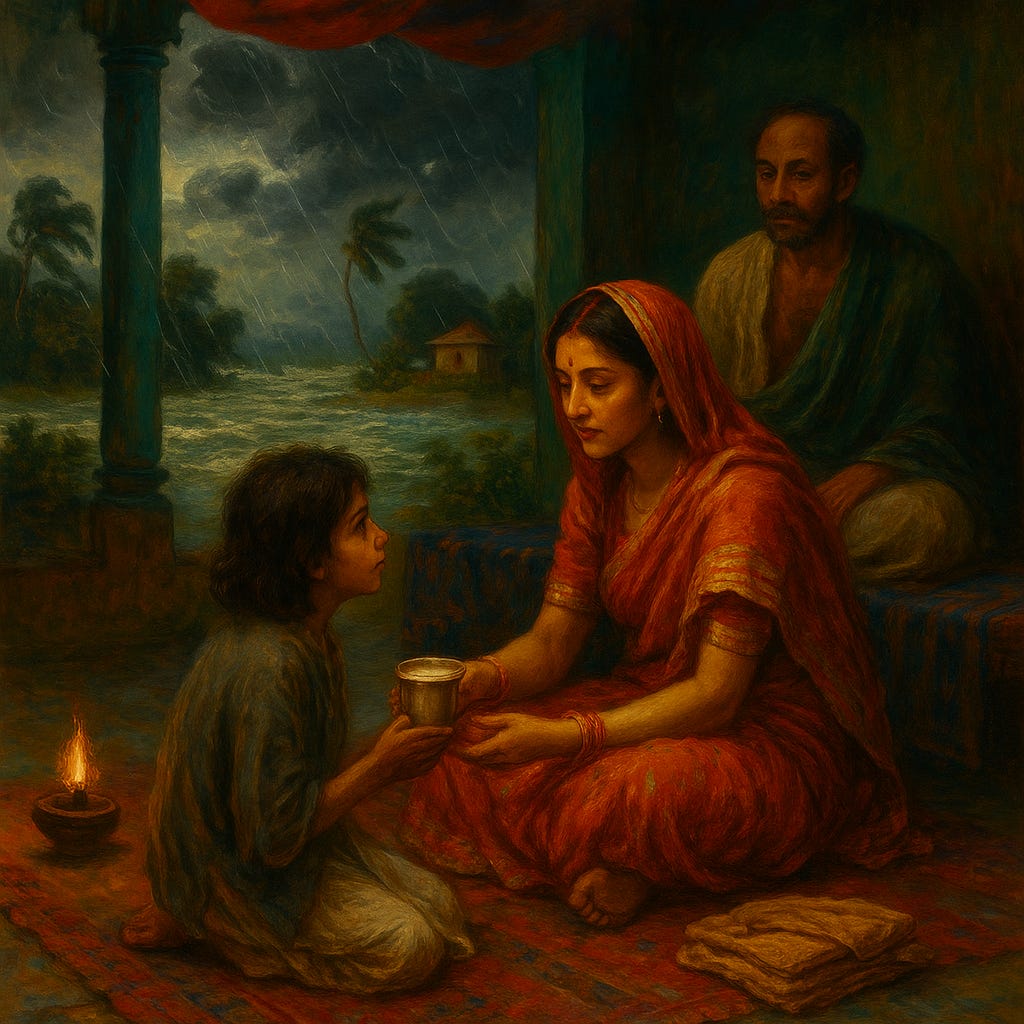
Towards evening the storm was at its height. From the terrific downpour of rain, the crash of thunder, and the repeated flashes of lightning, you might think that a battle of the gods and demons was raging in the skies. Black clouds waved like the Flags of Doom. The Ganges was lashed into a fury, and the trees of the gardens on either bank swayed from side to side with sighs and groans.
In a closed room of one of the riverside houses at Chandernagore, a husband and his wife were seated on a bed spread on the floor, intently discussing. An earthen lamp burned beside them.
The husband, Sharat, was saying: "I wish you would stay on a few days more; you would then be able to return home quite strong again."
The wife, Kiran, was saying: "I have quite recovered already. It will not, cannot possibly, do me any harm to go home now."
Every married person will at once understand that the conversation was not quite so brief as I have reported it. The matter was not difficult, but the arguments for and against did not advance it towards a solution. Like a rudderless boat, the discussion kept turning round and round the same point; and at last threatened to be overwhelmed in a flood of tears.
Sharat said: "The doctor thinks you should stop here a few days longer."
Kiran replied: "Your doctor knows everything!"
"Well," said Sharat, "you know that just now all sorts of illnesses are abroad. You would do well to stop here a month or two more."
"And at this moment I suppose every one in this place is perfectly well!"
What had happened was this: Kiran was a universal favourite with her family and neighbours, so that, when she fell seriously ill, they were all anxious. The village wiseacres thought it shameless for her husband to make so much fuss about a mere wife and even to suggest a change of air, and asked if Sharat supposed that no woman had ever been ill before, or whether he had found out that the folk of the place to which he meant to take her were immortal. Did he imagine that the writ of Fate did not run there? But Sharat and his mother turned a deaf ear to them, thinking that the little life of their darling was of greater importance than the united wisdom of a village. People are wont to reason thus when danger threatens their loved ones. So Sharat went to Chandernagore, and Kiran recovered, though she was still very weak. There was a pinched look on her face which filled the beholder with pity, and made his heart tremble, as he thought how narrowly she had escaped death.
Kiran was fond of society and amusement; the loneliness of her riverside villa did not suit her at all. There was nothing to do, there were no interesting neighbours, and she hated to be busy all day with medicine and dieting. There was no fun in measuring doses and making fomentations. Such was the subject discussed in their closed room on this stormy evening.
So long as Kiran deigned to argue, there was a chance of a fair fight. When she ceased to reply, and with a toss of her head disconsolately looked the other way, the poor man was disarmed. He was on the point of surrendering unconditionally when a servant shouted a message through the shut door.
Sharat got up and on opening the door learnt that a boat had been upset in the storm, and that one of the occupants, a young Brahmin boy, had succeeded in swimming ashore at their garden.
Kiran was at once her own sweet self and set to work to get out some dry clothes for the boy. She then warmed a cup of milk and invited him to her room.
The boy had long curly hair, big expressive eyes, and no sign yet of hair on the face. Kiran, after getting him to drink some milk asked him all about himself.
He told her that his name was Nilkanta, and that he belonged to a theatrical troupe. They were coming to play in a neighbouring villa when the boat had suddenly foundered in the storm. He had no idea what had become of his companions. He was a good swimmer and had just managed to reach the shore.
The boy stayed with them. His narrow escape from a terrible death made Kiran take a warm interest in him. Sharat thought the boy's appearance at this moment rather a good thing, as his wife would now have something to amuse her, and might be persuaded to stay on for some time longer. Her mother-in-law, too, was pleased at the prospect of profiting their Brahmin guest by her kindness. And Nilkanta himself was delighted at his double escape from his master and from the other world, as well as at finding a home in this wealthy family.
But in a short while Sharat and his mother changed their opinion, and longed for his departure. The boy found a secret pleasure in smoking Sharat's hookahs; he would calmly go off in pouring rain with Sharat's best silk umbrella for a stroll through the village, and make friends with all whom he met. Moreover, he had got hold of a mongrel village dog which he petted so recklessly that it came indoors with muddy paws, and left tokens of its visit on Sharat's spotless bed. Then he gathered about him a devoted band of boys of all sorts and sizes, and the result was that not a solitary mango in the neighbourhood had a chance of ripening that season.
There is no doubt that Kiran had a hand in spoiling the boy. Sharat often warned her about it, but she would not listen to him. She made a dandy of him with Sharat's cast-off clothes, and gave him new ones also. And because she felt drawn towards him, and had a curiosity to know more about him, she was constantly calling him to her own room. After her bath and midday meal Kiran would be seated on the bedstead with her betel-leaf box by her side; and while her maid combed and dried her hair, Nilkanta would stand in front and recite pieces out of his repertory with appropriate gesture and song, his elf-locks waving wildly. Thus the long afternoon hours passed merrily away. Kiran would often try to persuade Sharat to sit with her as one of the audience, but Sharat, who had taken a cordial dislike to the boy, refused; nor could Nilkanta do his part half so well when Sharat was there. His mother would sometimes be lured by the hope of hearing sacred names in the recitation; but love of her mid-day sleep speedily overcame devotion, and she lay lapped in dreams.
The boy often got his ears boxed and pulled by Sharat, but as this was nothing to what he had been used to as a member of the troupe, he did not mind it in the least. In his short experience of the world he had come to the conclusion that, as the earth consisted of land and water, so human life was made up of eatings and beatings, and that the beatings largely predominated.
It was hard to tell Nilkanta's age. If it was about fourteen or fifteen, then his face was too old for his years; if seventeen or eighteen, then it was too young. He was either a man too early or a boy too late. The fact was that, joining the theatrical band when very young, he had played the parts of Radhika, Damayanti, and Sita, and a thoughtful Providence so arranged things that he grew to the exact stature that his manager required, and then growth ceased.
Since every one saw how small Nilkanta was, and he him
















 United States
