


Two Pair of Truants
Description
The Elephant Island Chronicles
Presents
Two Pair of Truants
By Beach and Bog-Land Some Irish Stories
By Jane Barlow
Foreword by Gio Marron
Foreword
In an age of national revival and literary gravitas, Jane Barlow stood apart—not by rejecting Ireland’s rural life, but by portraying it with clarity, affection, and mischief. “Two Pair of Truants”, nestled within her 1905 collection By Beach and Bog-Land, is one of her most deftly balanced pieces: humorous without malice, provincial without condescension, and vividly local without descending into caricature.
Barlow was among the few late-Victorian Irish writers to center her fiction on the domestic and social rhythms of the countryside without the scaffolding of myth or melodrama. Rather than depicting Ireland as a political chessboard or romantic ruin, she offered it as a living, breathing, wonderfully muddled place—where children skip school, mothers fret, policemen misidentify toddlers, and donkeys refuse to cooperate.
In “Two Pair of Truants,” we follow two overlapping misadventures: one by Minnie and Baby Lawlor, little girls who seize an accidental holiday to chase glimpses of aristocratic grandeur; the other by Mick and Rosanna Tierney, would-be fairgoers who ditch their siblings at a police barracks to enjoy the pleasures of Killavin Fair unburdened. The ensuing chaos—of lost children, mistaken identities, and a community’s hilariously misplaced reactions—becomes a canvas for Barlow’s quiet satire.
What gives the story its enduring charm is not just the plot, but the way Barlow inhabits her world. Her ear for Hiberno-English is pitch-perfect, her eye for social foibles sharp, and her tone unsentimental yet humane. The children here are not angels nor moral lessons in motion; they are mischievous, imaginative, and gloriously flawed. The adults, for their part, are equal parts worried, clueless, and stubborn. Authority figures fumble, assumptions pile up, and what should be a crisis dissolves into a comedy of errors.
Behind the humor, however, is a subtle commentary on adult hypocrisy and the blurry lines between order and disorder in small communities. Barlow doesn’t scold; she observes. And what she observes is both timeless and particular: the petty tyrannies of domestic life, the fleeting thrills of forbidden adventure, and the constant tension between propriety and freedom.
“Two Pair of Truants” deserves renewed attention not just as a charming children's caper, but as a finely constructed piece of realist storytelling that gently mocks the structures of rural life while celebrating its characters’ irrepressible vitality. Jane Barlow’s fiction, long overshadowed by her more canonical contemporaries, rewards us with an Ireland not torn by rebellion or framed in Celtic mist—but by laughter, misunderstanding, and the ever-complicated art of getting children to school on time.
By Beach and Bog-Land: Some Irish Stories“Two Pair of Truants”by Jane Barlow
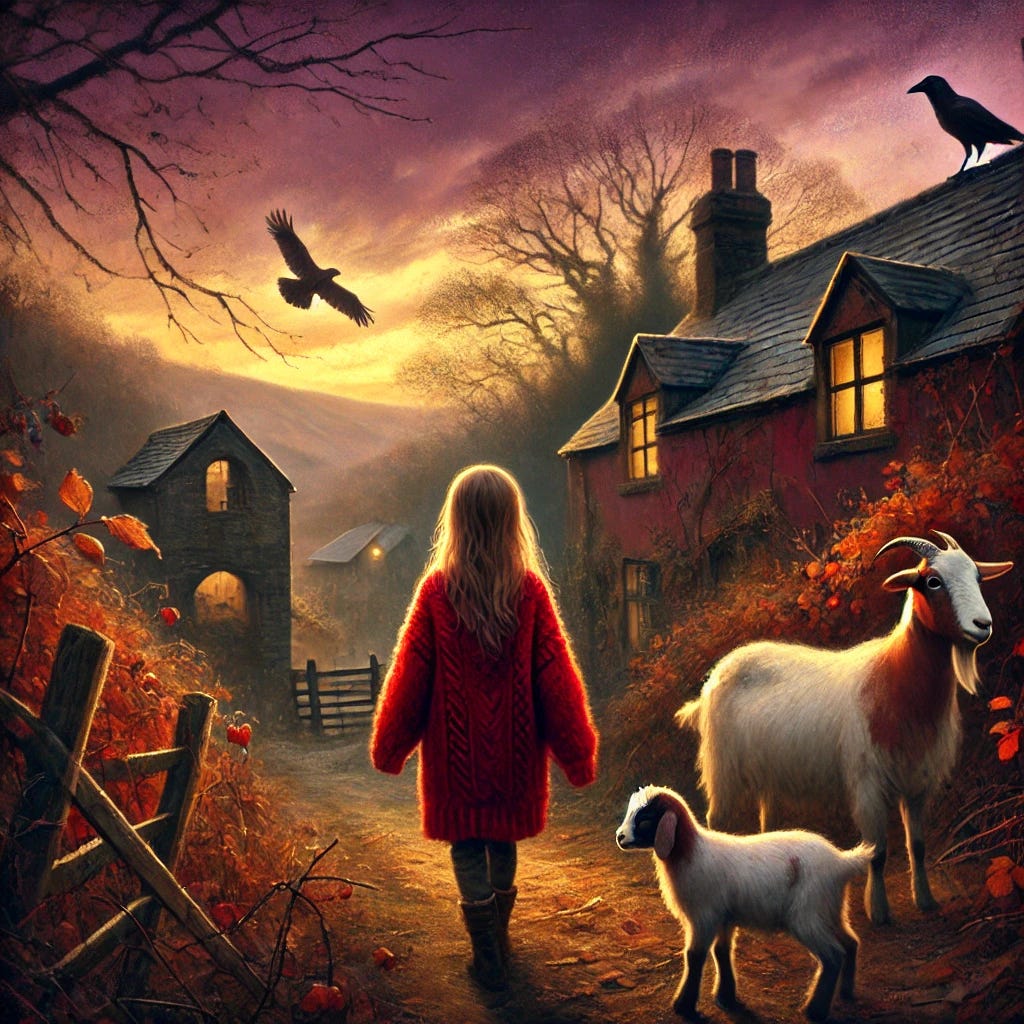
Ever since little Minnie Lawlor, accompanied by her mother and younger sister, had come to live with her grandmother in a gate-lodge of Shanlough Castle, her great wish had been to visit the castle itself, which was always whetting her curiosity by showing just the rim of one turret, like the edge of a crinkled cloud, over the rounded tree-tops in the distance. But it was not until some months had passed that she found an opportunity. Then, on a showery May morning, her mother set off early to Killavin Fair; her grandmother was pinned to the big chair in the chimney-corner by an access of rheumatics; Lizzie Hackett, the cross girl who scrubbed for them, sent word that she could not come till noon; and, as the last link in this chain of lucky chances, the rope-reins of Willie Downing’s ass-cart snapped right in front of the lodge gate just when Minnie and Baby were setting off for school. “Bad manners to you, Juggy, for a contrary ould baste!” Willie was saying as he halted for repairs. “Would nothin’ else suit you but to set me chuckin’ th’ ould reins till they broke on us in a place where a man hasn’t so much as a bit of string?” Willie, being twelve years old, seemed of formidable age and size to Minnie, who was seven: but the good-natured expression of his face, where large freckles made a well-covered pattern, emboldened her to propose the plan which had occurred to her at the sight of the empty ass-cart. As a preliminary, however, she supplied him with the longest bit of twine she could twitch from the thrifty wisp hung on the hook of a dresser. After which, “Is it anywheres near the castle you’ll be drivin’ to?” she inquired, pointing in that direction.
“I’m apt to be passin’ it pretty middlin’ near,” said Willie, struggling to knot a pair of rather skimpy ends.
“And do you think you could be takin’ me and Baby along wid you that far?” said Minnie.
“What for at all?” he said, looking doubtful.
“To see the grandeur that’s in it,” replied Minnie.
“Up at th’ ould place?” said Willie. “I never heard tell there was any such a thing in it.”
“Well, there’s grand people in it, at all events,” said Minnie. “Me grandmother does be sayin’ the Fitzallens hasn’t their equals next or nigh them. Lords of the land they are, and the top of everythin’. I’d like finely to be seein’ them, and so would Baby. But if we’ve any talk of walkin’ a step up the avenue, me grandmother always says: ‘On no account suffer them, Maria; it mightn’t be liked by the Family.’ So we do be stoppin’ in the little ugly shrubbery.”
“I dunno is there e’er a lord in it,” said Willie, doubtfully. “If there is, I never laid eyes on him.” This was disappointing.
“I suppose you’re very ignorant,” Minnie remarked after a slight pause, as if she had sought and found a satisfactory explanation.
“Pretty middlin’ I am, sure enough,” Willie said more decidedly, and then added, as if he, too, had hit upon a probable conjecture: “Belike yous would be wantin’ to see Mrs O’Rourke, th’ ould housekeeper?” Minnie might have replied truly that she had never heard tell of any such person; but as the idea seemed to remove her new acquaintance’s difficulties she answered: “Ay, sure we could go see her if you took us along. I can step in meself over the wheel, and you can aisy give Baby a heft up.” “But in my belief it’s goin’ to school the two of yous had a right to be,” Willie said, relapsing into doubt again as he glanced at their small bundle of ragged-edged books.
“Och, me mother’d say we might have a holiday this minyit, only she’s went to the fair,” Minnie affirmed confidently, though she might have had some difficulty in reconciling this belief with her gladness that there was not present anybody whose permission need be asked. “I’ll get in first.”
“Themselves inside there might be infuriated wid the whole of us,” said Willie, still unconvinced.
“Sure you’re not a tinker, are you?” Minnie said, ostentatiously surveying the no-contents of the cart. “They do be biddin’ us have nothin’ to say to tinkers, but ne’er a tin can or anythin’ I see in it.” As Willie’s objections seemed to be over-ruled by this argument, she continued: “So Baby and I’ll run in and leave our books, and get our good hats; we’ll be back agin you have the reins mended—mind you wait for us.”
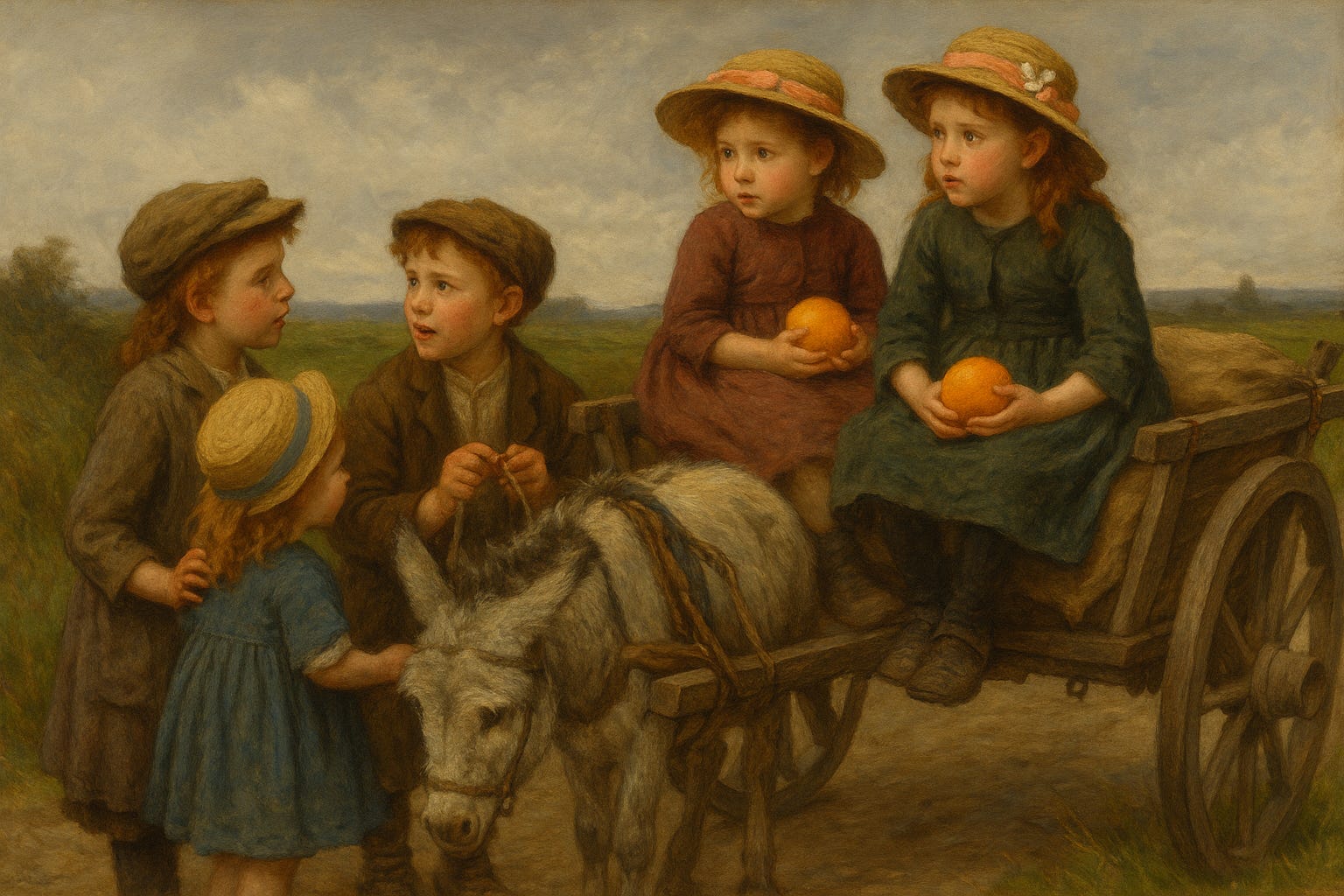
Her anxiety about her appearance before the eyes of the grand people made her risk losing the chance of seeing them at all as she hurried herself and her sister into their best jackets and new hats trimmed with pink gauze and daisies; while a wild hope she secretly entertained that they would be offered hospitality up at the castle led her to discard the basket containing their dinners. Baby, indeed, was inclined to demur at this, so Minnie compromised the matter by extracting the two oranges which crowned the menu, and Baby, bearing the golden balls, followed as contented as any ordinary queen.
The ass-cart had obligingly waited for them, and Willie Downing had spread a sack for them to sit on at the back. He also helped Baby to scramble up, but unfortunately said to Minnie, “You’d better be keepin’ a hold on her, for ones of that size don’t have much wit. She’d drop off as aisy as a sod of peat, and be delayin’ me to pick her up”—a remark which Baby resented, as albeit three years short of Minnie’s age, and thrice as young as Willie, she had a strong sense of her own dignity. Otherwise the drive was very thoroughly enjoyable. The cart was not, indeed, a luxurious vehicle, being simply a flat wooden tray on wheels, with no springs to soften its jolts, and no rail to prevent one of them from jerking out an unwary passenger. But the little girls thought it a most desirable substitute for their stuffily stupid schoolroom, and when they were rocked as if in a boat on a choppy sea, Minnie said that it was as good as going two ways at once. Juggy’s pace was slow, as suited her venerable appearance, for many years had made her as white as if she had been bleached and as stiff as if she had been starched. Willie had a thick ash stick, with which he every now and then made a loud rattling clatter on the front board of the cart. “You might as well,” he explained, “be batin’ ould carpets as Juggy, but the noise keeps her awake sometimes.” Minnie and Baby, however, had so much to look at in the strange bog-land through which the cart was passing that they were in no hurry for the end of their drive. In fact, even Minnie felt a little forlorn when Willie drew up at a small gate in a high stone wall and said: “I’ll be droppin’ yous here. It’s the nearest I can be bringin’ yous to the castle. You’ll find your ways to it pretty middlin’ aisy by them shru














 United States
