


The Tomorrower
Description
The Elephant Island Chronicle
presents
The Tomorrower
By Conrad Hannan
Narration by Eleven Labs
Chapter 1: Harry
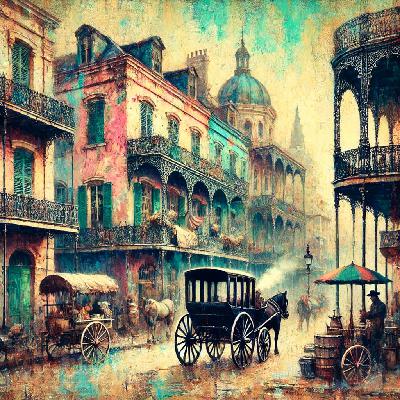
The year was 1893, and New Orleans was a city dressed in its Sunday finery yet crumbling at the seams. The carriages creaked along cobblestone streets, rattling past vendors hawking pralines and fruit. The scent of chicory coffee mingled with the sharp, earthy aroma of tobacco, wafting over iron-wrought balconies and curling through the narrow alleys of the French Quarter. Laughter and muffled jazz spilled out from the dimly lit saloons, accompanied by the clinking of glasses and the shuffle of footsteps.
This was New Orleans—a decadent, decaying heart pumping with languid indifference, where the past haunted every step like a specter. Grand colonial homes with fading pastel hues stood tall, their plaster chipping, wrought iron gates rusted at the hinges, as vines slowly strangled their facades. It was a place where history lingered in the very air, a blend of hope and entropy. And it was in this contradictory place—equal parts life and decay—that Harry Delacroix lived, or rather, existed.
Harry was known as a "tomorrower," a title he wore with the same shabby charm as his moth-eaten suit. His neighbors in the Vieux Carré muttered the word with an affectionate derision, a mix of sympathy and resignation. To be a tomorrower was to master the art of the defer—a smile, a shrug, and always, "I'll get to that tomorrow." It was never spoken with remorse but with the casualness of someone who believed that time was always on his side. A wink, a nod, and "tomorrow" rolled off his tongue like honey dripping from a spoon.
It was his manner, and people laughed, a laughter tinged with something else—an undercurrent of pity, perhaps fear. For what was more tragic than a man of promise who never fulfilled it?
Harry had once been a figure of promise, a young man with ideas that could have reshaped entire businesses, romances that could have forged families, and dreams that might have touched the sky—but always tomorrow. He lingered in the shadowy recesses of society, a fixture at the cafés and riverbanks, a man forever on the cusp of doing something worthwhile. He could often be seen standing at Jackson Square, beneath the looming silhouette of St. Louis Cathedral, looking out at the tourists, traders, and sailors who bustled through the city. He watched but never acted.
To the unknowing eye, Harry appeared to be just another dapper gentleman of the Quarter, his frock coat brushed enough to make an impression but never truly crisp. His mustache was well-groomed, his hat tipped just so, but the small creases in his trousers and the dull scuffs on his boots suggested a man too comfortable with where he stood to bother improving his station.
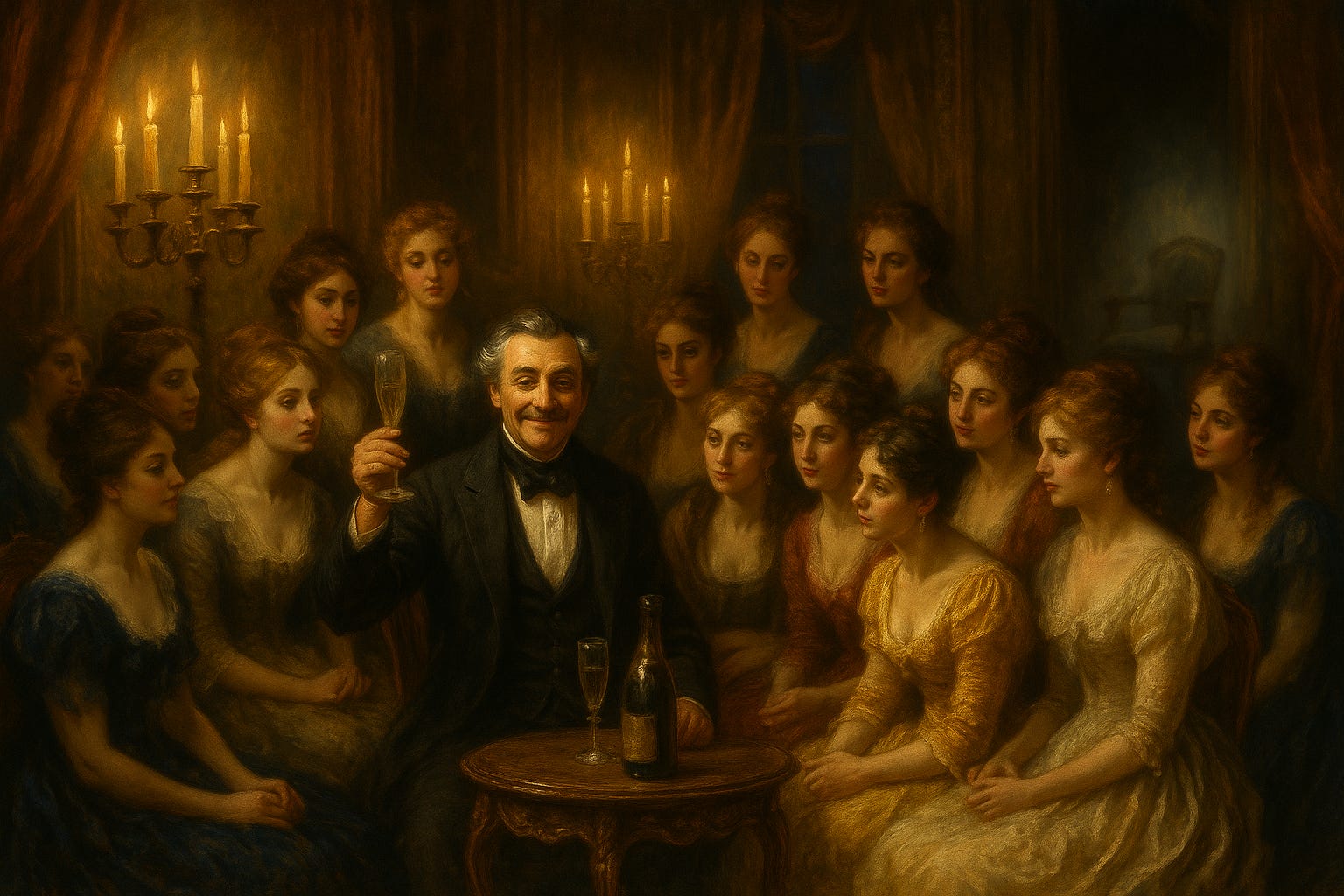
Harry sauntered from his dilapidated apartment to the grand halls of high-society gatherings, always in his worn frock coat, always greeted with the same mix of exasperation and amusement. He attended the soirees of the city’s well-to-do, hovering near the edges of rooms bathed in the warm glow of chandelier light. He nursed glasses of champagne and exchanged pleasantries with acquaintances who had grown too used to seeing him idling at the periphery.
“Harry, my boy!” boomed Alphonse Devereaux, an old friend from school whose ruddy face always glowed a shade too red after an evening's libations. “You’re just in time for a round of cards!” But Harry merely smiled, waved his hand dismissively, and replied, “Perhaps tomorrow, Alphonse.” And Alphonse would laugh, slapping Harry on the back, but there was a tightness, a flicker of something like pity behind the laughter.
Even as a child, Harry had shown great promise. He was quick-witted, sharp with numbers, and blessed with a natural charisma that drew people to him. The city's old buildings seemed to groan as they settled in their foundations, the plaster flaking, the paint curling, as though the city itself had grown tired of waiting. And Harry, with his potential that once burned bright, drifted among the crowds, his hands in his pockets, watching opportunities pass him by like the steamships on the Mississippi—coming in loud, gleaming, full of promise, and leaving without him.
His mother, Madame Delacroix, had once been proud of her bright-eyed boy. She had imagined a future for him that was gilded and certain—perhaps a merchant or lawyer. But when her husband passed, Harry’s studies had become inconsistent, and the responsibilities of business fell on her tired shoulders. She would look at Harry with a sigh as he rambled on about a new idea he would put into action “tomorrow,” and she knew, somewhere deep down, that her son would not fulfill those promises.
Harry himself was not blind to his situation. He was acutely aware of the sideways glances, the forced smiles, the hopeful suggestions of his few remaining friends that perhaps he should “find himself some occupation” or “do something worthwhile.” But Harry always had a reason, an excuse—a thousand tomorrows laid out before him, each sparkling with potential, each good enough to hold off on action.
One particularly hot afternoon, Harry found himself wandering down Esplanade Avenue, his hat tipped low to block out the sun. The cicadas droned in the oak trees above, their song a reminder of the passing time. He ended up at a small café, a place he frequented far too often. The café owner, an older man named Jacques, knew Harry well. He had watched him grow from an ambitious young man into the tired figure who now slouched at his tables.
“Same as always, Harry?” Jacques asked, his voice gruff but not unkind.
Harry nodded. “You know me, Jacques. One more cup of coffee, and then I’m off to change the world.”
Jacques snorted, shaking his head. “Tomorrow, eh?” He set the cup down with a thunk.
“Tomorrow,” Harry echoed, raising his cup in a mock toast, his lips curling into a faint, sardonic smile.
New Orleans seemed to embody Harry’s mindset—a place forever teetering between grandeur and ruin, where past triumphs cast long shadows over an uncertain present. The French Quarter, the pulse of the city, was filled with music, laughter, and decay. The brass bands blared from barroom doors, mingling with the cries of peddlers and the steady clip-clop of carriage horses, and the streets were alive, filled with a hundred stories, each more pressing and more real than Harry’s endless tomorrows.
Harry was content to drift through this tapestry of decadence and decline, never quite stepping into the fabric of life itself. He wandered past the raucous parties, the laughter echoing through windows, the drifting smoke of cigars, the chatter of deals made and broken. He liked to imagine himself a part of it, yet was too comfortable on the edges.
And so Harry lingered—watching, smiling, always a spectator. He was a master of deferment, the consummate “tomorrower,” and it suited him well. His friends—those who still considered him a friend—would see him at gatherings and ask about his plans, to which Harry always replied with enthusiasm. He spoke of new ventures, ideas, and dreams, always with the same ending: tomorrow.
There were moments when, late at night, after a third or fourth drink, Harry felt a gnawing emptiness—a sense that the opportunities he let slip past were piling up behind him, a mountain of what-ifs that grew heavier each day. He would shake it off, light a cigarette, and reassure himself that he had time. That tomorrow, everything would be different.
But in the city that wore decay like a second skin, Harry's tomorrows were starting to grow thin.
Chapter 2: Glimpses of Potential and Stagnation
Harry’s life had always been about moments—a lifetime filled with fragmentary vignettes of potential where everything seemed poised, just waiting for him to take the reins. One such moment came with the prospect of a partnership. His old friend, Bernard, had recently come into ownership of a small dry goods shop just off Decatur Street. Bernard was practical and shrewd, the sort who could build from almost nothing. He had offered Harry a stake—a chance to help turn it into something more than a humble merchant’s shop.
Harry had stood at the foot of the stairwell leading up to Bernard's office. He had looked up, the door to opportunity open before him, the muffled sounds of Bernard bustling about inside. Harry had hesitated—was this really what he wanted? Was it enough? He had stood there, calculating the risks, the uncertainties, the effort. By the time he finally made up his mind, the stairs felt daunting. He took a step, then another, but as his hand reached for the doorknob, it was already too late. The "Closed" sign was hung. Bernard had moved on, tired of waiting, unwilling to rest his hopes on a man who lived for tomorrow.
And that was not the first time. Harry often found himself on the brink—just on the cusp of doing something real, something tangible—but then something would pull him back, keep him from crossing that line from thought to action. He remembered the day he stood on the levee, watching the riverboats come in. An old friend, Pierre, called to him from the deck, a grin on his face, motioning for Harry to join him on an adventure to Baton Rouge. Harry had thought to go—it seemed impulsive, exciting, maybe exactly what he needed. But his feet felt heavy, rooted to the spot. “Perhaps another time, Pierre,” he shouted back. The boat pulled away, and Harry remained where he was, watching as the river swallowed his chance for something different.
The grandeur of the Devereaux Mansion was always a reminder of the choices others made—choices that led them to places of prestige and wealth, which Harry never dared to make. The chandeliers cast a golden glow over














 United States
