



Reasons Why Walking Away Is So Powerful
Description
This is a complete breakdown of the major reasons why walking away is so powerful.
In all, my team and I have found seven distinct reasons that we’d like to talk about today,
- Allows You To Take Them Off The Pedestal
- The No Contact Triad
- Success Stories Consistently Cite That “Outgrowing An Ex Is Key”
- Gives The Avoidant A Chance For Nostalgic Reverie To Kick In
- You Are Setting A Firm Boundary
- You Finally Have Space To Heal
- You Are Removing Yourself From A Potentially Toxic Situation
There’s quite a bit to cover today so I’m just going to dive right in!

Reason #1: Allows You To Take Them Off The Pedestal
A few weeks ago my wife and I partnered up on writing an article about codependence and noticed that many of our clients exhibit codependent tendencies.
Basically their entire world revolves around their breakup, their partner, or their ex.
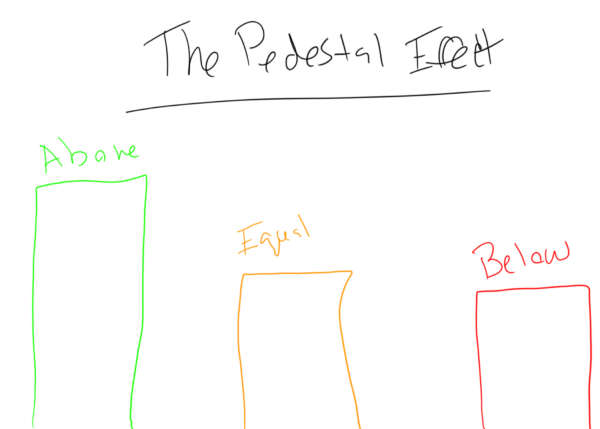
This creates what I call the pedestal effect.
Here’s a video I did on it,
So what we’re always trying to caution our clients against is the idea of putting your ex or partner on a pedestal.
You want them to be equal to you or perhaps a little bit below.
The goal is not to punch above your weight class, so to speak.
However, in some codependent relationships, things can shift. What might have started as you being above or equal to them on the pedestal can change.
Suddenly, you find yourself below them on the pedestal, and you have placed them above you on your own pedestal.
Essentially, by walking away, you can attempt to reclaim your position and knock them off that pedestal, so that you both stand on equal footing.
Reason #2: The No Contact Triad
One of the things we always recommend to our clients after a breakup is to implement a period of no contact, which can also be interpreted as walking away.
This can be scary for a lot of people, but what many don’t realize about the no contact rule is that it incorporates three specific strategies:
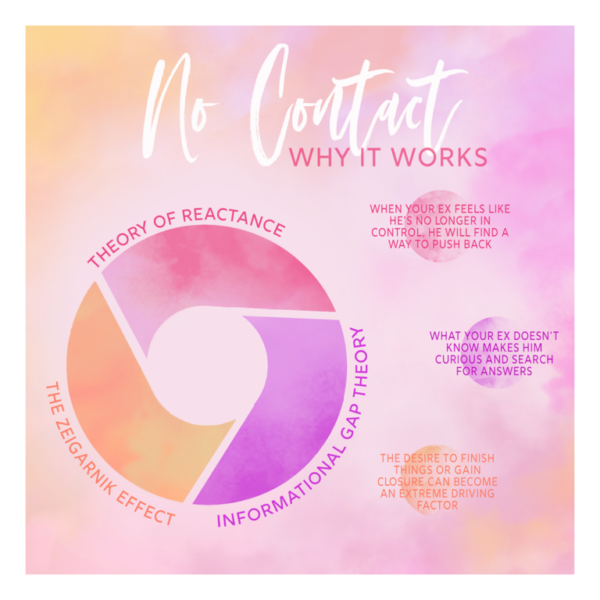
- The theory of reactance
- The informational gap theory
- The Zeigarnik effect
Let’s do a quick breakdown of these.
Theory Of Reactance
The theory of reactance is based on the psychological principle that people don’t like it when their behavioral freedoms are taken away.
You can read more about it here.
When this happens, they are more likely to respond in a way that seeks to regain that freedom.
By initiating the no contact rule, you are not engaging in communication with your ex, effectively taking away their behavioral freedom to converse with you.
This can trigger some exes to take actions to regain that freedom, sometimes resulting in unexpected reactions.
Like this,

(Yes, this was a real screenshot from our community!)
However, it’s important to note that most exes don’t reach out at all during the no contact period.
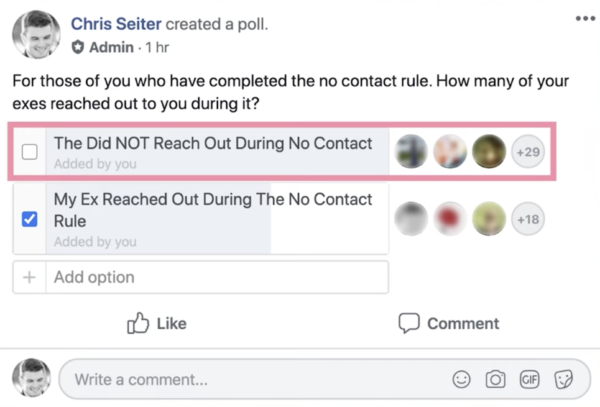
Thus, reactance actually does seem to be the exception to the rule.
Information Gap
This suggests that what your ex doesn’t know about you creates curiosity and prompts them to seek answers.
They may not directly approach you, but instead, observe from afar or even enlist friends to gather information.
This has happened to me.
Back in 2008 when I was around 18 years old, I went through my very first breakup.
During that time, I used to never talk to my ex’s best friend. However, all of a sudden, the best friend started calling me and probing for information about “how I was doing.”
It turned out she was doing so on behalf of my ex, trying to gather details about how I was doing.
All because of the information gap.
Last but certainly not least is…
The Zeigarnik Effect
This states that people remember interrupted or incomplete tasks better than completed ones.
The desire for closure or to finish unfinished business can become a strong driving force. By denying your ex the opportunity to gain closure, the unfulfilled task of achieving closure can upset them and potentially increase their desire to come back.
Reason #3: Success Stories Consistently Cite Outgrowing Their Ex As Key
It’s often said in the breakup industry as a cliché that if you should
“Just move on from your ex.”
Do that and they’ll come back…
Simple, right?
Well….
Ironically, this cliché is often proven to be true.
One aspect I take pride in, particularly within our community, is making the interviews I’ve conducted with success stories readily available for listening.
During these interviews, my main goal is to uncover what strategies worked for them.
It doesn’t matter to me whether they used our program or not; I simply want to understand what led to their success.
Over time, I’ve noticed consistent themes and patterns that emerge.
The no contact rule is a major theme in every success story I’ve interviewed. While it’s possible that this emphasis on no contact is because of our influence in their lives, we can’t ignore the fact that implementing no contact and walking away appears to be crucial.
However, the larger theme that I’ve observed is that those who are able to successfully outgrow their ex reach a point where they question whether they even want their ex back.
It’s at this stage that things start to fall into place for them.
Outgrowing an ex becomes a pivotal factor in their journey.
Reason #4: It Gives The Avoidant Nostalgic Reverie A Chance To Kick In
I want to bring up coach Amor here because she raised an important question that her clients often ask her when she tells them to outgrow their exes.
The question was, what if walking away makes your ex give up on you or forget about you, or it makes them move on because they can sense you’re moving on?
My response: You actually want them to think you’re moving on.
Statistics and internal polls within our community indicate that many of our clients have avoidant exes.
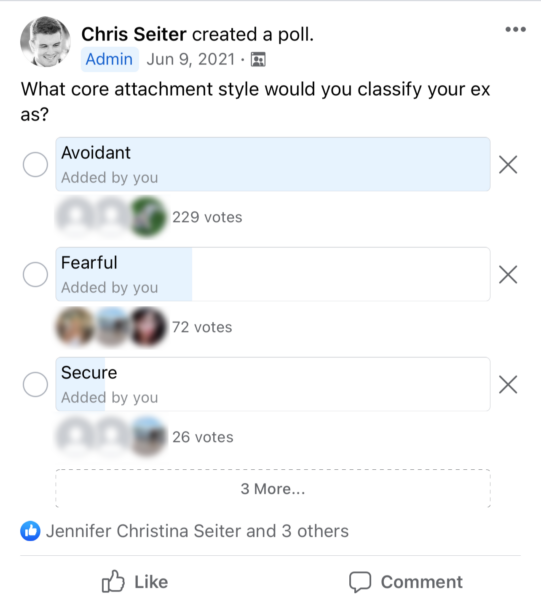
Avoidant individuals typically don’t allow themselves to miss someone until that person becomes unavailable, once they’re out of the relationship.
The code is essentially this: once you have moved on to a point where the avoidant thinks they don’t have to worry about getting back together with you, that’s when the avoidant starts experiencing nostalgic reverie.
I basically made an entire video on my YouTube channel arguing this singular point:
Ironically, it is during this period of nostalgia that the concept of the phantom ex comes into play. It serves as a mechanism for avoidant individuals to maintain distance, avoiding commitment while engaging in daydreams from a safe distance.
As strange as it may sound, we have discovered that the reason outgrowing your ex is so effective in breakup scenarios is due to the avoidant aspect.
When you outgrow your ex, they perceive that you no longer desire them.
This realization can trigger a sense of longing and daydreaming about you, resulting in that nostalgic reverie. This state of nostalgia often leads to a specific action that we frequently hear about: when someone has moved on, found happiness in a new re


 United States
