


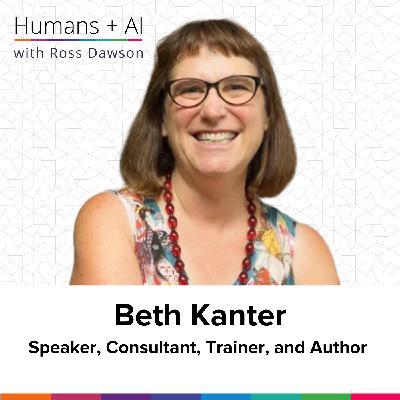
Beth Kanter on AI to augment nonprofits, Socratic dialogue, AI team charters, and using Taylor Swift’s pens (AC Ep20)
Description
“I call it the AI sandwich. When we want to use augmentation, we’re always the bread and the LLM is the cheese in the middle.”
–Beth Kanter

About Beth Kanter
Beth Kanter is a leading speaker, consultant, and author on digital transformation in nonprofits, with over three decades experience and global demand for her keynotes and workshops. She has been named one of the most influential women in technology by Fast Company and was awarded the lifetime achievement in nonprofit technology from NTEN. She is author of The Happy Healthy Nonprofit and The Smart Nonprofit.
What you will learn
- How technology, especially AI, can be leveraged to free up time and increase nonprofit impact
- Strategies for reinvesting saved time into high-value human activities and relationship-building
- A practical framework for collaborating with AI by identifying automation, augmentation, and human-only tasks
- Techniques for using AI as a thinking partner—such as Socratic dialog and intentional reflection—to enhance learning
- Best practices for intentional, mindful use of large language models to maximize human strengths and avoid cognitive offloading
- Approaches for nonprofit fundraising using AI, including ethical personalization and improved donor communication
- Risks like ‘work slop’ and actionable norms for productive AI collaboration within teams
- Emerging human skills essential for the future of work in a humans-plus-AI organizational landscape
Episode Resources
Transcript
Ross Dawson: Beth, it is a delight to have you on the show.
Beth Kanter: Oh, it’s a delight to be here. I’ve admired your work for a really long time, so it’s really great to be able to have a conversation.
Ross Dawson: Well, very similarly, for the very, very long time that I’ve known of your work, you’ve always focused on how technologies can augment nonprofits. I’d just like to hear—well, I mean, the reason is obvious, but I’d like to know the why, and also, what is it that’s different about the application of technologies, including AI, to nonprofits?
Beth Kanter: So I think the why is, I mean, I’ve always—I’ve been working in the nonprofit sector for decades, and I didn’t start off as a techie. I kind of got into it accidentally a few decades ago, when I started on a project for the New York Foundation for the Arts to help artists get on the internet. I learned a lot about the internet and websites and all of that, and I really enjoyed translating that in a way that made it accessible to nonprofit leaders. So that’s sort of how I’ve run my career in the last number of decades: learn from the techies, translate it, make it more accessible, so people have fun and enjoy the exploration of adopting it.
And that’s what actually keeps me going. Whenever a new technology or something new comes out, it’s the ability to learn something and then turn around and teach it to others and share that learning. In terms of the most recent wave of new technology—AI—my sense is that with nonprofits, we have some that have barreled ahead, the early adopters doing a lot of cutting-edge work, but a lot of organizations are just at that they’re either really concerned about all of the potential bad things that can happen from the technology, and I think that traps them from moving forward, or others where there’s not a cohesive strategy around it, so there’s a lot of shadow use going on.
Then we have a smaller segment that is doing the training and trying to leverage it at an enterprise level. So I see organizations at these different stages, with a majority of them at the exploring or experimenting stage.
Ross Dawson: So, you know, going back to what you were saying about being a bit of a translator, I think that’s an extraordinarily valuable role—how do you take the ideas and make them accessible and palatable to your audience? But I think there’s an inspiration piece as well in the work that you do, inspiring people that this can be useful.
Beth Kanter: Yeah, to show—to keep people past their concerns. There’s a lot of folks, and this has been a constant theme for a number of decades. The technology changes, but the people stay the same, and the concerns are similar. It’s going to take a long time to learn it, I feel overwhelmed. I think AI adds an extra layer, because people are very aware, from reading the headlines, of some of the potential societal impacts, and people also have in their heads some of the scie






 United States
