


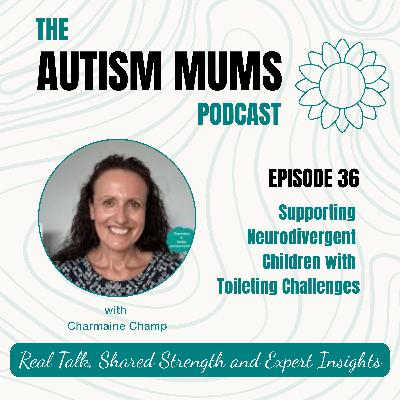
Charmaine Champ: Supporting Neurodivergent Children with Toileting Challenges
Description
Toileting challenges can feel overwhelming for parents of neurodivergent children, especially when withholding, accidents, or anxiety become part of everyday life. In this episode, we’re joined by the compassionate and highly experienced Charmaine Champ, who brings over 30 years of professional and lived experience to help families understand what’s really happening inside their child’s body. Charmaine shares why toileting can feel so hard, the small steps that make progress possible, and the gentle, practical strategies that help children feel safe and confident.
Biography
Charmaine Champ is a Registered Nurse in Learning Disability (RNLD), Community Nurse Specialist (BSc Hons), Queen’s Nursing Institute Award winner, and a Continence, Sleep, and Understanding Emotions Consultant with over 30 years’ experience supporting children and young people. Drawing on a rich background across clinics, schools, charities, NHS services, and family homes, as well as her own lived experience as a mum in a neurodivergent household, Charmaine specialises in helping children recognise, understand, and respond to the messages their bodies send, so wees and poos can happen comfortably and safely. Her approach blends research-backed guidance with a compassionate, gut-health-informed lens, empowering families, carers, and professionals to support neurodivergent children with toileting, sleep, and emotional regulation in a way that truly meets their individual needs.
Key Takeaways
Why recognising internal body cues matters for understanding a child’s toileting challenges and choosing the right starting point.
What withholding really signals and how seeing it as communication—not behaviour—shift the whole approach.
Breaking skills into tiny, achievable steps helps children feel safe, confident, and less overwhelmed.
Identifying missed signals such as difficulty noticing hunger, fullness, or the need to poo or wee can unlock new progress.
Sensory needs play a powerful role, influencing where, when, and how a child feels able to use the toilet.
Consistency across home, school, and healthcare builds familiarity and reduces anxiety for neurodivergent children.
Medications like Movicol require proper guidance, and understanding dosage and purpose helps parents advocate with clarity.
Using visuals and accessible communication makes environments more supporting and inclusive for all children.
Understanding the ‘why’ behind toileting patterns gives parents reassurance, confidence, and a clearer sense of direction.
Mentioned in This Episode
Connect with Charmaine Champ
Free gift: https://clear-steps-consultancy.newzenler.com/courses/what-to-do-about-poo
Email: Info@clearstepsconsultancy.co.uk
Website: https://www.clearstepsconsultancy.co.uk
Facebook: https://www.facebook.com/ContinenceConsultantTrainer
Instagram: https://www.instagram.com/continenceconsultanttrainer
Connect with The Autism Mums
Website – https://theautismmums.com/
Follow us on Instagram https://www.instagram.com/theautismmums
Follow us on Facebook https://www.facebook.com/theautismmums
Follow us on TikTok https://www.tiktok.com/@theautismmums
Transcript
Victoria Bennion:
Today, we’re talking about toileting - it's a topic that many families navigate behind closed doors without proper guidance and clarity. To help us bring light, understanding, and practical support to this area, we’re joined by the wonderful Charmaine Champ. Charmaine is a Queen’s Nursing Institute Award–winning specialist with over 30 years of experience supporting children and young people with their toileting, sleep, and emotional regulation needs.
She’s also a mum in a neurodivergent household, so she understands these challenges from both a professional and a personal perspective.
In our conversation, she explains why toileting can be so complex for our children, what might be happening inside their bodies, and how small, gentle steps can lead to real progress.
If your child struggles with toileting we think you’re going to find this episode incredibly helpful.
Welcome to the podcast, Charmaine.
Charmaine Champ:
Thank you very much..
Victoria Bennion: Can
you share your journey and talk a little bit about what inspired you to
dedicate over 30 years to supporting children and young people, particularly
those with learning disabilities?
Charmaine Champ:
Yeah, of course. . It probably started when I had a school placement. So you
remember when you were at sort of school? Many years ago. I don't think they do
it now, but many years ago I used to have like a work placement and I worked in
a special needs school as from my work placement and absolutely loved it.
Charmaine Champ: And
I was like, oh, I really. I really like doing this. I'd like to do more of it.
And then I decided that I was going to become a nurse, but I wanted to be a
learn disability nurse. And when I was doing my different placements, I was
working with lots of different people, families, children's, all different
ages.
Charmaine Champ: And
just thought, do you know what, I just, that's what I wanna specialize in. I
just want to [00:01:00 ] help people get their
views across because so often things were happening to people and. They didn't
know, like, I worked with a lot of children where they had really complex
cases, so they may be non-speaking, they may have difficulties like getting about
physically as well.
Charmaine Champ: I
wanted to help with like communication side of things, just trying to get their
message across. So that's where it all started from work placement. You never
think that these things would start from there, would you?
Victoria Bennion: Oh
no, I did mine in a barrister's chambers. It's
Natalie Tealdi: Oh
yeah.
Victoria Bennion:
random.
Charmaine Champ: I
mean, you never know where these things take you to.
Charmaine Champ: Over
the years cause then I now live in a neurodivergent household. So I not only
have had to my professional experience, but I have personal experience as well.
Victoria Bennion:
Could you talk a little bit about your approach?
Charmaine Champ:
Yeah, of course. . I've been able to gather, , research that's taken [00:02:00 ] place over the years. So there's lots of
different research available as well as like my experience as well, and put it
all together within our holistic p and p approach. So this is all about not
just looking at one area.
Charmaine Champ:
Often you'll hear. I've been to the doctor or I've been to consultant wherever,
and they're just looking at medication or they're just looking at, you know, it
tends to be just looking at medication, and although medication plays a vital
role and it does help, it isn't the only way to help our children.
Charmaine Champ: So
what I do, I've developed, the holistic p and p approach to make sure that we
are looking at more than one area because it's not just about just sitting on
the toilet equally. It's not just about just having medication. And often I
find that toileting progress isn't able to be made when just one approach is
looked at.[00:03:00 ]
Charmaine Champ: So
when our children, if they're just having the medication and we've been in that
process for years and years and years and we just think we're making no
progress whatsoever. My child is still having accidents. They're still
withholding, you know, they're still only pooing in an nappy, whatever that may
be.
Charmaine Champ: , It
won't work because like we mentioned before, it may not , be given them the
right way, but equally we haven't looked at the other areas. So we tend to look
at, the p and the P approach, the holistic approach to make sure that we are
looking at more than one area to make sure that our children can progress in a
way that's gonna be ri












 United States
