


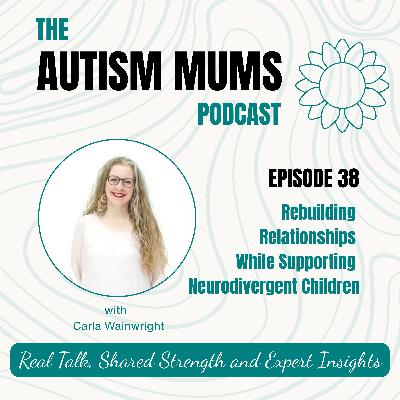
Rebuilding Relationships While Supporting Neurodivergent Children with Carla Wainwright
Description
In today’s episode, of The Autism Mums Podcast, Victoria is hosting solo as Nat is home with an unwell little one. She’s joined by the wonderful Carla Wainwright, a Holistic Wellness Coach and Relationship Transformation specialist who supports parents and couples navigating the stress, overwhelm, and emotional load that can come when a child’s health or development needs extra support.
Carla Wainwright's Biography
Carla Wainwright is a Holistic Wellness Coach and Relationship Transformation specialist who helps parents and couples navigate the stress, disconnection, and overwhelm that can come when a child’s health or development needs extra support. With a graduate degree in biological sciences, a 4-year practitioner diploma in Homeopathy and Heilkunst, and over 25 years as an embodied yoga teacher, Carla blends science, somatic practice, and coaching to guide couples in rekindling intimacy, deepening connection, and restoring shared purpose. Her compassionate, practical approach creates space for parents to thrive - both individually and together—while walking alongside their child’s unique health journey.
Key Takeaways
- Many relationship challenges stem from the fact that none of us were taught how to stay connected when life feels overwhelming.
- Parenting a neurodivergent or high-needs child can magnify existing patterns of disconnection within a couple.
- Emotional exhaustion and nervous system overload often show up as distance, irritability, or feeling like “roommates” instead of partners.
- Co-regulation—calming your nervous systems together—is often the first gentle step toward rebuilding intimacy.
- Small, simple practices like sitting side-by-side, holding hands, or breathing together can create emotional safety.
- Clear and compassionate communication, especially using “I” language, helps both people feel heard rather than blamed.
- Loving, well-expressed boundaries can strengthen a relationship rather than push partners apart.
- Prioritising your relationship supports the whole household
- Understanding each partner’s unique coping style can ease misunderstandings and reduce conflict.
- The path back to connection starts with nervous system regulation—first for yourself, and then with each other.
Connect with Carla
Instagram: https://www.instagram.com/carlawainwright/
Facebook: https://www.facebook.com/CarlaWainwrightCreatrix/
Website: https://www.carlawainwright.com/
Free Gift: The Connected Way Forward – Carla’s free 3-minute connection practice for couples, designed to gently rebuild closeness even when life feels overwhelming
https://www.carlawainwright.com/connected-way-forward
Connect with The Autism Mums
Website https://theautismmums.com/
Follow us on Instagram https://www.instagram.com/theautismmums
Follow us on Facebook https://www.facebook.com/theautismmums
Transcript
Rebuilding Relationships While Supporting Neurodivergent
Children with Carla Wainwright
[00:00:00 ]
Victoria Bennion:
Hello and welcome. It's Victoria and I'm on my own today as Nat has an ill
child, but I'm grateful to be joined by our guest, Carla Wayne Wright. Carla is
a holistic wellness coach and relationship transformation specialist who helps
parents and couples find their way through the stress and emotional load that
comes with supporting a child whose development or health needs are a little
different.
Victoria Bennion:
Welcome to the podcast, Carla. It's great to have you here with us today.
Carla Wainwright: Oh,
I'm thrilled to be here. Thank you.
Victoria Bennion: How
did you get into this line of work? I wonder if you Could talk to us about your
own journey.
Carla Wainwright:
Sure. Yeah. So, you know, my background actually started in science, so I
worked for many years as a wildlife biologist. I always had like a deep passion
for nature and animals, and I began to shift into homeopathy and holistic
health. As a result of, you know, my own healing journey. And when I was
practicing as a homeopath, you know, I was working with families who had
children with complex or neurodivergent needs and, you know, [00:01:00 ] parents is usually the mother would come
in, of course wanting to support the child, but it became really clear to me,
of course, there was this immense stress that the parents were carrying and
that the stress was showing up in the family dynamic and also in the
relationship. And so I would always encourage the mother to get support and,
and treatment as well because,
Carla Wainwright: it,
the mother's falling apart. It's so hard for her to support her, her child, and
her family. And so over time, I did this for quite a while and then in my own
journey , of healing my own trauma, I became a sex, love and relationship
coach. And that worked naturally expanded to supporting women and couples.
Carla Wainwright: And
I have a deep. Passion to support couples, to reconnect to , their intimacy, ,
their connection, their emotional resilience. I, I really feel that. You know,
the container of the couple., It's like this beautiful, sacred container for
growth and evolution. But we're not taught how to do this.
Carla Wainwright:
Relationships [00:02:00 ] can be beautiful and
powerful and deeply challenging, and that's even without all the extra
responsibilities of, of parenting and caregiving. One of my passions is
supporting couples to, strip off some of those layers of their own hurt
experiences or traumas to really connect back to one another in the ways that
brought them together in the first place so that their relationship and their
families can flourish.
Carla Wainwright: We
all wanna thrive. But often we need support to be able to do that. So it, it
is, it's one of my great joys to be able to support couples on that path and in
turn, really allow their families and their childrens to thrive as well.
Victoria Bennion: Oh,
that's lovely. What are some of the common challenges that you see couples
facing when they're raising a child who needs extra support?
Carla Wainwright:
Yeah, so this is something that. Many, many couples deal with. And you know,
actually I would say that couples who may not even have children face all kinds
of challenges. And, um, I think I'd like to preface this [00:03:00 ] by, by saying, I, I feel like
relationships are something that we're just supposed to magically know how to
do without any training.
Carla Wainwright:
And, uh, the reality is, is that most of us didn't, we weren't necessarily
modeled great relationships in our families, like I certainly wasn't. Some of
us were lucky to have parents who modeled great relationships, but it's not the
norm. And then of course we have culture and just society modeling, not always
healthy relationships.
Carla Wainwright: So
we're somehow just supposed to magically know how to navigate relationships and
have a thriving partnership that is able to weather all kinds of storms and
challenges. And the reality is, is that we don't really have. That base. So I
always come to, you know, the idea of relationships with a lot of compassion
because.
Carla Wainwright:
Often the starting point is that we actually don't really know how to stay
connected, especially when things are difficult. So if we layer on top of that
parenting a child who needs extra support, this really then can amplify [00:04:00 ] a lot of preexisting patterns of
disconnection that might be already.
Carla Wainwright:
Present in a relationship. And you know, there's so many challenges that
couples can face. So of course there's the emotional exhaustion, nervous system
overload. You know, parents are running on empty living in fight or flight
mode. And then we can layer on top of that for women. As they move into their
later thirties and forties all of the perimenopausal symptoms, which are also
exacerbating stress responses and hormone fluctuations and make everything in
life that much more difficult.
Carla Wainwright: Um.
Other challenges that parents face are, you know, there's an uneven load. Often
one parent is taking on more of the emotional, logistical, or therapeutic care
and that can create , more distance. And you know, when that distance really
begins to take hold, the identity of the couple. Begins to become lost and the
couple really starts to function more in like





 United States
