


The Podcast - Episode 4: Black British Life in the Regency and Beyond
Description
Hello dear friends,
If you’ve watched the wildly-popular Netflix series Bridgerton or the wonderful film The Personal History of David Copperfield starring Dev Patel, you might have experienced and appreciated what today’s podcast guest saw: People of color in a fictionalized dramatization of 18th and 19th Century Britain. But in Gretchen Gerzina’s case - and unlike most of us - she knows the back stories of the real lives of Black residents of Britain in those eras.
Professor Gerzina says she is drawn to “biographies and lives of those who cross boundaries of history, time, place or race” - that’s on her website - and her work is all about this.
In books like Black London, Black Victorians, and Britain's Black Past, Gerzina bridges all of those boundaries for us - connecting us to people across time, place, and history - and introducing us to some of the Black performers, memoirists, activists and everyday people in Britain in the 18th and 19th centuries.
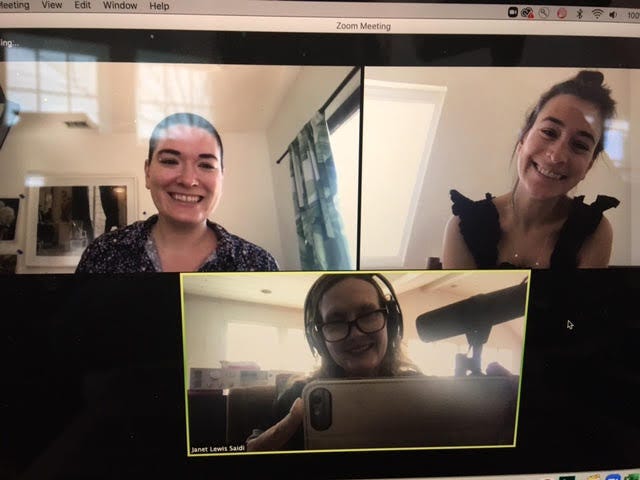
Professor Gerzina joined me a few weeks ago, by Zoom, for today’s Austen Connection podcast, and we talked about the lives of some of these Black residents of Britain historically, how she is helping to tell the stories about their lives, and how contemporary fictionalizations of Regency England capture these stories, or not.
Enjoy the podcast - and if you prefer to read, here’s an excerpt from our conversation.
Plain Jane
So, I have been poring through your books, and I really enjoyed Black London [among others]. And … it's just really beautiful the way that you write about what you're doing - reconstructing, repainting history. In a way, you say, to illuminate the unseen vistas of people and places that are part of British history and part of our world history. Really illuminating the stories of the people and the community of Black women and men in [the] Regency era in 18th and 19th century Britain. So would you just talk first, Professor Gerzina, about that, illuminating the unseen? In what ways has this history been erased? And in what ways are you still trying to uncover that history?
Gretchen Gerzina
So that book was published 25 years ago or so and it's still being read all the time. And in fact, it's available as a free download through the Dartmouth College Library. And it stays in people's minds. The reason I wrote it was that I was actually working on a very different book. And … I went into a bookshop, a very well known bookstore in London, looking for … Peter Fryer’s book called Staying Power, the history of Black people in Britain - massive book. And it had just come out in paperback. So I said, “Oh, let me go buy that.” And I went into the bookshop, and I couldn't find it. And I finally went up to a clerk. And I said, “I'm looking for this new this book. It's just been released in paperback.” And she looked at me and said, “Madam, there were no Black people in Britain before the Second World War.” And I said, “Well, no, that's not true.” .. .
So I got so angry. I never found the book. I mean, I went to another bookshop, and it was right there. But I got so angry that I went home and put aside the book I was working on and wrote Black London. Now, I wasn't the first to write about this. Other people have written about it. And I wanted to both consolidate some of their research, go back to their research, and really look at everything that I could find. And then try to tell the story of Black people living in England.
It was supposed to be called Black London. It was called Black London here but in England it was published as Black England. And of course, the reviewers all said, “Well, this is all about London. Why are you not calling it Black London?” which was amusing. …
But I wanted to make people see … that these people are walking the same streets, we're living in the same neighborhoods. And I wanted to make it a living, breathing history. Now a lot of other people are working on this now and have done for a long time. But when I first started working on it, there weren't as many. And it wasn't known. And even now, it's not so much that it's been erased, as has been forgotten. People didn't quite realize that there had been a Black British history that goes back as far as the Romans. And they're still finding, they're excavating, you know, old Roman encampments and finding Black African nobility women. And they are doing documentaries on it. I've been in a few. So it's become quite a well-known issue now. Although there's still a great sense of many British people wanting not to understand or believe that past.
I wanted to make people see … that these people are walking the same streets, we're living in the same neighborhoods. And I wanted to make it a living, breathing history.
Plain Jane
So I suppose, as you say, this was almost 25 years ago, that Black London came out. You've mentioned in the BBC series that you did, Britain's Black Past, you mentioned that it's a detective job … finding these stories. How have you managed to find the stories that you found? And what was it like putting that into an audio series?
Gretchen Gerzina
That was wonderful. And of course, it became a book, which was published when all the new research came out last year. So I was able to update a lot of the things … I've got to say - you're in radio - these producers … who have these independent companies and do the productions for BBC, they're incredible researchers. They sometimes find people that I hadn't been able to find, because we academics think in a very different kind of way than radio and television producers, who are out there finding people. So … I knew a lot of the people and we went to some of the places - but they were able to find some people I didn't know about. And then there were incredible stories … I think I was supposed to originally spend six months doing it. And then I was about to change jobs. And I only had one month. So I think I traveled all over Britain in one month doing the entire series. I would wake up in London and get on the train to Glasgow, spend the afternoon in Glasgow, come back to London. The next day, I go to Bristol, you know, kind of went on and on like that.
Plain Jane
That [sounds like] a really fun part of it.
Gretchen Gerzina
Yeah, it was very tough. … Going to some of these places to really stand in the houses or on the shore. … But it was quite an adventure, to unearth some of these stories. And to just see how, for many people, these stories still last. People still really care.
Plain Jane
What stories have fascinated you? What have [written about] so many individual stories that are wonderful to hear. But what have you found most surprising and exciting to discover?
Gretchen Gerzina
There's one - maybe it's one of the ones you're gonna ask about - which is Nathaniel Wells. And I resisted using that story. But they really pushed me because I hadn't really known it before. Nathaniel Wells was the son of a slave owner. He was mixed race. So he was the son of a [enslaved woman] and a slave owner. The owner … had daughters, but no legitimate sons. … He left this money to this mixed-race son ... He sent him off to England to be educated, as many slave owners did with their mixed-race children. And he went to boarding school and he studied. And then he died when Nathaniel was only 20 or 21, when he became the heir. He spent a lot of money. He was a young guy, and he moved to Wales to Chepstow. And he used the money to buy this enormous place.
He built this incredible house. He had acres upon acres of this scenic land that was so gorgeous, that it became a kind of pleasure ground. And people would come - there was an open day - and they could come and walk through the parks and all of the mountains, and it was quite something. But he made his money. His money came from the slave plantation. And in fact, his mother owned slaves, his mother, who had been herself enslaved, and I was very reluctant to tell the story of a - essentially a Black or mixed-race - slave owner living in Britain. He married a succession of wealth, to white women … and his house is a ruin now. But he became the first Black sheriff in Britain. He had this enormous wealth. He didn't die with a lot of money. But his story was one I never expected to find.
The one in my heart is always Ignatius Sancho, who's now been a play and everything.
Plain Jane
Why is he the one in your heart?
Gretchen Gerzina
Well, because he was so amusing and so serious at the same time.
He was brought as an enslaved child. He managed to get away, he was taken in by the Montague family, finally, away from these “three witches,” I think people call them now, who had owned him, didn't want him to read.
So they took him in, he was educated. And he became a butler in their house for many, many years. And then he was a little on the heavy side, and then finally couldn't continue to do all his work. So they gave him a pension, and some money. And he moved to London.
And he … set up a shop in Westminster, right near the heart of everything of the movers and shakers of British aristocracy and politics. And people would come into his shop. He married a Black woman, which was unusual at the time. And he wrote these letters, and he kne








 United States
