


The Podcast - Episode 7: Jane Austen will teach you, challenge you, and rescue you
Description
Hello friends,
Today, a podcast episode!
It would not have been possible to have our Everything Emma month here at the Austen Connection without consulting Professor George Justice.
Dr. Justice is the editor of the 2011 Norton Critical Edition of Emma, a professor of 18th Century British literature, and a frequent contributor to the Chronicle of Higher Education. And he’s also the husband of Austen scholar, author, and friend Devoney Looser, who tells the story of their romantic meet-cute in a previous Austen Connection episode.
Consult him we did, and the conversation was really fun, because: Emma is fun, just as it is also complex, surprising, baffling, and romantic.
All of this complexity comes out in the conversation with George Justice. We explore what’s going on with Austen men, what’s going on with Austen women, and how romance and power get wrapped up in the stories of Austen.
I first met Dr. Justice on the campus of the University of Missouri, where he served as dean of the graduate school. Now, he is a professor of English at Arizona State University. But in the process of that journey, from Missouri to Arizona, and from administration back to the classroom, he rediscovered the power of teaching Jane Austen.
This journey also has involved a recovery from a serious illness, and Dr. Justice says one of the things that got him through tough times has been reading Jane Austen, and talking about Jane Austen with his students.
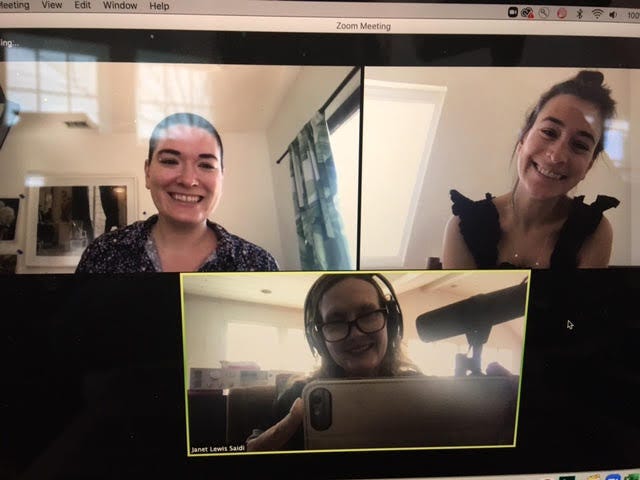
We spoke on a recent sunny Saturday, by Zoom. Here’s an edited excerpt from our conversation:
*Please note: There is a light mention of sexual assault in this conversation, about 20 minutes in, and again at 40 about minutes.
Plain Jane
I'm so glad that you're sharing your beautiful Saturday morning.
Let me just ask a little bit about your work, George. So you're obviously on English literature with a focus on women's writing and publishing. And you're writing a book on Jane Austen, as a writer for Reaktion Books, the “Critical Lives” series. You also write about higher education, very compellingly, in the Chronicle of Higher Education.
What, in all of this, are you most focused on and most passionate about, like, right this minute?
George Justice
I can't say there is one thing because you're right, you just outlined the two major threads of my career as they've evolved. They both involve students, higher education, and places where I think I can contribute.
But on the literature side, it feels like a miracle to me to be able to write about Jane Austen, to do research on Jane Austen, and especially, to teach Jane Austen to undergraduate students, which I can't imagine a more enjoyable thing that I can pretend is productive for myself to do.
But my most recently published book is How to Be a Dean from the Johns Hopkins University Press.
So figuring out ways, outside of administration, to take my passion for higher education to make structural change, structural change that is also focused on the individual.
And I think that's something that maybe I'll be able to bring back to a discussion of the novels, genre, and to teaching. I love thinking about what the novel is. But what I also love is what it means to individual human beings to change their lives and do great things in the world.
Plain Jane
George, you said something else, about your illness, which you handled, it seemed, so gracefully. But I know that it's been huge. And in some ways, you were hit by this turn-the-world-upside-down thing. And then the world itself was turned upside down, not too long later. So in some ways, we're all kind of stunned. But you look the picture of health, and it's so great to see it. What were you reading during this time? Can Jane Austen get you through something like that?
George Justice
To me, it was therapeutic. It was therapeutic not only to reread her books, and to dig back in, more generally, to 18th century literature, but I was a little shaky, you know, I had been very sick. I had not from my own choice been thrust out of a job that I had spent 70 hours working on actively, and the rest of my life kind of thinking about, when I got into the classroom, and started teaching Jane Austen again.
And it was absolutely life-changing. And I realized, that is what the life of an educator should be. And it was really … a life-changing class for me, not only because it marked kind of re-entry into a different kind of career: But the students were so shockingly great to me. To me, having these students in that class, loving Jane Austen and understanding things about Jane Austen, was transformational in my understanding about what the rest of my life and the rest of my career are going to be. I can bring together a complete passion for bringing Jane Austen not just to white, upper-middle class students at a private liberal arts college, but at Arizona State University, 120,000 students. It's now a Hispanic serving institution. It serves many, many first generation and low-income students, and they love Jane Austen. Not only with as much passion, but with at least as much insight as any students I've ever had anywhere else in my life. That class changed my life, when I had these students engaging with such depth and brilliance with the texts.
Plain Jane
That's amazing. I hear you George, I think that's true. It is life changing. And this project arose also from the difficult times, the winter of the pandemic, and just looking for something to lift you up and a community to engage in. What you're describing, going into that classroom, sharing Austen, but then also having some brilliance shared back at you and just literally connecting around the stories.
But you know, the Norton Anthology that you edited and curated came out almost 20 years ago. And you may have not looked at it recently. I have. But you were talking about the power of Jane Austen, then, so it's Everything Emma in the Austen connection right now.
George Justice
Good for me.
Plain Jane
Yes. Well, is Emma your favorite novel of all time?
George Justice
Oh, that is a a very difficult question. And I know because you talked to Devoney and you had Devoney on your podcast a couple of weeks ago. In that now infamous conversation, I declared to Devoney that Mansfield Park was my favorite novel. And I do love Mansfield Park … because it was the first one that grabbed me. I mean, I was assigned it in a class my first year of grad school. I didn't read it until then, and I started reading it and it was just one of those amazing things, but my life was changed: How could I not have seen this or understood this in my past 22 years of life? I stayed up all night reading it, and it was like an onslaught. If you ask me, yes, that was my favorite.
Plain Jane
Well, I'm just curious. It seems to me like you were a more mature 22 year old. I mean, I read Mansfield Park when I was just out of college. Weirdly, I've never been assigned much Jane Austen at all. I just discovered it after all of the degrees - it was only two degrees - in English. … It wasn't until later that I realized there's a heck of a lot going on with Austen. What were you noticing? Why were you reading it up late at night? I mean … I had kind of a weird education, up until college. But you had a good education. So maybe you did have the training to spot the subtexts.
George Justice
I don't know if it was about the subtext. I think it was about Fanny Price.
Plain Jane
You like the underdog! Devoney said this …
George Justice
The underdog and the person with depth, with a strong, correct, and unassailable moral code, oppressed by the world.
I mean, that was a thing that just for whatever reason, maybe, from my high school years, which were kind of miserable, the person who was neglected. I mean, it just spoke to me, this whole world moving around in a cynical and nasty way. And yet, there's a moral center to that world, which was Fanny Price.
So it wasn't even, it was not a literary reading, where I was looking at themes and context. It was Fanny Price. Who is, as you know, of such huge controversy in the Jane Austen world, because there are so many self-proclaimed Janeites who hate Fanny Price. To me, Fanny Price is the true center of Jane Austen. Which is why I found the film both interesting and disturbing, because Patricia Rozema melds Jane Austen and Fanny Price together, which I think actually weakens Fanny Price.
But I do believe that the role of Fanny Price in the world, and especially in her world, is a truth about the social world. And it grabbed me.
To me, Fanny Price is the true center of Jane Austen. … I do believe that the role of Fanny Price in the world, and especially in her world, is a truth about the social world. And it grabbed me.
And the unbelievable moment when she turns down Henry Crawford. I always bring it up in class and I ask my students, “Should she have accepted Henry Crawford?” And the ones who read it correctly but glibly, always say, “Of course not.” The ones who are very cynical say, “Of course she should.” The real answer is, “I don't know.” Because that actually is the answer that the narrator p











 United States
