


The Podcast - S2 Ep4: Muslim romance right out of Jane Austen
Description
Hello dear friends,
We’re heading into the holidays - and next week our topic is Bad Families from Jane Austen, just in time for our family gatherings for the US holiday, Thanksgiving Day. Stay tuned for that!
But first, let’s talk about romance.
Specifically, let’s talk about Muslim romance.
The author Uzma Jalaluddin is well known in the Jane Austen world for her retelling of Pride and Prejudice. Her novel Ayesha At Last puts Lizzy Bennet - or Ayesha - in a large Muslim family in the Scarborough neighborhood of Toronto, where she’s navigating complicated cousins, domineering matriarchs, and the rituals of marriage proposals, all while hoping to find the time to follow her ambitions for poetry.
Uzma Jalaluddin herself seems outrageously busy.
When she’s not writing novels, teaching high school, and parenting, she writes a column for the Toronto Star about education, family, and life - it’s called “Samosas and Maple Syrup.”
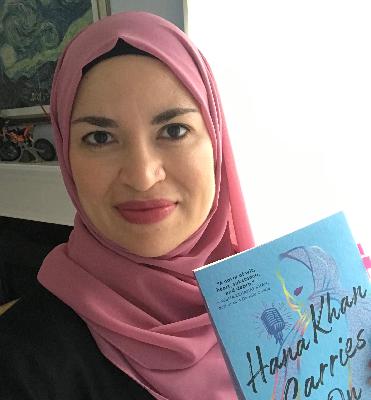
Ms. Jalaluddin’s latest novel is Hana Khan Carries On. It’s been optioned for the screen by Amazon Studios and writer-producer Mindy Kaling.
In this conversation, Uzma Jalaluddin tells us how she discovered Jane Austen - as a teen, at the local library in the Toronto neighborhood she grew up in - Scarborough. That neighborhood is also the setting for both of her romcom novels, Ayesha At Last and Hana Khan Carries On. It’s a diverse, vibrant neighborhood that now her readers also feel right at home in - at least in our imaginations.
Enjoy this podcast, available on Spotify and Apple, or by simply clicking Play, above. Check out the links to more Muslim women writers and artists below, send us other recommendations, and leave us a comment!
And for those who prefer words to audio or like both, here’s an excerpt from our conversation:
Uzma Jalaluddin
I was - I am and was - a voracious reader. Growing up, I was constantly in the library. I was that kid who - the high school that I went to was right across the street from a large public library. And so during lunch breaks after school, I would just head over to the library and borrow books and hang out there. And I just studied there, I would just basically live there. And even my school library, of course, had a pretty good collection of books. And that's really where I was among my people, when I was in the library.
Plain Jane
And was that in Scarborough, Toronto?
Uzma Jalaluddin
That's right. It was in Scarborough. It's the Cedarbrae library, if any of your listeners are from Toronto. It’s a very large building,
Plain Jane
And shout out to libraries and librarians.
Uzma Jalaluddin
Oh my God, hashtag-library-love, I have so much love. And I think so many writers can relate to this, right? Like you become a writer out of a sense of, a love of reading.
And I think I was a teenager - I must have been 15 or 16 years old - and I heard about Jane Austen. And I was one of those kids that just was like, “I want to read all the classics. I'm really interested. I'm going to try everything. I'm going to try reading Dickens and, you know, the Russian novels and Anna Karenina. And let me try Shakespeare,” and all of this. …
So I picked up Pride and Prejudice, and I read it. And I remember the language was, it felt very old-fashioned to me. And it took me a while to get through it. And I did read it. And then I remember after I - because it takes a while, especially as a teenage girl, for it to sort of pick up ... there was something about that book that just stuck with me. And I kept going back to it and rereading it. And I'm a kid and then I'm a child of the ‘90s. So when the 1995 A&E special came out, you know, I got the box set. And I would watch it. My mom watched it with me, it was this thing that we both really enjoy doing.
And I think I've said this before, multiple times: But the books that you read when you're young, especially at those formative ages, the ones that you love, they just stay with you. Those stories just stay with you. And I feel like Jane Austen and specifically Pride and Prejudice - and I did go on further and read all of her novels - have traveled with me throughout my life. And I'm so glad that they have, because … my take on Elizabeth and Darcy came out in Ayesha At Last. And that is a book that has brought me so much joy, sharing with the world, writing it, and all of the things that have come afterwards. It's been truly a privilege.
Plain Jane
I love the way you say that Jane Austen travels with you through life. That is something that really brings people - Jane Austen readers - together too. Because we kind of have fellow travelers traveling with Jane Austen through life when we have this community, which is cool. But I know that from hearing you talk with Janeite communities, and reading some of your interviews as well, that you really see it - correct me if I'm wrong - but you seem to see yourself as a writer first and then the genre romance, the retellings, come second?
So it seems like you were writing Ayesha At Last, and those characters were kind of taking shape, and the story was taking shape, and you realized, there's an element of Pride and Prejudice and Jane Austen in this, which isn't surprising. Can you tell us how you ended up with a retelling?
Uzma Jalaluddin
My first novel took me a really long time to write. And then it's probably just a function of the fact that I'm a busy person. I'm a high school teacher. I also have two young boys. And when I started writing this book in 2010, I knew that it was going to be a long marathon. And the book wasn't published until 2018. So it took me about seven years for the entire book to kind of take place.
And it wasn't until my fourth or fifth draft, that I gave the book to a friend of mine. And she she pointed out that this has a lot of the elements of Pride and Prejudice. Specifically, she was pointing out the fact that I seem to have a Mr. Darcy character in Khalid, and Elizabeth Bennet character in Ayesha, and a Mr. Wickham character in Tarek, and I thought, “Oh, my goodness, I didn't even see it.”
And that's the ironic thing. I mean, I was writing a book and I was leaning into these tropes, these well-known characters that I love, and I didn't see it. And I made a very deliberate choice. And it was her suggestion, but it was also something that I decided to lean into. I thought, “I'm a completely unknown writer. Here I am sitting in Markham, Ontario, writing this book. No one's heard of me.” I wasn't writing for the Star at this time, either - [I’m a] high school teacher. And on top of that, I'm writing about these unapologetically Muslim characters. Or, as you said, [going] so deep inside of the community that it feels like all I'm talking about are Muslim characters. Who's going to give me a chance? This was like 2014, right? Who's going to give me a chance? Nobody. So let me do something that pays homage to a story that I love, which is Jane Austen's Pride and Prejudice, and also turn it and use it for my own devices. Because that story, I think, really resonates with South Asian communities to this day, even though the book itself was written over 200 years ago.
And so that's what I did. I reread - for the dozenth time or more - Pride and Prejudice, and I picked out the pieces that I thought would really translate well, and I went about and I rewrote my book. And it felt like I should have done that from the beginning, because that would have saved me years of drafting. Because that's the book it was trying to be, I just didn't see it.
[T]he books that you read when you're young, especially at those formative ages, the ones that you love, they just stay with you. Those stories just stay with you. And I feel like Jane Austen and specifically Pride and Prejudice - and I did go on further and read all of her novels - have traveled with me throughout my life.
Plain Jane
Well, it's helpful to have some scaffolding for your imagination to just go wild within … to just kind of hold you together. So that does make sense. And you're saying something really profound here in a way, making me realize that the stories of Jane Austen and the Jane Austen community - not to overstate their influence - can provide access to voices, provide an audience, provide access, and provide a way for diverse voices. You've said something really interesting in the Toronto Star, you talked about the challenge that you felt like was in front of you to get your story. And the story of this family, of these characters in the public eye, and published, and you have written in the Toronto Star that “the lack of diversity in the arts has harmed me in ways I'm only starting to untangle.” Can you tell us a little bit about the lack of diversity in the arts, and how and what a challenge that has been for you?
Uzma Jalaluddin
When I wrote that piece, in particular, I pitched it to my editor as a way for me to sort of unpack this, and almost have this as a battle cry. It was an encouragement for parents, my fellow parents - who are maybe first-generation immigrants, unlike me, or maybe are like me, second-generation immigrants … they're, you know, so far removed from their home countries - to encourage those children to go into the creative arts. Because I feel like in Asian communities, in









 United States
