


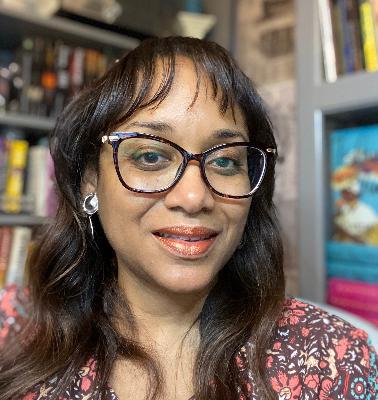
The Podcast - S2, Ep5: Regency women of color finding romance, making history
Description
Thanks for being here at the Austen Connection. You can see all of the Austen Connection conversations including the podcast here. If you are not signed up yet you can take a few seconds to sign up, below, to get all of the conversations dropped into your inbox. Thank you!
Hello Austen Connection friends,
Here in the Austen world I’ve noticed that many of you consider December and the holidays the time of romance: We see you with your lights, your lattes, your Hallmark binges - and more power to you.
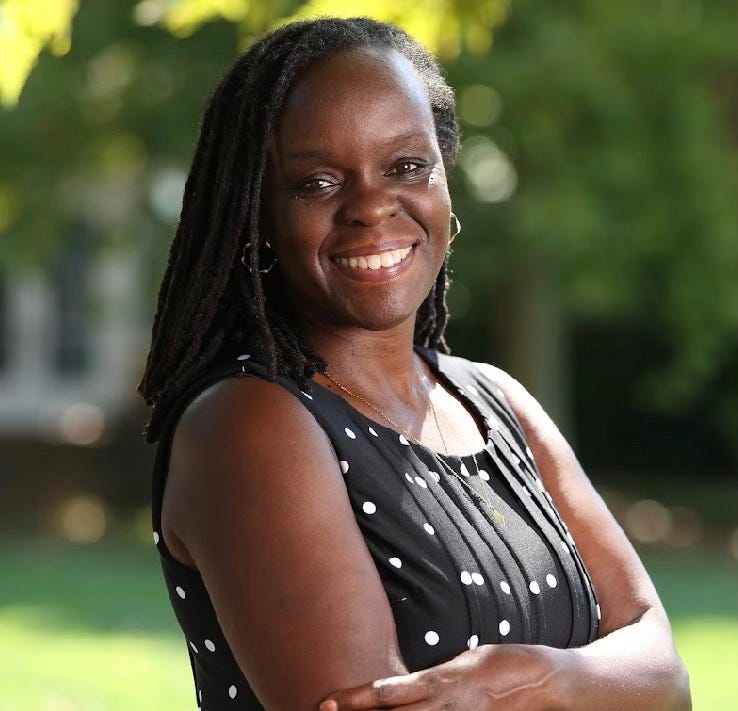
Today’s post fits right into your romance dreams, and features our conversation with long-time romance and historical fiction author Vanessa Riley.
And it’s a podcast episode! So you can simply click Play above to stream this conversation, or you can listen on Apple or Spotify.
It also has suddenly struck me that I should tell you that you can, any time, simply go to the Austen Connection site and see many conversations like this one, plus podcast episodes, chats, and general #JaneAusten breakdowns, all free and waiting for you to curl up on the sofa with (don’t forget your cuppa tea). Enjoy!
And now, for our main feature of the week: Author Vanessa Riley.
Dr. Riley - who has a PhD. from Stanford in mechanical engineering - has always found romance to be, as she says, a “happy place.” She tells us she began burning through Signet romances while an undergrad - as a break from “differential equations”!
And she was first inspired to discover the hidden histories of Black and biracial women of the Regency and colonial-era Caribbean when she came across that Jane Austen novel fragment we know as Sanditon. Austen’s biracial heiress of the West Indies - Miss Georgiana Lambe - started Vanessa Riley on this journey.
Dr. Riley’s latest novel Island Queen is all about the real life of Dorothy Kirwan Thomas. Dorothy, or “Doll,” Thomas was a Regency-era entrepreneur who became a dynamic figure in the early 1800s Caribbean. She was born into slavery on the island of Montserrat, and worked to buy her freedom and go on to become a wealthy landowner, leaving a legacy of children, and grandchildren, some of whom were educated in England. And she also had some interesting lovers along the way.
After being introduced to Austen’s Miss Lambe, Dr. Riley began digging for evidence of Regency-era and colonial women of color, and her research led her to the life of Dorothy Thomas, and eventually led to the novel Island Queen. The book has been optioned for the screen by two of the creatives behind the Netflix series “Bridgerton” - director Julie Anne Robinson and actor Adjoa Andoh, who plays Lady Danbury in the series, have teamed up with producer Victoria Fea.
The life of Dorothy Thomas is fascinating, and telling her story involves using a lot of words we might not associate with women surviving under colonial oppression - words like entrepreneurship, agency, manumission, wealth, power, romance. And perhaps the most important three words of all: Happily Ever After.
In this conversation for the Austen Connection podcast, Vanessa Riley talks about how she went from being a Math major, and then an engineer - to being a writer. She says if you love writing, that doesn’t leave you - no matter how many degrees you have.
Enjoy the conversation!
Plain Jane
What attracts you to the romance genre?
Vanessa Riley
The promise of the Happy Ever After. And you need that after you take a test for differential equations.
Plain Jane
Yes! Is this what got you through grad school?
Vanessa Riley
Yes. And undergrad is actually when I really started reading every Signet romance known to mankind, because they were nice and quick. And bananas - the plots were all over the place. And it was just something different to do. You know, engineering programs can be very intense … and sometimes you just want something [where] you know the ending. That you don't have to integrate under a curve. You just want to be assured of a happy place. And romance has always been that happy place.
Plain Jane
Yeah, so you like the structure. But a lot … can happen within that courtship plot. Do you find that you find intellectual challenges within that, that might be surprising to people who don't know the romance genre?
Vanessa Riley
For those who don't know the romance genre, writing romance is actually hard. Romance gets a really bad rap because they say it's formulaic. Well, it's formulaic because that's the promise that they've given to the reader. That's the only genre that you can pick up and get guaranteed to know that it's going to be safe. It's a happy ending. But how you get to that happy ending, how you vary your characters, tasks, and goals, and relationship status, [is] an emotional journey. That is what makes it exciting and different. And that's why there's no two stories that are the same. That is the fun of it. But in order to be that, to give people something different every time, you have to be extremely creative.
[W]riting romance is actually hard. Romance gets a really bad rap because they say it's formulaic. Well, it's formulaic because that's the promise that they've given to the reader. That's the only genre that you can pick up and get guaranteed to know that it's going to be safe. It's a happy ending. … But in order to be that, to give people something different every time, you have to be extremely creative.
And my friends who write romance, I write romance - these stories are just all over the map. They're different. They're engaging you, there's something for everyone. Now, there's something for everyone. That was not always the case. … But it's it's actually a difficult animal. And I find a lot of great writers start writing romance because once you can deliver how these two unique individuals are better together in a plausible way, and then you've taken them on a journey, you have the basis to write other types of fiction.
So it's a great training ground to be able to write romance.
Plain Jane
Well, you know who would agree with you is a great genre writer named Stephen King. I think we're finding that genre is harder than has been previously thought, like you just said. Did you struggle to get it? Did you kind of take it on as a challenge? Or do you feel like it kind of came naturally for you, because you just wanted that HEA, and you just figured out how to get there.
Vanessa Riley
The plotting has always been, I would say, my strength. My mother didn't allow a lot of different types of books in the house. But we had Shakespeare … we had all these different types of things. And so I would kind of junkie out on TV, and I would rewrite episodes of “Dallas.”
Plain Jane
Not everybody, not every kid, is doing that!
Vanessa Riley
So I used to entertain my brothers by coming up with these little stories. And they would be, you know, different variants of TV shows or something that I wanted to change the ending because it wasn't happy: J.R., you know, realizes that Sue Ellen was great. And they got back together and lived happily ever after. And he stopped doing all these bad things.
Plain Jane
So you learned, you learned plotting from J.R. and Sue Ellen …
Vanessa Riley
And structure from Shakespeare. So there we go - the perfect match!
Plain Jane
What attracts you to the Regency period, specifically and Regency stories?
Vanessa Riley
I think because of the nature of the books that my mother made sure that we read, I have an older voice. It's … these worlds always fascinated me. I am a history buff. Another degree I almost got was a minor in history when I was at Penn State. It just - Western Civ particularly - was extremely interesting, the foundations of the world, traveling through Roman history. … I was geeking on it. I loved it.
And then when we get to the Romanticism periods, and I stumble upon this author named Jane Austen, and I'm reading it and I love Pride and Prejudice, and we get to Mansfield - Oh, she's got a little political streak going on in here! And then I get the Sanditon and the wealthiest woman in the book is a … from the West Indies. My father's from Trinidad and Tobago. It's just … like, “Oh, this now makes sense, why I'm here!”
To tell these stories, and as you do more research, and you realize how big the Caribbean part of the narrative of this time period is, and how it has been completely obliterated or obscured, it just makes you say, “Where are my people? Where's the representation?” I mean, all the economies of the world, 80 percent of the GDP is coming from the sugar trade. … But that's all the stolen labor from the West Indies that is making sugarcane and indigo and cotton and coffee, all from all of the colonies in the West Indies. And yet you read romance, you read a lot of historical fiction, and this is not mentioned. You will get the heroic Duke. But you won't learn that his generational wealth is coming from … Dominica or plantations in Demerara. And you forget this piece.
You know, Jane Austen: We think of her as historical. She's a contemporary writer. So she's writing what she saw during that day. And when you get to this Miss Lambe, you realize that West Indi










 United States
