



The Podcast - S2 Ep3: Jane Austen for the People
Description
Hello friends,
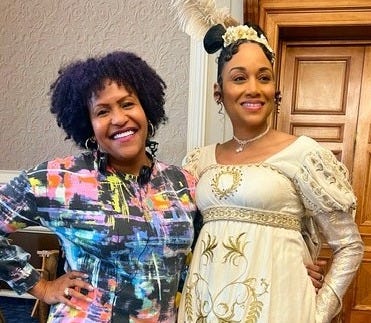
Today we bring a new podcast episode and conversation that I think you will love. It’s with Damianne Scott, an educator, writer and speaker in the Jane Austen community - she teaches literature at the University of Cincinnati Blue Ash College and Cincinnati State University. And she’s the host of the Facebook page, Black Girl Loves Jane.
She’s also working on a very intriguing project right now - rewriting the story of Jane Austen’s Persuasion into the setting of an African-American megachurch.
In her own book project, Persuaded, due out from Meryton Press next year, Ms. Scott makes Anne Elliot a PK - or preacher’s kid. And as Dr. Cornell West has pointed out, in a legendary talk at the JASNA Annual General Meeting of 2012, Jane Austen was also a PK, or preacher’s kid.
This is a world that Damianne Scott knows well, and it’s a world I also am not unfamiliar with - I also, as it happens, am a PK - so I really enjoyed this conversation.
Ms. Scott says that as a student of 19th century literature, which she has loved since middle school, she often has found herself the only Black student in the room. So she appreciates the nontraditional casting of shows like Bridgerton, but has also watched and addressed the backlash that has arisen from that production and from the PBS series Sanditon.
An article Damianne Scott contributed to JASNA.org, or the Jane Austen Society of North America online, addressed the pineapple controversy surrounding the Sanditon series. A chorus of viewers felt that using the pineapple emoji as a fan symbol for the show was insensitive to the cultural weight and the connotations of colonialism and of the slave trade carried by that symbol. Damianne Scott weighed in, and she weighs in here, in this conversation, saying she hopes people and the community of Austen lovers and fans will continue to grow and understand that - as she says - Austen doesn't want to be put up on a pedestal: Jane Austen, she says, wants to be among the people. I love that.
Press play here (above) to stream this from any device, or find the Austen Connection podcast on Spotify or Apple. Enjoy!
And for you word lovers, here’s an excerpt from our conversation:
Plain Jane
Let me talk a little bit first about Persuasion. So why do you love the story of Persuasion?
Damianne Scott
Well, I love the story of Persuasion … It was my first Jane Austen novel that I read in college. And the first one I did a paper on. So that was one reason why I loved it.
Second, I do enjoy the movie, the one that [from 1995], with Ciarán Hinds, the BBC, is one of my favorite adaptations.
And then I like it now. Because Anne Elliot is very adaptable for any woman today, who is over a certain age who is not married, who has no children, and who has come to bear the responsibility - either willingly or unwillingly - to be the caregiver of their parents, and their finances, the dependable child in the household.
And I find that very relatable to me, because I am not married, have no children, and have become the pseudo-caregiver [and] financial-responsibility person, in my family.
So it speaks to me.
The other thing is, I think that Persuasion in itself, again, is very adaptable to what I'm doing now with my rewriting of it and modernizing it.
Anne - she's always criticized by her father for the way she looks. There's that famous scene where, you know, she's talking, and he's like, “Oh, your skin looks better today, you changed cold creams”! And he talks about the naval officers, and he talks about Admiral Croft and how, you know, he looks pretty well for somebody who was in the Navy!
Plain Jane
And it's very funny, like, it's a source of humor, but also it's just, you feel Anne’s pain. I mean, any woman in the world feels Anne’s pain with all of this. We're also laughing at it.
Damianne Scott
Because he's totally ridiculous! Like, really. So it is very funny.
And so my adaptation- it's a little focused on physicality. So my Anne does not necessarily have a skin issue, but she has a weight issue. And then, because she's in this community, a small community - well, not a small community, but anyone who knows about African-American megachurches, which is where my book takes place ... people can still pretty much know your business, because it's a small community.
Plain Jane
So let me - I have to ask you more about this: I want you to talk about this retelling, but I will just say, I grew up going to Black churches. And I grew up going to megachurches. But never a Black megachurch.
Damianne Scott
Well, there actually are not that many.
Plain Jane
Well, I grew up in a sort of evangelical background. So I didn't love the megachurches … So can we just pause for a second and you tell me: Why that setting? Why the Black megachurch?
Damianne Scott
Well, because I'm familiar with it. It is, you know, my world. I go to church now. And so, though my church was not a megachurch, in the terms of how we think of it, when I was growing up, it had about 500 members. And at that time, so those were like mid-’80s, that was a big number of people. And then my pastor, he was the head bishop of the state of Ohio, for our denomination. So I'm very used to that church, where everybody knows your business. And you know what it means to be a preacher's kid, so I wasn’t a preacher's kid. But I know what it means to be a preacher's kid and deacon’s kid, someone-of-authority’s kid, everybody talking about what's going on and everybody else. It is a village mentality.
Plain Jane
Yeah, that's so true. And it is like a village. You were starting to say everybody knows each other's business. It's like the “four and twenty country families.” But I love what you're sayingd: there's a hierarchy, it can be a very wonderful, close community. It can also be a fairly oppressive community. And nobody shows this better than Jane Austen, right? I just have to say, Dami, so you were going to megachurches in the ‘80s; I remember going to the megachurches in the ‘80s. And this was in Atlanta. I would not have stepped foot in there without, like, [full] makeup, hair …!
Damianne Scott
Oh yeah.
Plain Jane
So, whole thing. And I kind of resented that, you know? So what was your experience? What has been your experience in the church?
Damianne Scott
So … I think I am not critiquing the church as a whole, pastors as a whole, as [much as] this particular pastor. But yeah … I came from a denomination for a long time [where] you didn't wear makeup, so that wasn't a problem. But you know, we were dressed, you didn't go to church and pants … you put together your hair, no jeans, there was no such thing as wearing jeans to church, on a Sunday morning. … if you're a woman, you wear a skirt. … I didn't resent it, because that's all I knew. I didn't feel oppressed by it. Especially when I was young. My friends were there, my family was there. That's where I participated in things, where I cultivated my speaking abilities or my writing abilities. So it didn't find it oppressive, to me, growing up at all.
And then as I grew up, something altered and changed. I did start seeing things a little different, because then I realized, you know, church is also business. And so sometimes, it's all business, just like with all denominations … preaching one thing and doing the other. And so there is a little greed aspect to some churches - not all, of course. So … with this hierarchy, there is a power trip …
Because of how the system was set up in America, systematically, the racism, the church was the only place where Black people could have clout. So if you are a pastor, or deacon, if you're a missionary, you have power. You have clout. What you say, goes.
And so if you are the child of a pastor, a bishop, or whatever, people are looking at you. They expect you to act a certain way, be a certain way, do things a certain way, because you are not only reflective of Christ … but you're also reflected on that power structure.
If you do something, you are challenging that power structure, that whole thing might fall down. And so Sir Walter, my character, he is a pastor of a megachurch. But he also has some gambling issues, and some spending habit issues. And he puts his church into debt, where he's almost losing the church and the upper limits of his power and his clout in the community. And then he has these children and one of them … is fiscally responsible and capable and efficient and knows how to run things. He doesn't see her value because she doesn't represent what he thinks a daughter should look like. Physically. … She’s someone with intelligence. She's kind of challenging his wisdom … his thought process.
And so that makes it really Austen. Even though it's 2021.
Plain Jane
That's so great. Everything you're describing is this character - that's so Austen, a character, a strong woman, a smart woman who's undermined and undervalued, and just how frustrating that can be. But Jane Austen just shows people how to go forward. So that's kind of what appeals to you


















 United States
