


The Podcast - Episode 6: Devoney Looser on Living, Loving and Arguing About Jane Austen
Description
Hello dear friends,
Welcome to another week of The Austen Connection and our sixth podcast episode, which you can stream from right here, or from Apple or Spotify!
And this episode features a conversation with Austen scholar and Janeite Devoney Looser - who for many of you captures the spirit and vibe of Jane Austen’s stories in her work and in her life:
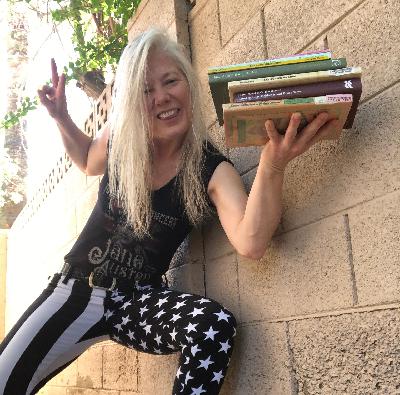
Looser has dedicated so much of her life to connecting through literature and Jane Austen, from her books, her teaching, her many appearances at conferences and at Janeite and JASNA gatherings, and also in her personal life through her marriage to Austen scholar George Justice and her roller derby career as Stone Cold Jane Austen.
These days Devoney Looser is working on a new book, due out from Bloomsbury next year: Sister Novelists: Jane and Anna Maria Porter in the Age of Austen explores two sister novelists writing, innovating, and breaking rules in the Regency and Victorian eras.
Devoney Looser is also the author of The Making of Jane Austen.
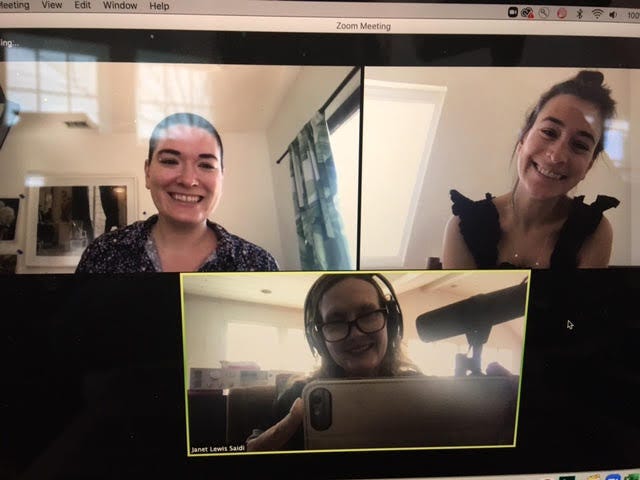
And - full transparency here - I’m lucky enough to call Devoney Looser a friend. We met as professors on a campus in Missouri. So this is a continuation of conversations that Devoney and I have had for years. We got together by Zoom a few weeks ago and talked about many things, including the first time she read Austen, how an Austen argument was the foundation of her first conversation with her husband, and how - just like Jane Austen - Devoney straddles the worlds of both high culture and pop culture.
Here’s an excerpt from our conversation. Enjoy!
Plain Jane: So let me just start if you don't mind with a couple of just questions about your personal Austen journey. What Austen did you first read? When did you discover Austen? Do you remember which book? And which time and place?
Devoney Looser: Absolutely. And this is a question that I really enjoy. It's a kind of conversion question, right? … So I love that this is where we start … I do have my awakening moment. And your awakening, I think this is a common story for a lot of Janeites, which is why the story resonates. It was my mother, who handed me a copy of Sense and Sensibility and Pride and Prejudice bound together. I now have this book. It was a Modern Library edition of both of those novels that was published in the ‘50s. And she handed it to me because … she knew I was a reader, she knew I loved to read. And she said, “Here's one that I think you should read.”
We had books from her childhood, or from church book sales in our house, we had a lot of books in our house. And I started to try to read it. And I really stumbled because I could not get at the language. But she was insistent, she kept kind of putting it toward me, and saying, “I think you should read this one.” And I think it was maybe around the third time I tried it - Pride and Prejudice is what I started with - it just really took. You know, it was like, Oh, wait this is kind of funny. And I like these characters. And I like the story.
So after I got my PhD, I learned that my mother had actually never read Pride and Prejudice before. And to me that actually made her giving it to me even more meaningful. She is not college educated. She wanted me to have an education. And the idea that novels could be handed down from mothers to daughters, even mothers without an education, to say, “Here's a way for you to have access to more opportunities,” is what the books are about too, in a way, right? I mean, the mothers aren't always the ones doing it in the books. In fact, they're often not. But the books are functioning as that opening up - worlds opening up possibilities and opening up education, self actualization. You know that this is to me meaningful that my mother knew that this is a book that educated girls should read, and that she wanted it for me.
Plain Jane: She was tapping into something that she hadn't had herself and just trying to give that to you. That's awesome. So you're a professor, scholar, writer. … What attracts you to the conversations about Jane Austen, and teaching Jane Austen?
Devoney Looser: I think the thing about Austen that keeps me coming back to her is how readable she is. And lots of people say this in the critical community and the Janeite community like the scholars and JASNA. I think even anyone who picks her up casually having not read her in 20 years or never read it before, there's a complexity there on the level of the sentences, paragraph, plot, that is really, to me. enriching, or generative - it generates ideas.
And every time I go back to the books, I see something new. every age, every experience that I've made it through, gives me a new way into those sentences. And there are a lot of books that we love, but that we can't really imagine rereading with the same level of love, I think. And for me, that makes Austen just really remarkable. The idea that you can go back to her, you know, every year. A lot of people who love her books read her every year, all six every year. Do you know that joke from Gilbert Ryle, the philosopher, philosopher Gilbert Ryle was asked, this is a century ago, asked, “Sir, do you do you read novels?” And he said, “Yes, I do, all six every year.” So this is this is a good Janeite in-joke, that the only novels there are these six? Obviously not true. … But the relatability is how I would I would answer that.
Plain Jane: So I mean, Jane Austen can be, like you say, kind of adapted to your life as you go through different things in life. But you, with The Making of Jane Austen have really documented how not only individuals can adapt Jane Austen to their lives, but movements can adapt Jane Austen to their causes and ... we see that in kind of exciting ways. Can you talk a little bit about why her? Why are her novels so adaptable throughout the last couple of hundred years?
Devoney Looser: So I know you know this, I talked about this in The Making of Jane Austen about the ways that various people have very different political persuasions find a reflection of their values or questions or concerns in her novels. So she has been used to argue opposing sides of political questions for 150 years and probably longer. I think this was partly to do with the fact that her novels and her fiction open up questions more often than they close them. And I think it's her relationship to the didactic tradition in her day, the moralizing tradition. I think she's really stepping outside of that and more interested in gray areas, than in declaring what's right and what's wrong. So I think this is a beautiful, complex thing about her novels and they’re novels of genius, to my mind, and I'm not afraid to use that word. But they also present certain kinds of really interesting challenges, because you can't go to them and say, “What should I think?” They don't really answer that question for you in a clear away. I think in other kinds of didactic fiction where there's a clear moral outcome, this person's punished with death, or, you know, or some kind of tragic outcome, or this person's rewarded, and it's all going to be, you know, happily ever after, and nothing ever is going to go wrong. Her novels are working outside of that to some degree. So I do think that that's one reason why people have very different experiences and political persuasions and motivations, come to her novels, and it can be kind of like a Rorschach test, right? You can see what you want to see in the designs to some degree. Now, I do think people can get it wrong, I think you can find there are arguments that people make that I think there is absolutely no textual evidence for that whatsoever. But oftentimes, I can look at someone coming to a conclusion that might be different from the one that I reached, and say, Well, I see where you can get that from emphasizing this point, more than this one, or seeing this passage as the crucial one, instead of another passage.
I think this is a beautiful, complex thing about her novels and they’re novels of genius, to my mind, and I'm not afraid to use that word. But they also present certain kinds of really interesting challenges, because you can't go to them and say, “What should I think?” They don't really answer that question for you in a clear away.
Plain Jane It's also occurring to me listening to you Devoney, that she sort of makes people think, in ways that might be uncomfortable. She must be one of the few novelists that can actually draw you to her story, draw you in and draw you to that narrator. But also be uncomfortable, maybe with what she's giving you. And maybe we just stepped around the discomfort some of us. Do you think that's an accurate way of thinking about Jane Austen as well?
Devoney Looser: I think that's beautifully put. And, you know, I think too we can read her novels on many different levels. If you say, I want to go into this for a love story, that's funny, with a happy ending, which is what many people who read in the romance genre know the formula, and they're going to it because they like the formula. And it might have different things in different component parts. But you know that at the end you're not going to be distressed and dealing with something tragic, right? So when you go into an Austen novel, the kinds of discomfort you're describing, that they will be there along with something happy, too. So I think you could just read it for the happy ending. [But] I see that as a real lost opportunity. Because I think the happy endings are tacked on from genre expectation about comedies. If you're focusing on the happy ending







 United States
