


 Claim Ownership
Swift Healthcare
Subscribed: 1Played: 13
Subscribe

© 2021 Swift Group LLC. All rights reserved.
Description
Welcome to the Swift Healthcare video podcast! This Podcast is for you – healthcare folks. It’s about your needs, as providers, as leaders, clinicians, team members, professionals. Each episode, Dr. Swift will have a conversation with a thought leader touching on Healthcare and Leadership, including perspectives from within and from outside healthcare.
22 Episodes
Reverse
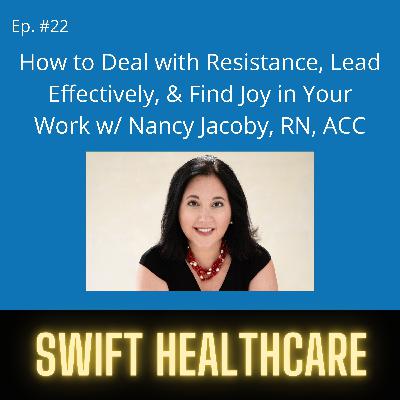
How do you Deal with Resistance, Lead Effectively, & Find Joy in Your Work? Nancy Jacoby RN, MBA, MHSA, FACHE, ACC guests on Swift Healthcare Podcast where we discuss all this and more! Tune in because you do not want to miss it!
Ranked a Top 60 Healthcare Leadership podcast by Feedspot.
Nancy Jacoby on LinkedIn:
https://www.linkedin.com/in/njacobyfache/
Music Credit: Jason Shaw from Audionautix.com
THE IMPERFECT SHOW NOTES
To help make this podcast more accessible to those who are hearing impaired or those who like to read rather than listen to podcasts, we’d love to offer polished show notes. However, Swift Healthcare is in its first year.
What we can offer currently are these imperfect show notes. The transcription is far from perfect. But hopefully it’s close enough - even with the errors - to give those who aren’t able or inclined to audio interviews a way to participate. Please enjoy!
Transcript
[00:00:00] Patrick Swift, PhD, MBA, FACHE: [00:00:00] Welcome folks to another episode of the Swift healthcare video podcast. I'm Patrick Swift, your host, I'm so excited about Nancy Jacoby being on the show. Nancy, welcome to the show.
[00:00:08] Nancy Jacoby RN, MBA, MHSA, FACHE, ACC: [00:00:08] Thank you, Patrick. It's a pleasure to be here with you today.
[00:00:11]Patrick Swift, PhD, MBA, FACHE: [00:00:11] It's a joy and the title of our show here is how to deal with resistance lead effectively and find joy in your work. I love that. And so folks, let me share with you Nancy's bio here, which I love doing the top of the show. Nancy Jacoby is a former healthcare executive with 25 years of experience in the industry. She's a board certified. She is board certified in healthcare management by the American college of healthcare executives and is a fellow of the college go ACHE. I'm a FACHE as well. So I'm delighted that you're on the show prior to serving in leadership positions, Nancy, as a registered nurse with a passion for caring for the geriatric patients, she's actually still licensed in two States and she founded Nancy Jacoby [00:01:00] consulting and Nancy Jacoby coaching and consulting. And I have to call out that you went to Xavier university in Cincinnati. Having a great love for the Jesuits. I got, I got to give a shout out for your you're a Jesuit education and being a Xavier.
[00:01:13] Nancy Jacoby RN, MBA, MHSA, FACHE, ACC: [00:01:13] That's right. I'm proud to be a Xavier alum.
[00:01:16] Patrick Swift, PhD, MBA, FACHE: [00:01:16] Outstanding. So we're going to talk about how to deal with resistance lead effectively and find joy at work. And if I may, let me also ask you, we did a little prep folks on before the show and about, you know, the arc of the book. Podcasts we're taping here, but I want to also ask you what got you into health care. If I may what drew you into healthcare and the passion you have because it's so strong and the impact you're having you know, what's your, what's your, why? What drew you into healthcare?
[00:01:44] Nancy Jacoby RN, MBA, MHSA, FACHE, ACC: [00:01:44] Well, you know, Patrick, it's funny because you know, you fill out these child books that your parents give you, you know, year by year with, you know, your grade school teacher and your friends. And what do you want to be when you grow up and early on, I identified looking back, I identified a lot of focus [00:02:00] on. What I would call helping professions, you know, being a nurse, being a teacher and nurse stayed there for a good couple of years. Right. And you know, when I, when I first went to college at Xavier I started out as a psych major because I always had a gravitation towards people with, you know, emotional health needs. And I just, I got attracted to nursing because I felt like I could serve the whole patient and the whole person. And the mission of caring for the sick. I mean, what, what's more noble than that, right? I've always been attracted to something where in some way, shape or form, I'm going to have an impact. That's more than just on paper. Like I wanted to have a tangible impact
[00:02:44] Patrick Swift, PhD, MBA, FACHE: [00:02:44] Yeah. Yeah.
[00:02:45] Nancy Jacoby RN, MBA, MHSA, FACHE, ACC: [00:02:45] and that that's, that's really what drew me to nursing. And. It drew me into healthcare administration, believe it or not, because I could make an impact on so many different levels. You know, people might say, well, that sounds [00:03:00] strange. How do you do that? Well, because you can, you can touch the patient. You can touch the organization. And then in a leadership role, you have the awesome responsibility to lead mentor and develop others. And it was probably one of the most fulfilling parts of my job.
[00:03:17] Patrick Swift, PhD, MBA, FACHE: [00:03:17] Aw. Oh, I mean, it's really, I love that because it's, it's pulling together all of the intention you had of being in the helping profession, even as a young person. And then, and then being in the workforce and being a healer and coaching and helping others heal and. You know, I hope listeners are thinking about what got you into health care yourself, or if you're thinking about healthcare the show is for, from the CEO to the new employee, to the aspiring healthcare professional we all can learn, we can all find inspiration and joy from each other.
[00:03:45] And thinking about what drew you into healthcare, Nancy I think is beautiful for our listeners also to think about what drew you into healthcare. Cause hell if we can connect more and more to a purpose, it is a protective. Barrier protective factor from [00:04:00] burnout. Because if we're dealing with burnout, one of the biggest things we can do is connect to our meaning and purpose. And so I love you sharing that short story as a neuropsychologist. I know listeners can't help, but be thinking about that question for themselves. Well, why am I doing this? And it gets back to purpose. So. One of the challenges in dealing with burnout, whether you're a provider, whether you're a physician, a nurse, a clinician, or a leader, or both is we all deal with resistance. And so I'd love to, I love this. You've got amazing blog. You've got a lot of great content out there. Let's talk about, here's the question? What do you mean by making friends with resistance?
[00:04:38] Nancy Jacoby RN, MBA, MHSA, FACHE, ACC: [00:04:38] Absolutely. And people who are listening right now, they, they must be thinking, you're crazy. How can you make friends with resistance? Right. It's, you know, it's funny because when people think of resistance, a lot of the times it's, it's something negative, you know? So if I'm doing a workshop or if I'm having a conversation like this, when I, when I ask people, well, what's the first thing that comes to mind. When you think of resistance, it's [00:05:00] often negative words like, you know, right. I hear words like obstacle, blockade, stubborn impeding progress, you know challenge, you know, conflict. Right. And it doesn't have to be that way because resistance is really a natural part of any change that we're bringing to the table. Whether it's
[00:05:22] Patrick Swift, PhD, MBA, FACHE: [00:05:22] And you said the change work. Cause then people, then we can't help, but think of like, Oh, blood pressure. Right. And what you're doing is normalizing that normal part of what we do, right?
[00:05:33] Nancy Jacoby RN, MBA, MHSA, FACHE, ACC: [00:05:33] absolute normal part of what we do, whether whether we're undergoing an individual change that we think might be very simple, or whether we're helping a team go through a change or, you know, Patrick at the organizational level, if we're doing something huge, you know, like a merger and we're going to bring two organizations together, like. The potential for resistance there on so many levels is very high because it's normal. It's, [00:06:00] it's, it's, it's like a friend that you have next to you all the time. Just welcoming it to the table and saying, I know you're here. Glad you're here with us. Let's figure out how to use you.
[00:06:11] Patrick Swift, PhD, MBA, FACHE: [00:06:11] I love that angle about how to then use resistance, because I love to contemplate the notion of the yoga of healthcare being a meditator and, and the notion of. Yoga of healthcare, this notion of developing our flexibility and our, our, our, our, our skills and our abilities and using resistance as part of the physical yoga. But here, you're talking about using resistance to be more. More, whether it's effective, be more healthy, to be more happy to be more effective as a leader, this, this you know, you've written it can be a gift. So what are your thoughts about, you know, how, how is resistance a gift?
[00:06:53] Nancy Jacoby RN, MBA, MHSA, FACHE, ACC: [00:06:53] Absolutely. Well, you know, if you think about why re why we resist, right. [00:07:00] Oftentimes on some level, there's some sort of fear factor in there, whether it's, you know, at the individual level we're undergoing some sort of change or we're trying something new, right. We may be kind of afraid of it. Going back to that big organizational context, like, you know, Holy smokes, we're bringing two organizations together. And. This is huge, right? It's huge on so many levels. We're bringing together cultures and finances and teams and information systems, all these things that are coming together when the resistance is coming to the table. And you know, it's funny. Cause I, I read a great book about resistance, a guy named Rick Mauer wrote beyond the wall of resistance and he talks about three levels of resistance.
[00:07:43] And when I think about some of the projects that I've led in healthcare, it's, it's just so on the money because when resistance shows up, it can, it can tell us three things. It can tell us that, all right, we don't, we don't get what's going on. Like, you know, the, I don't get it. I don't, I don't understand this. [00:08:00] Like
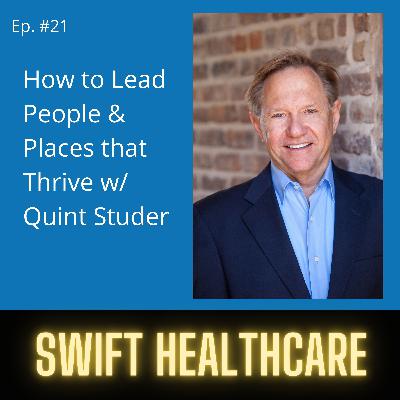
How do you lead people & places that thrive? Quint Studer guests on Swift Healthcare Podcast where we discuss his Wall Street Journal bestseller “The Busy Leaders Handbook,” the importance of addressing our own emotional health as well as the emotional health of our workforce, and critical concepts that all leaders and aspiring leaders can benefit from hearing. Plus what’s next on the horizon from Quint’s upcoming book titled, “The Calling.” It’s a MasterClass from a legend in healthcare and you do not want to miss it!
Ranked a Top 60 Healthcare Leadership podcast by Feedspot.
Listen & Watch: https://swifthealthcare.com/podcast/
Apple Podcasts: http://apple.co/3aFpEpl
YouTube: https://youtu.be/g5QLzwVc9CM
(A Top Healthcare Leadership YouTube Channel)
Quint Studer Links for Show notes:
www.quintstuder.com
https://thebusyleadershandbook.com/
https://gratitude-symposium.heysummit.com/
www.studeri.org
Music Credit: Jason Shaw from www.Audionautix.com
THE IMPERFECT SHOW NOTES
To help make this podcast more accessible to those who are hearing impaired or those who like to read rather than listen to podcasts, we’d love to offer polished show notes. However, Swift Healthcare is in its first year.
What we can offer currently are these imperfect show notes. The transcription is far from perfect. But hopefully it’s close enough – even with the errors – to give those who aren’t able or inclined to audio interviews a way to participate. Please enjoy!
Transcript
MasterClass: How to Lead People & Places that Thrive w/ Quint Studer
[00:00:00] Patrick Swift, PhD, MBA, FACHE: [00:00:00] Welcome folks to another episode of the Swift healthcare video podcast. I am so excited about our guest for this show. Today, we have Quint Studer, Quint. Welcome to the show.
[00:00:10] Quint Studer, MS: [00:00:10] I'm pumped about you being here, in fact, and I own a minor league baseball team and it's all about high energy, high fun. And if you're not, if you're thinking about getting a side job on healthcare, we could use you at the ballpark now. So thank you.
[00:00:24] Patrick Swift, PhD, MBA, FACHE: [00:00:24] I would, I would jump at that chance, , you know, be careful what you ask for Quint. I'm a,
[00:00:28]Quint Studer, MS: [00:00:28] We're ready.
[00:00:29] Patrick Swift, PhD, MBA, FACHE: [00:00:29] My wife's in Miami right now, visiting some family. I think I'd be happy to get down on the Pensacola. Folks, if you can feel the love. , I hope you can because the man we have on the show here, , I, , have the greatest respect for, and you are in in for a treat and, , Quint. I know you're a humble man. , and I just want to acknowledge how, , you have impacted this profession. So folks, if you are listening, pay attention because I have a master class for you in this conversation.
[00:00:56] And most importantly, with my values, it's about joy, [00:01:00] hope, compassion, courage. And who better to have on the show than Quint Studer. So here's Quint's bio. If you don't know who Quint Studer is, listen to this Quint Studer is a well-known healthcare operator, author, coach, and mentor to many, many, many, many.
[00:01:15] He has dedicated the last three decades to creating tools and techniques that make healthcare a better place for physicians to practice medicine, patients, to receive care and employees to work. He's written numerous books. I've got a couple here on my desk. I'm going to show you articles. And his work is always based on evidence, research and tools and techniques. So Quint Studer, welcome to the Swift healthcare video podcast.
[00:01:40] Quint Studer, MS: [00:01:40] No, no, I'm excited to be here. Thanks for the opportunity.
[00:01:43] Patrick Swift, PhD, MBA, FACHE: [00:01:43] Absolutely Quint. So let's kick it off with some fun here. And, , uh, I want to ask you in your own words what got you into healthcare? Why do you do what you do? Quint?
[00:01:54] Quint Studer, MS: [00:01:54] Well, it's going to be way different than most people think. , alcoholism got me into healthcare. [00:02:00] Um, I was, When I was 31 years old, December 24th of 1982, I crashed, I surrendered personally. All of a sudden I had that moment of clarity. They talk about, and I said, this isn't my life's not trending in the right direction.
[00:02:16] And so I sought help and I'm a recovering alcoholic. I'm in my 39th year of sobriety. So how I got into healthcare was I was, it's going to 12 step meetings at a hospital that treated people for alcoholism. And I was going to meetings and, , I saw an ad that they were looking for someone to work at the treatment center in, in working with school districts and employers. And because I was a teacher of children with special needs. and when, once I got in recovery, I started something called a student assistance program. It mirrored an employee assistance program, but for students that they could reach out, particularly if they had a family member or so on. So i.
[00:02:55] Patrick Swift, PhD, MBA, FACHE: [00:02:55] you did Quint. That's great. That's fantastic!
[00:02:59] Quint Studer, MS: [00:02:59] I, I, [00:03:00] um, talked to them and they hired me as a community relations rep. And I did that for three years and one employee, a worked in a hospital before they went back to work, we did something called a back to work. And I, , went with them to talk to the human resource person about how do they reenter the workplace. And one day a human resource person at a hospital in Wisconsin said, you know, we have an opening here. In marketing community relations, you really do a good job. Why don't you come here? So that's how I got into healthcare. So when I speak to colleges, they want to know my career track. I say, well, it might not be the one you want to follow, but it is what it is.
[00:03:38] Patrick Swift, PhD, MBA, FACHE: [00:03:38] Uh, I, I love that Quint because I love the expression. , Turning your, your kryptonite into super your super power. And, , what you've done in the arc of this story even is acknowledging, , the, the sorrow and the rock bottom and the insight and the compassion that arose from that. And by [00:04:00] that suffering and sorrow has led to, a global impact on raising the bar in healthcare,
[00:04:06] Quint Studer, MS: [00:04:06] Yeah, we
[00:04:07] Patrick Swift, PhD, MBA, FACHE: [00:04:07] in
[00:04:07] Quint Studer, MS: [00:04:07] You know in recovery when you help, when you help somebody recover, they call it 12 stepping or bringing 12 steps to them. And I tell people I've been 12 stepping healthcare now for a while.
[00:04:17] Patrick Swift, PhD, MBA, FACHE: [00:04:17] I love it. I love it. So folks, , step on up let's step here. , I I'm, I'm inspired by that. , , , Phrase, turn of phrase. We're we're, we're 12 stepping healthcare here. , there's so much for us to talk about in thinking about this conversation. One of the first questions I want to ask you, , is listen, folks I've got Quint has published many books. I've got. , the busy leaders handbook, how to lead people in places to thrive, building a vibrant community. , but the first one I read of Quint's , this is my favorite. , you can see it's dog ear-ed and got all kinds of notes on it ears, hardwiring excellence. And, , I happen to love this book and I wanted to ask the author. , what, , what about that book, , is your favorite [00:05:00] part, your favorite message that stands out of that book?
[00:05:02] Quint Studer, MS: [00:05:02] Well, I think that my favorite part is when you read the stories about people recapturing their purpose in healthcare. For example, on page 251, I got, I got a letter from a person who I'm and I'll just read it real quick and I'll, I won't read the whole, whole thing. It says, ,
[00:05:18] I know I make a difference. One of my employees who had been here just about a year, became employee of the month when it was announced, she received the recognition of brought tears to her eyes. She was pleased during the whole month. Usually she was very quiet and somewhat withdrawn. During this month. She was one of the girls. We talked about things with their coworkers that she had never talked about before.
[00:05:37] The moment I realized just how much it meant to her was when she was diagnosed with cancer is during the month she was employee of the month while talking to her husband about a return to work. He mentioned to me that she never felt so included and proud in her whole life. The job here at the hospital is a dream job for her, and she had really not felt worthy of working here.
[00:05:55] Just so proud of her employee, of the month plaque , that she hung in her living room for all to see during your [00:06:00] illness. She felt she had an extended family. She said she felt loved by her coworkers. We visited her on a regular basis and called her several times a week to see if she needed anything about five months later, Susan, our coworker died. We were very sad at her passing. I personally attended her funeral with four other women from our office. As we approached the coffin, we saw something at the exact same moment that we could not believe on the back of her coffin. next to her shoulder was her employee of the month plaque and a card signed by all of us in the office at that moment in my life. I thought of you for, I had made a difference.
[00:06:32]That's that's what I love, you know, health care. We come in with a full emotional bank account, but because what happens there there's withdrawals . So what I love the most is when I see people, , sort of recapturing it. And once you recapture it, you realized how much you missed it, and then you keep it.
[00:06:51] Patrick Swift, PhD, MBA, FACHE: [00:06:51] Yeah. Yeah. I love that. And in the face of the burnout and the suffering and the sorrow that our colleagues in healthcare, whether you're [00:07:00] new to the profession, whether you're a CEO, whether you're near retirement, it doesn't matter. Ther
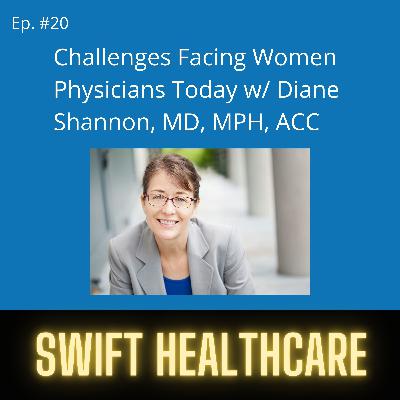
Tune into Swift Healthcare Podcast with guest Diane Shannon, MD, MPH, ACC
Ranked a Top 60 Healthcare Leadership podcast by Feedspot.
Dr. Diane Shannon is a former primary care physician, a certified coach, and co-author of the book, Preventing Physician Burnout: Curing The Chaos And Returning Joy To The Practice Of Medicine. Her personal experience with burnout and conversations with hundreds of physicians motivated her to pursue coaching training and certification. She now helps women physicians harness their superpowers and create lives in which they can thrive. She also continues to advocate for health system change through her writing, which you can find on LinkedIn or her website, dianeshannon.com.
Links for Diane Shannon, MD, MPH, ACC:
https://www.linkedin.com/in/dianewshannon/
www.dianeshannon.com.
Music Credit: Jason Shaw from www.Audionautix.com
THE IMPERFECT SHOW NOTES
To help make this podcast more accessible to those who are hearing impaired or those who like to read rather than listen to podcasts, we’d love to offer polished show notes. However, Swift Healthcare is in its first year.
What we can offer currently are these imperfect show notes. The transcription is far from perfect. But hopefully it’s close enough - even with the errors - to give those who aren’t able or inclined to audio interviews a way to participate. Please enjoy!
Transcript
[00:00:00] Patrick Swift, PhD, MBA, FACHE: [00:00:00] Welcome folks. In another episode of the Swift healthcare podcast, I'm delighted that you're here and I've a wonderful guest for us. Diane Shannon, Diane. Welcome to the show.
[00:00:09] Diane Shannon, MD, MPH, ACC: [00:00:09] Thank you so much, Patrick. Glad to be here.
[00:00:11] Patrick Swift, PhD, MBA, FACHE: [00:00:11] It's a joy having you here, Diane and folks. Let me share with you. Diane's bio I want to encourage you to perk your ears. This is, this is going to be a good one. Dr. Diane Shannon is a former primary care physician. She's a certified coach and a co author of the book, preventing physician burnout, curing the chaos and returning joy to the practice of medicine. Isn't that delicious title. And I'm sure the wisdom in that book, doesn't just apply to physicians. It applies to addressing burnout in general, but, uh, with a passion for addressing physician burnout is what that book is about.
[00:00:46] And her personal experience with burnout and conversations with hundreds of physicians and motivated her to pursue coaching, training, and certification. She now helps women physicians harness their superpowers. I love that [00:01:00] and create lives in which they can thrive. She also continues to advocate for health system change through her writing, which you can find on LinkedIn.
[00:01:07] And we'll talk about her website. So stay tuned on that. But Diane. Welcome to the show. I'm delighted to hear Diane. And so let's jump right into it. And the focus of the show we're going to be talking about here is challenges. Facing women physicians today. And today is a loaded term because there's so much going on.
[00:01:32] Socio-politically in health care. COVID the aftereffects of COVID. There are so many elements in here that I'm, I'm delighted that we can be spending some time talking about this with Diane and talking about her research, but I'd love to start Diane with just your, why w what got you into this work recognizing you described yourself as a former physician.
[00:01:52] But I expect my MDs and respect what you've accomplished in your academic career. So tell us about that, uh, in, in how you perceive [00:02:00] yourself and how you've been contributing.
[00:02:02] Diane Shannon, MD, MPH, ACC: [00:02:02] Right. So I was inspired to become a physician because of my mother. Like a lot of physicians are inspired by family members. My mother was a nurse midwife. And I was lucky enough to be able to shadow her. At times with her patients, she had her own independent birth center, and I saw this incredible experience where she had these amazing connections with her patients.
[00:02:28] And I saw how satisfying her career was. It was really amazing and meaningful every day. And so that's what inspired me and I, uh, I happen to be good in biology. And so it was an easy movie, you know, Mo moved right into pre-med and then into med school and then into training and I chose primary care.
[00:02:48] Because I really, I really wanted that kind of connection with patients that, that meaningful connection that's healing. And now I understand healing both ways when that [00:03:00] connection works. And what I found is really starting in the clinical years, the third year of medical school, that the environment, the clinical environment was not really conducive to supporting that optimal relationship with patients.
[00:03:17] And one of the things I noticed first, I think was patient safety issues. And that really concerned me. Um, and this was back before the IOM report came out in 2001 that really, or 1999 and then 2001 that really focused attention on patient safety. So I was constantly aware of, okay, what do I have to navigate in order to protect my patients from something that might fall through the cracks?
[00:03:44] And I looking back now, I can say, I think that's part of what led to the burnout I experienced. Um, it probably wasn't all was also exacerbated by the conditions then, you know, there weren't work hour restrictions and was regularly working a hundred [00:04:00] hours a week. And sometimes as many as 130, I mean, it really was, um, overwhelming.
[00:04:06] So, uh, I thought about leaving, but I kept thinking, Oh, I'll just do the next thing. I'll just finish internship. I'll just finish residency. I'll just, you know, get my boards on, you know, pass my boards and then I'll, I'll start practicing and things will be better. And they were a little better, the worst rep, the worst burnout experience or symptoms that I had were actually during residency.
[00:04:29] Um, and I really, uh, I struggled, I, I felt like I gave up so many parts of who I am in order to, to be present for patients and get through training. Um, I, and I actually started having memory problems at home. Like within work, I was fine, but then I would come home and I'd forget things like zip codes, you know, just. Basics. Um, and I just, when I practiced, I, you know, I, I thought about, well maybe if this were a little bit different, so I changed [00:05:00] to a different practice site. Maybe if this were a little bit different and I just didn't see the kind of wholesale change to create an environment where I would feel I could connect with patients and also have a life. And so I made the decision to switch. And so I, I actually, in the last year I was practicing was part-time got a master's in public health because I really love looking at the big picture. And then I transitioned into a job at a communications company. So really overseeing the accuracy of medical documents that they had and what I found, I fell into writing while I was there.
[00:05:42] I loved it. And I thought this is what I want to do. So I left and I was a freelance writer for more than 20 years. And I gravitated towards writing about the healthcare system to try to understand what's going on with it. What are some of the patient's safety issues? How could things be [00:06:00] better and was I'm so inspired by. Individuals and organizations who see that and then make a change and have improvement and watching how that improvement can have a ripple effect. So that was really inspiring to me. And while I was doing that happened to, um, run across the definition of professional burnout, a light bulb went off and I thought, Oh, there's a name for it. I had no idea.
[00:06:28] Patrick Swift, PhD, MBA, FACHE: [00:06:28] Uh huh.
[00:06:29] Diane Shannon, MD, MPH, ACC: [00:06:29] And I happen to be working with a coach at the time. And she said to me, Diane, why have you never told your story publicly about leaving medicine and burnout? And I said, are you kidding? Why would I do that? Like, it just, it felt like such a w and I carried shame about it. Like, I should have been able to hack this.
[00:06:53] You know, and so over time I began to see that it actually was courageous to leave something that [00:07:00] wasn't working and to recreate a life that had some meaning. Right. And that worked for me. And so I did, I told my story, um, I wrote it, um, In a guest post on an NPR website and there was this amazing uptake.
[00:07:17] So there was something like 26,000 views in the first week. And this was, this was before much was written about physician burnout. So I think that came out in 2012 and physicians began contacting me and they'd say, I didn't know, anyone else felt this way. Right. Here. Here's what, here's what my life looks like right now.
[00:07:40] And I can't do this. Right. So that just inspired me to continue writing about it. I started a blog, um, ended up writing the book with my coauthor, Paul DeChant another physician. Now the book after interviewing all these experts about healthcare and the healthcare [00:08:00] system and burnout and physicians with burnout, what became so clear to us in writing the book is burnout is a reflection of a system problem.
[00:08:09] Patrick Swift, PhD, MBA, FACHE: [00:08:09] amen to that.
[00:08:10] Diane Shannon, MD, MPH, ACC: [00:08:10] Yeah. So I left that experience of, you know, writing the book. It's thinking. The only way to fix burnout for clinicians is to fix these deep complex system problems. And that's the only way that that was my thinking.
[00:08:27] Patrick Swift, PhD, MBA, FACHE: [00:08:27] yeah.
[00:08:29] Diane Shannon, MD, MPH, ACC: [00:08:29] And then I had an experience. What has helped me to see that it's a, both and situation.
[00:08:35] So that is the core of what drives burnout are system problems? No, it's the, it's the incredible amount of administrative work,
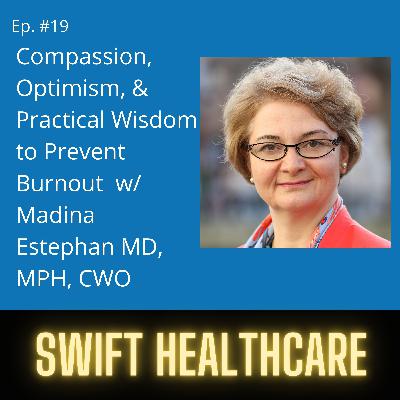
This episode records from Paris, France where we discuss the impact of COVID, keys to resilience for healthcare professionals, and practical wisdom to prevent burnout.
Ranked a Top 60 Healthcare Leadership podcast by Feedspot.
Dr. Estephan on LinkedIn:
https://maison-estephan.com/
https://www.linkedin.com/in/madinaestephanhealthcarecwo/
Music Credit:
Jason Shaw www.Audionautix.com
THE IMPERFECT SHOW NOTES
To help make this podcast more accessible to those who are hearing impaired or those who like to read rather than listen to podcasts, we’d love to offer polished show notes. However, Swift Healthcare is in its first year.
What we can offer currently are these imperfect show notes. The transcription is far from perfect. But hopefully it’s close enough - even with the errors - to give those who aren’t able or inclined to audio interviews a way to participate. Please enjoy!
Transcript
[00:00:00] Patrick Swift, PhD, MBA, FACHE: [00:00:00] Welcome folks to another episode of the Swift healthcare podcast . I'm Patrick Swift, your host, and I want to thank you for being here. Thank you for listening from South Africa and Latin America and Europe and the United States and all over. I'm grateful for our listeners and thank you for your support, uh, for the podcast as well. So for our show today, I have a wonderful guest, Dr. Madina Estephan, Madina . Welcome to the show.
[00:00:24] Madina Estephan, MD, MPH: [00:00:24] Hello. Hello, Dr. Swift . Thank you very much for inviting me. I'm so glad to be here today on show.
[00:00:34] Patrick Swift, PhD, MBA, FACHE: [00:00:34] I'm delighted you're here. I know that I know you used the word to let it all the time because I am delighted. Uh, and I'm so delighted to hear folks. Um, Dr. Estephan Madina , uh, is in Paris, France. And so I'm just like jump up and down. Pinch myself, excited, having been to Paris, having a great love for Paris as in American, how wonderful it is to have a guest on the show that's broadcasting from Paris, so, and a physician from Paris. So. [00:01:00] Here's Dr. Madina Estephan's bio coming from a family of three generations of healthcare professionals. Dr. Estefan, whose passion for the medical field was inspired at an early age. Can you imagined growing up at that household? , it led her to earn a medical degree. Obtain a master's degree in public health and as a multilingual multicultural health professional with over 20 years, clinical practice and international management experience, her career has been focused on training and consultancy. And she's focused on empowering you.
[00:01:31] She's focused on empowering healthcare professionals, healthcare leaders, healthcare providers, um, to unfold their therapeutic excellence. Unlock internal resources and unleash practical wisdom. I love that. I think we could all, you know, I got some gray hairs and lost all the hair on the top of my head. I think we could all use some, um, some wisdom and practical tools.
[00:01:51] So we're focusing on compassion, optimism, and practical wisdom for this episode. So that being said, Dr. [00:02:00] Estefan, let's just jump in Medina or a question here. Um, you know, welcome to the show from Paris. What's going on in Paris, right in here. What's the what's what's the latest. How, how, how are things.
[00:02:12]Madina Estephan, MD, MPH: [00:02:12] Listen, the good news. I have two news. Good news. Bad news. I'll start with the good one. The good news is that we have wonderful weather and the spring came. And so, uh, that's, uh, gives your energy, right? And the other staff is that we were in the middle of the pandemic. That's a bad piece of news, but we're rather struggling and the making all the best in the healthcare systems, this, , third wave slowly but surely so, and hopefully we'll be over that. And then we will welcome guests from the other side of a planet in Paris. One day.
[00:03:00] [00:03:00] Patrick Swift, PhD, MBA, FACHE: [00:03:00] Of course, of course I was listening to BBC and, uh, yesterday world service. And, um, there was a piece on, I believe, 80,000 new cases and, , you as a leader in, um, services and consulting and support, um, I know that you're in the middle of, , , helping healthcare professionals, , dealing with the burnout and the struggle and the pandemic and, and for the show, we're focusing on compassion, practical wisdom, and optimism.
[00:03:30] One of the things you talk about as soft skills and the importance of soft skills, and I would call them survival skills as well. What are the, what are the soft skills that, that healthcare professionals can be mindful of in their daily life right now? Just to get through everything going on.
[00:03:49] Madina Estephan, MD, MPH: [00:03:49] So you're absolutely right. It's not only survival skills. So I will say like French people also, so savoir vivre , right. Uh, [00:04:00] to know how to leave, you have to know to know how to be in Samoa fair, to know what to do. So let's call them survival or even human skills or skills of how to be, right. So, because somewhere what to do, we know as healthcare professionals and patient is expecting from us, the knowledge they expertize.
[00:04:32] So knowledge in your specific specialty, the hard knowledge, right? And the other side, we need those survival skills, uh, to know how to be ourself, how to protect ourselves, how to give the best of ourselves. Right. So, and amongst those soft skills for me, there are some which is absolutely [00:05:00] necessary to have in your toolbox, like a tool of books, like compassion, optimism, or those ma uh, practical wisdom skills, which are in a capacity.
[00:05:14] I think of the health care professionals. So, and when talking about compassion, Coming from the Latin word com passion , literally, which means I suffer with is the capacity of feeling suffering of the other's pain. Right. But all the other sides there is another part of the story is the willingness to act and do something to relieve suffering from the other one .
[00:05:45] Right. This is the, the, uh, the most, let's say demanding part of the compassion to be compassionate. I like the composition that compassion is in love in [00:06:00] action. It means to be able to put. Some kind of action plan to relieve the suffering from others. But as healthcare professionals, we're deeply suffering ourselves.
[00:06:14] Right? When we exercising our duty everyday duty activities, we have plenty of professional risks. There, including emotional exhaustion, distress, burnout, et cetera, and, uh, compassion, fatigue. So, first of all, we have to learn how to be compassionate with ourself, right. To stop and use the skills of compassion toward ourselves as the healthcare professionals and be able to them.
[00:06:48] Patrick Swift, PhD, MBA, FACHE: [00:06:48] I'm so glad you said that because it's about. If, if we are reminded every day to be compassionate with our selves with ourselves, it's still not enough. [00:07:00] We in the health care profession, you saying the importance of self compassion and for a listener right now, whether you're a healthcare leader, healthcare provider, um, healthcare professional, anyone working in healthcare, uh, Dr. Estephan's . Voice I'm telling you the importance of self-compassion. We needed that every day, uh, to be compassionate with ourselves and, and Medina, you speak about, um, emotional assertiveness of, of, um, come across some things you've written. And, um, I would appreciate your thoughts about emotional assertiveness in light of preventing burnout or addressing burnout or reducing burnout.
[00:07:38] What's the importance of emotional assertiveness? What's that about?
[00:07:43] Madina Estephan, MD, MPH: [00:07:43] Thank you Patrick, for this question because emotional assertiveness actually is a tool. Let's say, well, it's not invented by me. It was invented by invented or concept alive by John Parr, who is a UK, uh, doctor of [00:08:00] psychology. And actually it's a kind of tool which helps you regulate difficult emotions.
[00:08:09]Okay. In the way of understanding that we all are looking for the inner state of happiness, right? And this inner state of happiness can be of different degree for, from calm to joy. Right. And to get the Zener state of happiness we're always handling or, um, uh, facing different type of emotions. I, those emotions, the principal one is an anger.
[00:08:42] When something's going on around ourselves, in the environment, something goes wrong. We react in the first reaction is always anger. Then there can be anger, which is not expressed. Right. And then w [00:09:00] we can not handle the singer or express it authentic when it's happened. We're going to. focus and anger deeply inside of ourself and hurting somewhere else, self knowing what's going on with you, internalized anger, which is actually the part of the story.
[00:09:23]So facing these anger and be able to express anger in the right manner and the right place with the right person is the kind of emotional assertiveness . Yes.
[00:09:38] Patrick Swift, PhD, MBA, FACHE: [00:09:38] I love it. I love it. The notion of being angry at the right person at the right reason at the right time,
[00:09:45] Madina Estephan, MD, MPH: [00:09:45] authentically yes, typically affected that's that's the most important and how to learn, how to, to learn, to express the singer. First of all, to feel it, to [00:10:00] understand why, where. And from which part of you is coming from the past experience over the future experience, and then anchor yourself here in here now.
[00:10:11] So emotional assertiveness to express your rights and do what is right to do without harming others and taking the right of others.
[00:10:24] Patrick Swift, PhD, MBA, FACHE: [00:10:24] Beautiful. Beautiful. And these are all critical, um, skills, soft skills, emotional assertiveness, that the self-reflection what you're speaking about or that self-awa
Part 2 - Uncaring: How the Culture of Medicine Kills Doctors & Patients w/ Robert Pearl, MD.
Tune into Swift Healthcare Podcast to hear Robert Pearl, MD discuss his new book which has already become a #1 New Release in multiple Amazon categories and is soon to be a NY Times Bestseller!
Ranked a Top 60 Healthcare Leadership podcast by Feedspot.
In his new book, Dr. Pearl shines a light on the unseen and often toxic culture of medicine. Today’s physicians have a surprising disdain for technology, an unhealthy obsession with status, and an increasingly complicated relationship with their patients. All of this can be traced back to their earliest experiences in medical school, where doctors inherit a set of norms, beliefs, and expectations that shape almost every decision they make, with profound consequences for the rest of us.
Robert Pearl, MD Links:
https://robertpearlmd.com
https://robertpearlmd.com/books/
https://www.linkedin.com/in/robert-pearl-m-d-32427b98/
Music Credit: Jason Shaw from www.Audionautix.com
THE IMPERFECT SHOW NOTES
To help make this podcast more accessible to those who are hearing impaired or those who like to read rather than listen to podcasts, we’d love to offer polished show notes. However, Swift Healthcare is in its first year.
What we can offer currently are these imperfect show notes. The transcription is far from perfect. But hopefully it’s close enough - even with the errors - to give those who aren’t able or inclined to audio interviews a way to participate. Please enjoy!
Transcript
Patrick Swift, PhD, MBA, FACHE: [00:00:00] [00:00:00] Welcome folks to another episode of the Swift healthcare video podcast. I'm delighted that you're here and I have an amazing guest for our episode to Dr. Robert Pearl. Welcome back to the Swift healthcare video podcast, Dr. Pearl.
[00:00:13] Robert Pearl, MD: [00:00:13] It is a privilege to be back, Patrick , looking forward to it all week long.
[00:00:17] Patrick Swift, PhD, MBA, FACHE: [00:00:17] I'm glad, I'm glad. I'm glad. And we are talking about your book that is coming out Uncaring: How the culture of medicine is killing doctors and patients. I'm going to say that title again. It is packed Uncaring: How the culture of medicine is killing doctors and patients. And in this episode, last episode, hopefully you've dialed in and heard that one.
[00:00:40] This episode, we're going to be talking about doctors. We're going to be talking about providers and it wouldn't do justice without giving a little intro for Dr. Pearl here. So Dr. Pearl bear with me and for listeners, please take this in who you're listening to. This is Dr. Robert Pearl. He's the former CEO of the Permanente medical group, [00:01:00] the nation's largest medical group.
[00:01:01] At the time he was there in 99 to 2017, former president of the Mid-Atlantic Permanente medical group, 2009 to 17. He's led 10,000 physicians, 38,000 staff. These are people that get up in the morning and report to work. We're looking at 50,000 plus that he supported, uh, 5 million Kaiser Permanente members.
[00:01:20] He's been listen to this named one of modern healthcare's 50 most , influential physician leaders. And you're listening to him right now. He has a. Authored several books I'm gonna touch on that, but he's also hosting podcasts, fixing healthcare, another one, Coronavirus, the truth. And then he has a newsletter Monthly Musings on American healthcare.
[00:01:42] He's a regular contributor to Forbes. And the first book I'm sure we'll touch on one was Mistreated: why we think we're getting good healthcare and why we're usually wrong. Holy crap. That is just a great title. Uh, and then this new book coming out, uncaring, how the culture of medicine kills doctors and patients. With that [00:02:00] said the intro, Dr. Pearl, let's just jump right into it. And, , you have done some amazing things. I want to ask you number one, thanks for being on the show
[00:02:10]Robert Pearl, MD: [00:02:10] Thank you.
[00:02:11] Patrick Swift, PhD, MBA, FACHE: [00:02:11] Two , uh, we're talking about providers, folks, This book that's coming out is supporting doctors without borders, all the , all the proceeds of the goes to the doctors, to the borders. He's done some really cool stuff involving Ebola response to tsunamis, and I've got to pick his brain, uh, just because, um, share some insight being there. We're talking about providers, we're talking about professionals, we're talking about physicians. Um, what was your experience supporting providers, physicians, um, particularly, um, but supporting providers in response to Ebola and, uh, the tsunami
[00:02:45] The tsunami was fascinating because it was a lot more than just physicians. A lot of psychologists actually participated because the mental health issues of the people in Sri Lanka, which is where we went along with doctors without borders, [00:03:00] uh, was tremendous. So this happened, people may remember a little over a decade ago, a tsunami hit the area. Uh, it was the day after Christmas, but we knew that there were a lot of people who were killed, harmed and about to be harmed because the upcoming diseases with the communicable diseases and the contaminated water or the malaria then invariably would come. And so we worked with doctors without borders, uh, to figure out how we could send teams of volunteers there. I sent a secure email out to my physicians. Uh, they 10,000 of them. And I said, how many of
[00:03:47] day after Christmas.
[00:03:49] Robert Pearl, MD: [00:03:49] The day after Christmas? So half of them were on vacation with their family. And I said, how many of you would be willing to volunteer? And they're not going to get paid. We'll provide the [00:04:00] supplies. We'll provide the transportation, but they're, they're on vacation.
[00:04:03] This is their vacation to go to Sri Lanka. And then of course I'm a physician. So I have to provide informed consent. Number one, there may not be any food. Number two, the water could easily be contaminated. And number three there's been a civil war for 20 years. I figured maybe I get five or six over 200 people volunteered that week.
[00:04:26] Or we ended up sending 10 trips, saving tens of thousands of lives, providing the psychological support to them, avoiding malnutrition, avoiding death from diarrhea, avoiding malaria, all the different pieces, depending upon how the epidemic happened. And then we said teams to Guatemala. After the earthquake struck there, we sent teams to the South.
[00:04:55] After hurricane Katrina to Louisiana, we sent them [00:05:00] a great story. They arrived there and the police have a barricade up. So no one can come into the area where Katrina has been. So what do they do? They rent a car at night and they go around the police barricade so they can get in there and provide care to these people who were in tremendous need.
[00:05:17] And then the Ebola comes, uh, Liberia and the physicians there. And they're all physicians in this case because you need infectious disease, expertise and emergency expertise. They actually have to have IVs going into their arms while they're providing care, because they're wearing the protective suits that are so hot.
[00:05:36] It's 120 degrees inside the suit.
[00:05:39] Patrick Swift, PhD, MBA, FACHE: [00:05:39] Oh my God.
[00:05:39] Robert Pearl, MD: [00:05:39] are alive unless they're receiving IVs.
[00:05:43] Patrick Swift, PhD, MBA, FACHE: [00:05:43] Oh my God.
[00:05:44] Robert Pearl, MD: [00:05:44] And this to me is the amazing piece. Patrick, I talked to everyone who came back. Now just try to think about what it's like to be, be there. That 120 degree suit we're sitting there in the midst of a tsunami with knowing that there's civil war around you or the [00:06:00] hurricane debris of, uh, of central America. I have never seen happier physicians. The ones who went there made me think about all the trips that I've done. I fixed kids with cleft lip and cleft pallet. I've probably done a dozen trips to central South America, to some other countries as well. You know, you go there, you work 12 hour days, the ORs are not air conditioned.
[00:06:23] Food is rice and beans and everyone comes back fulfilled. Now think about in the context of burnout, what is missing? It's not the comfort, it's not the money. It's the mission and purpose. I think that we have lost that. And that's part of why I wrote on caring, how the culture of medicine kills doctors and patients, because I think some of it, much of it has been done to us, but much of it we've done to ourselves.
[00:06:53] And hopefully we'll get into that in greater detail. So people can start working on ways to [00:07:00] minimize the harm that they're experiencing.
[00:07:02] Patrick Swift, PhD, MBA, FACHE: [00:07:02] Yeah, your a story. It brings tears to my eyes. You're just talking about these people who are, um, volunteering. I mean, it's hope you speak about hope, Dr. Pearl. There's so much pessimism and confusion and misinformation and, and sarcasm and negativity and your story of expecting five and you get 200, um, people putting them their, their lives at risk, um, uh, giving up not only just vacation, but risking their lives, um, in Liberia and, and, and Sri Lanka. And, and these are stories of, of the reason why we go into healthcare. We all want to make that difference. Healthcare people are mission-driven people. And what you're talking about is, uh, facilitating folks, being able to follow their Dharma, follow their calling. And I know in the previous episode, we talked about you following your Dharma and your calling, and, um, it's so beautiful.
[00:07:57] That's why we go into healthcare we're mission [00:08:00] driven people, and you touch on being done to us as providers and doing it to ourselves, and that leads to a conversation about culture. Um, and, um, uh, I'm curious about your thoughts in this, in light of the amazing book that you hav
Part 1 - Uncaring: How the Culture of Medicine Kills Doctors & Patients w/ Robert Pearl, MD. Tune into Swift Healthcare Podcast to hear Robert Pearl, MD discuss his new book which has already become a #1 New Release in multiple Amazon categories and is soon to be a NY Times Bestseller!
Ranked a Top 60 Healthcare Leadership podcast by Feedspot.
In his new book, Dr. Pearl shines a light on the unseen and often toxic culture of medicine. Today’s physicians have a surprising disdain for technology, an unhealthy obsession with status, and an increasingly complicated relationship with their patients. All of this can be traced back to their earliest experiences in medical school, where doctors inherit a set of norms, beliefs, and expectations that shape almost every decision they make, with profound consequences for the rest of us.
Robert Pearl, MD Links:
https://robertpearlmd.com
https://robertpearlmd.com/books/
https://www.linkedin.com/in/robert-pearl-m-d-32427b98/
Music Credit: Jason Shaw from www.Audionautix.com
THE IMPERFECT SHOW NOTES
To help make this podcast more accessible to those who are hearing impaired or those who like to read rather than listen to podcasts, we’d love to offer polished show notes. However, Swift Healthcare is in its first year.
What we can offer currently are these imperfect show notes. The transcription is far from perfect. But hopefully it’s close enough - even with the errors - to give those who aren’t able or inclined to audio interviews a way to participate. Please enjoy!
Transcript:
[00:00:00] Patrick Swift, PhD, MBA, FACHE: [00:00:00] Welcome folks to another episode of the Swift healthcare video podcast, I am delighted that you're here welcome to our listeners in Latin America and Eastern Europe and the United States and all over the planet because I have an amazing guest.
[00:00:12] I'm so excited about Dr. Robert Pearl, Dr. Pearl. Welcome to the show.
[00:00:17] Robert Pearl, MD: [00:00:17] Thank you, Patrick. It's an honor. And a privilege to be here.
[00:00:20] Patrick Swift, PhD, MBA, FACHE: [00:00:20] Well, delighted you're here. And folks, I want you to take a seat, get comfortable. You're about to experience a masterclass. And, um, I could not ask for, uh, a better guest for a show. That's looking at the intersection of healthcare and leadership. Pop the hood. Look at the engine of healthcare. Talk about it from a, from a, uh, heart and head, an understanding perspective and someone who can see the big picture.
[00:00:47] Uh, Dr. Robert Pearl, I have this bio, I've got to read you a portion of his bio. Dr. Robert Pearl is the listen to all this, the former CEO of the Permanente medical group, the nation's [00:01:00] largest medical group former president of The Mid-Atlantic Permanente Medical Group in these roles, he led 10,000 physicians, 38,000 staff, healthcare professionals, responsible, nationally recognized medical care and 5 million Kaiser Permanente members.
[00:01:15] That's one. Two: one of the nation's Modern Healthcare's 50 most influential. Physician leaders. I know Robert is going to try to stop me, but hang on there. I want to share this with listeners. He's the author of mistreated, why we think we're getting good healthcare and why we're usually wrong. Can you not resonate with that?
[00:01:33] Uh, his next book coming out, which I'm so excited about uncaring, how the culture of medicine kills doctors and patients, ah, such a great title. He hosts multiple podcasts, fixing healthcare, coronavirus the truth. We got to hear the truth about coronavirus God, uh, publishes a newsletter with over 12,000 subscribers.
[00:01:52] If you're not subscribed, please subscribe a monthly musings on health American healthcare. He's a regular contributor to Forbes. Um, [00:02:00] the man is a dynamo, um, leading with heart and, uh, let's start with the book uncaring, how the culture of medicine is killing doctors and patients at the top of the show.
[00:02:12] We're going to end on this, but at the top of the show, uh, Robert, please just share with folks, um, the book and how folks can get it and who it's helping. This is listen to this. Who's helping.
[00:02:24] Robert Pearl, MD: [00:02:24] Well, thank you so much, Patrick. When I wrote the book mistreated, I was talking about the systemic problems, how healthcare is paid for how healthcare is organized, how it's technologically or not technologically supported. And as I travel around the country and I talked about this in patients, it was clear to me there was something else missing.
[00:02:49] And I researched trying to figure out what it was. And I wrote the book about what I believe it to be, which is the physician culture. I don't know. I call it the physician culture is really the [00:03:00] culture of all people provide care. I just know the physician side, having been the head of the medical group far better than I know all the other pieces, but it equally applies.
[00:03:10] And for those of your viewers who do pre-order the book. They go to my website, Robert Pearl md.com, where they can find access to a lot of providers, all the profits go to doctors without borders, if five Oh one C3 charity providing healthcare around the globe as did the profits from Mistreated and anyone who pre-orders, the book will get some freebies, including a signed book plates, including the discussion guide, a bibliography of other books on the same topic and a chance to pre-read the introductory chapter.
[00:03:48] And it will be delivered to your home on May 18th, the official pub date.
[00:03:53] Patrick Swift, PhD, MBA, FACHE: [00:03:53] love it. I love it. I love it. And again, folks that the proceeds of this book are going for doctors without borders, Medecines [00:04:00] Sans Frontieres. Uh, this is for good. Um, and it encapsulates some wisdom and love and compassion and courage. and joy that Dr. Pearl was compelled in that composing that book. So this up number one.
[00:04:13] Thank you. And two. This episode, we're going to do the show in two segments. The book is titled uncaring, how the culture of medicine is killing doctors and patients and being providers. We were talking who who's, who we going to focus on first. And we agreed the patients were going to start with an episode on the patients.
[00:04:29] And so we're going to touch on, um, the elements of the book, but from the patient perspective. And, um, part of this is a conversation about culture. And I want to start with your why you became a physician, because I know this influences your perspective on culture and, and your parent experience and, and how all this comes together.
[00:04:51] So, so where does this passion come from? Dr. Pearl?
[00:04:55] Robert Pearl, MD: [00:04:55] So as a naive 17 year old, I headed off to college [00:05:00] and I wanted to be a university professor. I wanted to teach philosophy and my hero who ultimately became the chairman of Reed college. He was brilliant. Didn't get tenure because of his political views. And I decided I wanted to go with this, something that would have no politics and that would Medicine. We're talking about life and death, Patrick, how could you be?
[00:05:30] How could there be politics? So I went to medical school and then I went on to Stanford to become a heart surgeon. And guess what? I found the best physicians didn't always get the referrals. Yeah, it was politics who you knew the club you belong to. And I, I almost dropped out of medicine,
[00:05:53] Patrick Swift, PhD, MBA, FACHE: [00:05:53] Yeah. Wow. Wow.
[00:05:55] Robert Pearl, MD: [00:05:55] and then I have a chance to go to Mexico on a volunteer [00:06:00] trip and fix children with cleft lip and cleft palette. And I fell in love with that opportunity, the mission and the purpose. And that's how I became what I do today, which is a reconstructive plastic surgeon.
[00:06:16] Patrick Swift, PhD, MBA, FACHE: [00:06:16] I love that. I love that story. And in your bio, your, you serve as a clinical professor of plastic surgery at Stanford university school of medicine and your faculty of Stanford graduate school of business, where you teach courses on strategy and leadership in lectures on informational tech and healthcare policy. And so you're taking the wisdom and the heart of your calling and the love for caring for patients that cleft lip surgeries, you, you, you it's, it's tangible how you can transform lives. Um, with, uh, medicine and how you've, you've brought that into the work you're doing here. So let's talk about patients and, and culture.
[00:06:53] And so, you know, from that perspective of, of, uh, which that just made me laugh, it's, it's, uh, you know, didn't want to go [00:07:00] into a career that involved politics that you went in medicine, and here we are, who am I? God, talk about politicized. Um, let's put the lid and let's put the politics aside. If we, if we put the heart of healthcare to this conversation and kick the politics to the curb, um, let's talk about the culture, um, of medicine and how it's impacting patients.
[00:07:22] Robert Pearl, MD: [00:07:22] Culture represents beliefs, the values, the norms that we as clinicians learn medical school residency, or we carry the with us throughout our entire career. It's not written down in any textbook. It's not giving a lecture, but it's through the stories through the language that people use. When I try to explain to people about culture, I start in the 1850s with Ignaz Semmelweis.
[00:07:57] He's a physician in [00:08:00] Austria, in Vienna at the leading hospital, and he's appointed the head of the delivery service and he's appalled. He's embarrassed. 18% mortality rate. What's really irksome is that the adjacent facility one run by nurse midwives has two thirds lower mortality. Now at the time when patients died from was puerperal fever, overwhelming infection of the uterus spread throughout the body and the cause was felt to be miasmas . Foul smelling pa
What can we do to promote women’s health, increase health equity, and prevent Ovarian Cancer? LOTS! If you want inspiration and practical ideas to improve your health and the health of those you love, then tune into Swift Healthcare Podcast with guest Diane Powis, PhD, Chief Spokeswoman at Aspira Women's Health.
Ranked a Top 60 Healthcare Leadership podcast by Feedspot.
Diane Powis, PhD is a licensed healthcare provider, an advocate for women’s health, and the Chief Spokeswoman at Aspira Women's Health. Through her advocacy, storytelling, coordination and management of an ethnically diverse patient advisory board, she is working toward empowering women to take control over their gynecological health by increasing their awareness of symptoms, understanding their genetic risks, and knowing that Aspira’s life saving biomarker tools exist.
Special Note:
Dr. Patrick Swift/Swift Healthcare do NOT have any financial relationships with any commercial interests with Aspira Health. Dr. Swift invited Dr. Powis on the show because they are grad school friends and Dr. Powis has an amazing and powerful story to share with the world. The information in this episode is not intended or implied to be a substitute for professional medical advice, diagnosis or treatment. All content, including text, graphics, images and information, contained on or available through this video podcast/web site is for general information purposes only.
Dr. Diane Powis, PhD Links:
https://www.linkedin.com/in/diane-powis-a7885a37/
https://aspirawh.com/
Music Credit:
Jason Shaw from www.Audionautix.com
THE IMPERFECT SHOW NOTES
To help make this podcast more accessible to those who are hearing impaired or those who like to read rather than listen to podcasts, we’d love to offer polished show notes. However, Swift Healthcare is in its first year.
What we can offer currently are these imperfect show notes. The transcription is far from perfect. But hopefully it’s close enough - even with the errors - to give those who aren’t able or inclined to audio interviews a way to participate. Please enjoy!
Transcript:
Advancing Women's Health, Change the Story w/ Diane Powis, PhD
[00:00:00] Patrick Swift, PhD, MBA, FACHE: [00:00:00] Welcome to another episode of the Swift healthcare video podcast. I'm delighted that you're here and I have a fantastic guest for us today. Diane Powis, Diane. Thanks for being on the show. Welcome to the show. Welcome to the Swift healthcare podcast.
[00:00:12] Diane Powis, PhD: [00:00:12] Thank you. It's an honor to be here, Patrick. Thanks for having me.
[00:00:16] Patrick Swift, PhD, MBA, FACHE: [00:00:16] It's a joy having you here and the show title is Advancing Women's Health, Change the Story with Diane Powis . And let me tell you about Diane Powis, a dear colleague of mine. Diane has worked as a clinical psychologist since 2001. She did her training at NYU medical center, the Rusk Institute of rehab medicine.
[00:00:37] And then she suffered through the postdoctoral fellowship in neuro-psychology rehabilitation, psychology at Mount Sinai medical center in neuro-psychology rehab psychology. I say suffered because she and I both went through the same program LOL.
[00:00:51] Diane Powis, PhD: [00:00:51] We survived together?
[00:00:53] Patrick Swift, PhD, MBA, FACHE: [00:00:53] fellows and, um yes!, uh, the, and inspiration and trainingand outstanding training and all the wonderful stuff [00:01:00] that came with that as well. Right. Um, but since then, Diane, um, served as a rehabilitation psychologist neuropsychologist at Stanford hospital. And then she was at Greenwich hospital where she specialized in behavioral medicine.
[00:01:14] And, um, here's where it gets real. Not that that is a significant enough, um, in her training and the services done for patients and, and, and the community. Um, but here's where it really gets interesting in the work Diane's done; since 2019, Diane served as the chief spokeswoman for the MAT , Marilyn Ann Trahan charity program aimed at raising awareness.
[00:01:36] For health care providers on how to better prevent and detect early stage breast and ovarian cancers. And since then in November, 2020, Diane joined ASPIRA women's health, senior leadership team as chief spokeswoman and through her advocacy, storytelling, coordination management of an ethnically diverse patient advisory board, she's working toward empowering women.
[00:01:59] All [00:02:00] of us have benefit to that. She's, she's working on empowering women to take control over their gynecological health by increasing their awareness of symptoms and to understanding their genetic risks and knowing that APIRA's life-saving biomarker tools exist. Diane Powis, Dr. Diane Powis . Thank you for being here.
[00:02:16] Diane Powis, PhD: [00:02:16] Thank you, Patrick, what a lovely introduction. I really appreciate that. And, um, I'm really looking forward to our conversation today and trying to get the message out there. So
[00:02:27] Patrick Swift, PhD, MBA, FACHE: [00:02:27] and that's why we're doing absolutely. I'm happy to do it. So I'm going to give you the title again. Folks, Advancing Women's Health, Change the Story with Diane Powis. Folks, . I want you to bear in mind. This is about women's health, but it's. It's advancing healthcare in general, whether we're healthcare leaders, we're healthcare providers, whether we're healthcare leader providers, or whether we support the work being done in health care.
[00:02:50] These are issues that we all at least need to have a working knowledge of. And I'm grateful that Diane is on the show to talk with us about it. So Diane, if we could start [00:03:00] with your journey of misdiagnosis to diagnosis and the relevance to what we're talking about here now.
[00:03:07]Diane Powis, PhD: [00:03:07] Thank you. So yeah, my, my journey to diagnosis, , I, um, fortunately just have been so blessed with a very healthy life up until age 45. , I have beautiful family, husband and children, two great kids. , a working as Patrick mentioned, , it a very rewarding position as a clinical neuropsychologist rehab psychologist at various hospitals. , and suddenly after my 45th birthday. I started to develop some strange new problems and symptoms. , this period lasted for over 10 months overall. , and the symptoms varied. , it started with, , heavy menstrual periods, , with my gynecologist, , and the symptoms ranged from. [00:04:00] Pelvic discomfort and urinating frequently again, with my gynecologist to, , lower back pain to bowel problems, to, , just not feeling exhausted and just knowing something was wrong. , what happened over the 10 month period is I was bounced from specialist to specialist and the diagnosis of ovarian cancer. Was missed. , and I was misdiagnosed with everything and anything from perimenopause to, , urinary tract infections, which the tests were negative, but the doctor said, well, it must be a false negative because, , you're still healthy. Nothing else would be wrong with you? , this is by my gynecologist along the way, I was referred to a urologist because, , since the many antibiotics I took for my faux bladder infection, , didn't seem to help. He said, well, , sorry. My faux , , urinary tract infection didn't seem to help. He said it must be a bladder infection.
[00:05:00] [00:04:59] So he referred me and this was a new doctor for me. He did his in-office evaluation and he did an, an office scan. And I told him I was really worried. Something just felt wrong. And he looked me in the eye and he said, um, Diane, you're perfectly fine. And as I was. Leaving the office. I, you know, I still wasn't convinced that, you know, as he put it, I have an overactive bladder and just take these new pills and that will help me.
[00:05:27] Um, I said, you know, doctor, look, I really think something's wrong. In fact, it's not just my, my bladder when I have to have a bowel movement, um, having some severe cramping and pain. And he smiled, chuckled, looked me in the eye and this is a direct quote. He said, well, that sounds like a gastrointestinal problem. So I guess I'm completely off the hook. So, uh,
[00:05:54] Patrick Swift, PhD, MBA, FACHE: [00:05:54] guess I'm completely off the
[00:05:55] Diane Powis, PhD: [00:05:55] guess I'm completely off the hook. Um, and that was the end of [00:06:00] that appointment and that interaction. Uh, from there I was passed. I saw my GP. She diagnosed me with diverticulitis because of the stomach pain and cramping, based on an in-office exam, more antibiotics after which, uh, those didn't help.
[00:06:17] I went to a gastroenterologist. She thought I had colitis. Um, ultimately this is 10 months after my initial heavy menstrual periods where I had peri-menopause. Um, she was, she had me for a colonoscopy to confirm the colitis and I woke up from the Twilight of the procedure and she stood over me and said, um, listen, I, I can't, I couldn't get the tube through.
[00:06:45] Cause there was a blockage. Um, you have cancer. So I was completely. I was completely blindsided. Yeah. It was devastating
[00:06:54] Patrick Swift, PhD, MBA, FACHE: [00:06:54] Incredible to be going through that months and months, and months, and months and months of seeing our colleagues in [00:07:00] healthcare who go to work every day with the intention of doing good. Um, but if we work in a siloed mentality and we think we're either on the hook or off the hook, then it's no longer putting the patient in the center of the care, but.
[00:07:16] Um, uh, put in the hero as the center of the care instead of the patient and that's backward, and that resulted in your journey there. Diane, and I'm so sorry, you went through that experience and that's why you're here. I mean, there's so much at stake cause your, your, unfortunately your story is not an exception.
[00:07:35] Um, you're a spokeswoman. Um, what's at stake for women here in general, and those who love them, we should be al
In this episode, we explore the four fundamental human needs, strategies for developing your influence as a leader, and best practices to not only increase your effectiveness but also build your character as a person who does good in the world.
What are our four fundamental human needs as individuals and leaders – and how do highly collaborative relationships and social networks meet our needs as individuals and leaders? Tune in and find out!
Our guest is Michael E. Frisina, founder and president of The Frisina Group, LLC. and The Center for Influential Leadership who is responsible for teaching, publishing, and speaking on the current trends in organizational performance.
Dr. Frisina serves as Chairman of the Health Administration Advisory Council for the American Public University/American Military University and is also an Executive in Residence with The University of North Texas School of Public Health.
Dr. Michael Frisina links:
https://www.thefrisinagroup.com/
https://www.linkedin.com/in/michael-e-frisina-phd-ltc-r-united-states-army-717a9614/
Music Credit:
Jason Shaw from www.Audionautix.com
THE IMPERFECT SHOW NOTES
To help make this podcast more accessible to those who are hearing impaired or those who like to read rather than listen to podcasts, we’d love to offer polished show notes. However, Swift Healthcare is in its first year.
What we can offer currently are these imperfect show notes. The transcription is far from perfect. But hopefully it’s close enough - even with the errors - to give those who aren’t able or inclined to audio interviews a way to participate. Please enjoy!
Transcript:
Influential & Effective Leadership for Good w/ Michael Frisina, PhD, MBA, LTC(R)
[00:00:00] Patrick Swift, PhD, MBA, FACHE: [00:00:00] Welcome folks to another episode of the Swift healthcare video podcast.
[00:00:03] I'm Patrick Swift. And I'm delighted that you're here listening, watching, and we have a fantastic show for you. And the focus of our show is influential and effective leadership for good. And we have the illustrious Michael E. Frisina . Michael, welcome to the show.
[00:00:22] Michael Frisina, PhD, LTC(R): [00:00:22] Thank you, Patrick. Great to see you. Great to be with you.
[00:00:25] Hello everyone.
[00:00:26]Patrick Swift, PhD, MBA, FACHE: [00:00:26] . Thank you Michael, for being here and folks, let me share with you. Michael's bio. This is impressive. And here we go. Michael E. Frisina is founder and president of the Frisina group and the center for influential leadership. Responsible for teaching. Publishing and speaking on the current trends and organizational performance, Dr. Frisina is a retired career officer of the United States army medical department, and a former civilian healthcare executive. He served in multiple roles in his career. Uh, currently he serving as, uh, including all the work he's [00:01:00] doing as chairman of health administration advisory council with American public university American military university.
[00:01:06] He's the author of two books, influential leadership. Change your behavior, change your organization, change healthcare. I love that title and leading yourself to a higher level of performance. And he's working on a third book right now. All right. With the ACHE . Is that right? Michael? Yeah.
[00:01:22] Michael Frisina, PhD, LTC(R): [00:01:22] Health administration press titled effective leadership behavior.
[00:01:26] Patrick Swift, PhD, MBA, FACHE: [00:01:26] Awesome. This is great. I'm excited. I'm looking forward to seeing that, um, you've authored over 50 papers and published articles on leadership and organizational effectiveness, and he's a longterm ACHE faculty member in the executive leadership track and two-time educational grant awardee. And lastly, I'll share he's an executive in residence with the university of North Texas school of public health. Welcome Michael.
[00:01:50] Michael Frisina, PhD, LTC(R): [00:01:50] Thank you, Patrick.
[00:01:52] Patrick Swift, PhD, MBA, FACHE: [00:01:52] Yeah, man. And as a salute to Texas, um, for those of you watching the show, I've got my cowboy hat here. This is a 10 gallon resist all [00:02:00] hat and being a native Texan. I just have to, I have to throw out some, some heres to Texas, uh, for, um, for the show. And Michael, I want to begin by saying thank you for your service,
[00:02:11] Michael Frisina, PhD, LTC(R): [00:02:11] well, thank you. I'd still be doing it. If they didn't tell me I was too old, but I still, I can still pass the old physical fitness test. I don't know. I can do the new one, but I can still do the old
[00:02:20] Patrick Swift, PhD, MBA, FACHE: [00:02:20] one. That's fantastic. I wish I could say that. Um, but thank you for your service and my pleasure in honor of, um, veterans.
[00:02:28] Um, there's two things. One I want to bring up folks, um, is I'm a regular contributor to the wounded warrior project, monthly contribute my wife and I support the wounded warrior project. Um, very supportive of that. Um, and if you watch my show, you know, I drink a lot of coffee. And, um, I'm constantly sipping on my coffee as I'm talking to my guests and I have some coffee that someone sent me.
[00:02:51] This is not a paid endorsement. Um, this is just, uh, a dear colleague of mine sent me Trident coffee, um, which is a veteran owned business. So we need to support our veterans. [00:03:00] And it sounds a little like mariachi and their son of a son of a sailor is, um, uh, organic Mexico, choppa Chiapas , us and my Mexican grandmother.
[00:03:09] I is from Chiapas , the, the birthplace of, uh, some very, um, uh, socially progressive, uh, leaders in Mexico for a revolution. And certainly we need a revolution in healthcare. So a lot of good stuff to throw out here in the beginning of our show, and
[00:03:25] Michael Frisina, PhD, LTC(R): [00:03:25] it's not bad coffee. Uh, if you'd like to, uh, Try it, um, it's Navy coffee.
[00:03:30] It's not army, you know, army good army coffee. You can stand a spoon up inside a cup of coffee, but as the Navy goes, you know, go army beat Navy, um, former faculty at West point, I've got to make sure I stay true to the core. So, um, go army beat Navy, but it's not bad coffee.
[00:03:50] Patrick Swift, PhD, MBA, FACHE: [00:03:50] Uh, for an army guy, uh, saying that about me coffee that's high praise. So, uh, Dr. Frisina , thank you. And, and, um, we've got a good sense of humor at the same time. [00:04:00] You know, we've got some good content for you. Um, uh, and we're going to be talking about, um, effective leadership, influential and effective leadership for good. So let's get right to it. So starting with influential leadership, you and I had a little brief conversation before, and what we started touching on was fascinating to me.
[00:04:16] And I want you to you to ask you to share with us. From your framework in all your experience and the perspective you've had. You've distilled a lot of great content for folks who are listeners, whether you're a leader or you're an aspiring leader. I don't care if you're in high school. I don't care if you're a 68 year old CEO of a hospital, we all can learn about leadership.
[00:04:36] And this show is about best practices. As about understanding leadership and new, a new, a new, even if you're a black belt, if you maintain a white belt attitude, you can learn more and you can be better and you can do good. That being said, let's talk about the four fundamental human needs. Dr. Frisina .
[00:04:53] Michael Frisina, PhD, LTC(R): [00:04:53] Sure. If, if leadership is anything, it's a social activity. We live our lives in a variety of social [00:05:00] networks. Our family is a shelter network. You have a group of friends and colleagues you can serve and service organizations, and then you have work. And if work isn't anything, the workplace, it's a network of social activity.
[00:05:12] So because of that, we can look at what, what I. Like to base the majority of our work on is the brain itself and how the brain functions from a physiological perspective, not psychology, but neuroanatomy, the different parts of the brain and different parts of the brain and how they interact. Uh, as we engage in these social networks and the neurochemicals that are stimulated from.
[00:05:35] Uh, social network behavior, uh, very simply, you know, the idea of leadership for good changing the world for good relieving. Some of the burden, the pain, the chaos of the world around us, you know, there's enough behavior that contributes to evil. We need to be focusing on behavior that focuses on contributing good and overcoming the evil with good.
[00:05:56] And so fundamentally the whole idea of [00:06:00] influential leadership and how you measure your effectiveness. As in your leadership behavior, there is no more critical element to your teams. Being able to function, to work, to focus on your objectives, to line objectives, to key results to you, getting the results you desire as a leader, then your individual leader behavior.
[00:06:17] And so the foundational thought that I had that got all of this started. Patrick about 10 years ago, was this one thought that individual leader behavior is the single most important predictor to how a team performs and believing that to be true. I wanted to be able to have science-based approach to proving it.
[00:06:36] And so we turned at that time about 10 years ago, this burgeoning growth in neuroscience and discovering parts of the brain and neurochemicals and how the brain works. And one of those very quickly as an example, leading to these four fundamental human needs of social networks and how we exchange and pour into each other.
[00:06:53] And these four fundamental human needs was simply through the act of kindness. Uh, we know that, uh, when [00:07:00] you engage in an act of kindness or someone does an act of kindness to you, and this is what's really amazing. If you just obser
In this episode, we discuss what engagement is all about and what healthcare folks should be expecting from their leaders. The guest is Dan Edds MBA, who for 25 years has been a practicing management consultant, working with state & local government, healthcare, K-12 education, higher education, and nonprofits.
Dan Edds, MBA is the author of 2 books, the first, Transformation Management, and his most recent, Leveraging the Genetics of Leadership, Cracking the code of sustainable team performance. His latest book demonstrates how organizations are revolutionizing the practice of leadership, recreating the world of work, and setting new standards for employee engagement and customer value.
Dan Edds, MBA links:
https://danieledds.com/
https://www.linkedin.com/in/danieledds/
Music Credit:
Jason Shaw from www.Audionautix.com
THE IMPERFECT SHOW NOTES
To help make this podcast more accessible to those who are hearing impaired or those who like to read rather than listen to podcasts, we’d love to offer polished show notes. However, Swift Healthcare is in its first year.
What we can offer currently are these imperfect show notes. The transcription is far from perfect. But hopefully it’s close enough - even with the errors - to give those who aren’t able or inclined to audio interviews a way to participate. Please enjoy!
Why Engaging Leadership is Better Leadership w/ Dan Edds, MBA
[00:00:00] Patrick Swift, PhD, MBA, FACHE: [00:00:00] Welcome folks to the Swift healthcare video podcast. I'm Patrick Swift. And I want to thank you for tuning in dialing in for watching being here. And I have a wonderful guest for us, Dan EDS, Dan, welcome to the
[00:00:12] Dan Edds, MBA: [00:00:12] show. Thank you. Great to be with you.
[00:00:15]Patrick Swift, PhD, MBA, FACHE: [00:00:15] Well, let me share with everyone your bio.
[00:00:18] This is a good one. Listen to this for 25 years. Dan EDS has been practicing, as a management consultant, working with state and local government healthcare, K through 12 education and nonprofits. He's the author of two books. The first was transformation management and his most recent leveraging the genetics of leadership cracking the code of sustainable team performance.
[00:00:39] Is out and available. And his latest book describes how organizations are revolutionizing the practice of leadership. Recreating the world of work. You hear that he's recreating, not just keeping with the status quo and setting new standards for employee engagement and customer value. Dan, welcome to the show.
[00:00:56]Dan Edds, MBA: [00:00:56] Thank you, Patrick.
[00:00:57]Patrick Swift, PhD, MBA, FACHE: [00:00:57] And I'd like to add also Dan, uh, [00:01:00] uh, doesn't have, I mean, it'd be saying this, but he's also a part of the advisory board and his local salvation army. So thank you, Dan, for your service to humanity. And, uh, I will ring a bell, uh, in celebration of the salvation army for a timeless recording.
[00:01:14] Someone may listen to this in December or maybe July, but, uh, thank, thank you. Support the salvation army, right? Abs absolutely. It's a, it's a, one of the world's fabulous organizations. It truly is. So in our episode today, uh, talking about engagement, talking about driving engagement, talking about, uh, leadership, discussing the intersection of healthcare and leadership, whether a listener is a leader.
[00:01:37] Whether a listener is a aspiring leader, whether someone's just seen a leader, uh, or someone is considering moving into a leadership position or wanting to be part of the conversation. The intention with this show is to. Pop the hood and give a chance to look under the hood about what's going on in healthcare from how we think about healthcare as leaders and as human beings, caring for [00:02:00] human beings.
[00:02:00]And Dan has a wealth of experience helping, uh, executives, helping organizations and helping leaders do better, not just a. Improve the metrics, but also to make a bigger impact on this planet. So, Dan, again, welcome to the show and I appreciate all your expertise. You're bringing to the table here.
[00:02:17] Dan Edds, MBA: [00:02:17] Thank you, Patrick. I'm honored.
[00:02:19] Patrick Swift, PhD, MBA, FACHE: [00:02:19] Yeah. So let's talk about engagement and I'd like to ask you in your own words to define engagement can mean a lot of different things in different people. And you've got a great perspective here on what is it engagement about?
[00:02:32]Dan Edds, MBA: [00:02:32] Well, that's a great question. And, uh, there's a couple of definitions. , but basically engagement means we are intellectually, psychologically and emotionally engaged with our work. , practically the way that works out is we like going to our work every day. We don't see it as drudgery. We see it as a place where we can contribute where we can give our best when we can feel that we are, , our, our voices valued and [00:03:00] respected where we, you know, I say where we can contribute.
[00:03:03] One of the interesting things I've noticed in my consulting journey is. I have never yet found a worker or a team that didn't want to contribute. in spite of what their boss has said sometimes, um, I consistently find that people want to feel good about what their work they want to feel proud of, who they work for. Right. And consistently time after time, after time, I find they are willing to sacrifice personal time so that they could work for an organization or a team that's a high performing.
[00:03:39] Patrick Swift, PhD, MBA, FACHE: [00:03:39] I love that. You said that Dan, because we, and we'll get into this, but you and I both know there's a certain percentage of the workforce that's actively disengaged, right?
[00:03:47] Sure. Sure. But what you're saying is hopeful. And there was a part in back of my mind. I'm like Dan, really? And, , what you're touching on is the hope that, , I think I've said before in another show, people don't choose evil for evil sake. They mistake [00:04:00] it for happiness. And what you're touching on is that.
[00:04:03] People want to make a difference. Even the one who's actively disengaged. If you ask that person, are you a jerk? That person won't say, no, I'm not a jerk. I just don't like the way things are done around here. Or I do want to make a difference. It's just, you guys suck as leaders and your message here. Dan is how can we, as leaders do a better job to engage everyone and not just the top. 87%, uh, who are making that difference. But even including the folks who are actively disengaged and quite frankly, have some good to tell us that we can improve in our leadership.
[00:04:34] Dan Edds, MBA: [00:04:34] Yep. You know, Gallup tells us that within, within the U S right now, uh, two thirds, 65% of the American workforce is either not engaged means they go to, they go to their job, they do their work. Uh, they do what they're told. They don't make any waves and they go home and forget about it. They basically don't care. Um, another 13% are, you know, drilling holes in the back of the [00:05:00] lifeboat. worldwide, that number is 85%. So that is the percentage that's not engaged right now. According to Gallup is in the, in this, here in the States, it's 52%, half of us go to work and we are, we don't care.
[00:05:15]Yeah. If, if organizations that intentionally seek to engage that middle 50%, when they do, they see an automatic bump in productivity and automatic bump in innovation in. Customer satisfaction and Oh, by the way, a huge bump in employee engagement. And they end up with employees that want to be there.
[00:05:39]Patrick Swift, PhD, MBA, FACHE: [00:05:39] That sounds like joy to me. So Dan, tell me, what is your, why behind all this? What, what, what, what about you? Yeah,
[00:05:47] Dan Edds, MBA: [00:05:47] so my, why. , has developed over time. There was never a one point that said, Oh, this is my why, but, uh, I'll give you one example. , it was maybe seven, eight years ago. , I was doing a project for a fairly [00:06:00] sizable state agency. , this agency happened to, , license 450,000 healthcare providers. And, , And they were a certifiable mess. And I can personally attest to having experienced that for licensure with the state agency. And I'm sure other healthcare providers listening to this show have done the state agencies, trying to get their license renewed and all that. Yeah, it was all that. And this group was a mess and, , it was my last, , meeting with the deputy director and, , You know, it was going to take them probably 18 months to implement what, what we had done.
[00:06:31]Uh, but there was some light at the end of the tunnel. And, , I was about ready to walk out the door. I had my coat on, I had my computer bag in my hand. My hand was on the door and almost in a confessional tone. She said, you know, I don't even tell my friends where I work anymore. Oh. And I turned around. I said, why?
[00:06:50]And she said, it's just too embarrassing. And I'd love to say I've never heard that ever before or since, but your reality is I've heard it [00:07:00] dozens of times in various ways in various venues. Um, P. And I come back to the same thing. People want to be excited. They want to be proud of where they work. And when I looked at this particular deputy director in the organization that she was working for, there is no bad people there, but she was working in a system that rewarded the executive leaders for their position and, placement to the governor.
[00:07:27]And they were not working in a system that required them or rewarded them to take care of their people, to take care of their customers, if you will, and to create an atmosphere within the organization or a culture within the organization that people wanted to come to. Um, and when I walked out of her office, the something just struck me out of that. You know, this was a crime, this is, this is real crime, a crime that a bright, smart well-educated
Hyper Collaboration and Compassion in Healthcare Leadership w/ Funso Olufade, PhD, MBA
In this episode, we pop the hood and look at the engine of healthcare from the perspective of a pharmaceutical CFO, exploring patient-centered care and the power of hyper-collaboration to make a difference in not only the lives of our patients, but our co-workers and stakeholders alike.
Dr. Funso Olufade, PhD, MBA is a healthcare finance leader and pharmaceutical executive. He has held roles in various roles at various multi-national companies with the quest of improving global patient access to medicines. Funso holds a Ph.D. in Health Sciences from Seton Hall University, an MBA in Finance, and a Bachelor of Science degree in Economics from Rutgers University.
Funso is also a member of the American College of Healthcare Executives of New Jersey (ACHENJ) and Chairs the Diversity and Inclusion Committee. He is the founder and Managing Director of Devoted Skies, a non-profit organization bridging the healthcare disparity gap in developing countries.
Funso Olufade Ph.D, MBA links:
https://www.linkedin.com/in/funsoolufade/
https://devotedskies.org/
Music Credit:
Jason Shaw from www.Audionautix.com
THE IMPERFECT SHOW NOTES
To help make this podcast more accessible to those who are hearing impaired or those who like to read rather than listen to podcasts, we’d love to offer polished show notes. However, Swift Healthcare is in its first year.
What we can offer currently are these imperfect show notes. The transcription is far from perfect. But hopefully it’s close enough - even with the errors - to give those who aren’t able or inclined to audio interviews a way to participate. Please enjoy!
Hyper-Collaboration and Compassion are Key to Healthcare Leadership
[00:00:00] Patrick Swift, PhD, MBA, FACHE: [00:00:00] Welcome folks to another episode of the Swift healthcare video podcast. I'm Patrick Swift, your host. I'm delighted that you're here and I have a fantastic guest for us today. I am delighted to welcome. Funso welcome to the show.
[00:00:13] Funso Olufade, PhD, MBA: [00:00:13] Thank you so much, Patrick. Very, truly an honor to be joining you on the podcast, delighted, .
[00:00:18]Patrick Swift, PhD, MBA, FACHE: [00:00:18] Thank you for being here for the zone. And I'm delighted to share for our listeners today. Celebrates an email I got yesterday that this podcast is ranked in the top healthcare leadership podcast from feed spot. So I want to give a kudos to feed spot, and I want to thank our listeners and viewers.
[00:00:33]. And let me tell you about our wonderful guest . Funso Olofade is a healthcare finance leader. He's a chief financial officer and he's a pharmaceutical executive he's held roles in various multinational companies with a quest of improving global patient access to medicines. What a novel idea, someone committed to improving.
[00:00:57] Uh, access to global to [00:01:00] medicines, um, Funso , uh, holds a PhD in health sciences from Seton hall university go Seton hall, an MBA in finance. Of course you'd want to have an MBA in finance as a CFO and a bachelor of science degree in economics from Rutgers university. And I'd also say he has a heart of gold.
[00:01:16] I know him personally, and he's got a heart of gold. Suunto is a member of the American college of healthcare executives of New Jersey and chairs, the diversity inclusion committee. And he's also a founding and managing director of devoted skies, a nonprofit organization bridging the healthcare disparity gap in developing countries.
[00:01:35] We're going to talk about all this and Funso welcome to the show.
[00:01:38] Funso Olufade, PhD, MBA: [00:01:38] now. Thank you again, Patrick. Congratulations on the Feedspot recognition. This is great.
[00:01:43]Patrick Swift, PhD, MBA, FACHE: [00:01:43] Let's get to it. So, um, what are you up to these days? I want to start with that.
[00:01:48] Funso Olufade, PhD, MBA: [00:01:48] Fantastic. Thank you. Thank you. It's a, again, truly an honor to be sharing this with you. Believe it or not. , it's, , you know, staying who I am, , maintaining, , this, this long journey and continue the adherence that it takes [00:02:00] to, , continue to provide, , global patient access to medicines, , in the world of COVID.
[00:02:04] I think everyone, , as struggled in balancing being a professional. Being a parent and also being teachers of our children at home too. So that challenge in the last year, I think we can all relate to. And that is really been my, my journey. , that's where I am, , every now and then I sit back and just still reflect on kind of the modern day challenges that we have in healthcare.
[00:02:26] Right. How can we create this integrated, , patient journey? , from diagnostics to, , how patients pay for medicines and they care themselves. , how does drug development evolved, , at a fastest speed? , we saw what happened with COVID, , drug development that used to take us years. Seven years happened, , when a matter of nine months.
[00:02:45] So all of these healthcare, , modern challenges as I call it, , it's things I like to tinker on and, , you know, continue to find ways contribute to, to advance them.
[00:02:54] Patrick Swift, PhD, MBA, FACHE: [00:02:54] Hmm. Funso and you're the first chief financial officer [00:03:00] in pharma on the show and, you know, finance and healthcare is not sexy. And I, here's a great opportunity to hear from someone who we can pop the hood and healthcare. We can look, look under the hood of what's going on in healthcare and what is giving you joy?
[00:03:16] And the work that you're doing in pharma that relates to CFO activities, but where's the joy. And what can our listeners learn about what the joy is in the work that you're doing for the company you're working for and what you're doing for, for, uh, access to medicine.
[00:03:29] Funso Olufade, PhD, MBA: [00:03:29] great. Great, great questions. Um, honestly, the analogy I give people is that, uh, you know, people like to say Benchside . To bedside. That's what happens in healthcare for scientists, at least, uh, because I started in a cubicle as a finance person, I figured I still had a longer way to go to get to the bedside.
[00:03:48] It's all about patients and the humanizing care delivery. That's really what healthcare is all about. So even as a CFO, what I try to do is to find ways where [00:04:00] all of my efforts and inputs can make that patient experience a lot better. These are our relatives. These are our friends, these are our community members.
[00:04:11] So what can I do in that journey to make sure that the patient experience is better? That is really, uh, what I embark on every day. And again, it's very rewarding. I tell a quick story here. Uh, the first time, , when I met a patient, , I was on a flight, , going from, , New Jersey to, to California. And one of the air stewardess, , was driving the cart and stopped near me, I was sitting in business class, , of course, , much earlier in my career days.
[00:04:38] And, , you know, approached me and said at that. Hey, Mr. Bigshot, how did you get to sit in this business class row? And I said, well, now it's not me. It is my company that afforded me this row. So, so great. What company do you work for? So I paused and I shared at what point company that makes a drug and you probably don't know anyone with this disease is very, very [00:05:00] debilitating. , the stores, no, tell me more. I want to know about this disease. So Ms. Multiple sclerosis is a really, really debilitating disease and, , what we have a disease modifying therapies and people don't get to live long once they're diagnosed with this disease, but we have a medicine again that slows the progression, and this is how patients get to live normal lives.
[00:05:20] Patrick Swift, PhD, MBA, FACHE: [00:05:20] Outstanding,
[00:05:21] Funso Olufade, PhD, MBA: [00:05:21] So as soon as she walked away, she came back to me to tell me that you don't think I know anyone with Ms, but I am actually an Ms. Patient. And the drug that you just described is what I'm on . And that's still what enables me to be able to function. So from that moment, , Patrick, and that moment, Patrick, I've realized that staying close to the patient is really what transforms everything we do in health care and challenges, decisions we've made and how we get a therapist in the marketplace, , on a daily basis.
[00:05:51] Patrick Swift, PhD, MBA, FACHE: [00:05:51] oh . That's, that's such a sweet story for them. So it's, it's a sweet story because you're, you're a CFO that talks about patient experience. [00:06:00] You also got asked by a stewardess, what are you doing in first class? And, um, there are diversity equity considerations there. If I were sitting in first class, the stewardess, wouldn't be asking me, what am I doing there?
[00:06:13] You got to ask that. And how did you respond? You responded with heart and it brings tears to my eyes because you. Focused on the cure of the patient and you're helping her. And that is the heart of healthcare. And I'm sorry to get teared up, but that's the power of, of what we can do in healthcare. I'm just so proud of you that you responded with.
[00:06:35] Well, this is how I serve and she responded with, Oh, I'm benefiting from that. That's beautiful. And it's just so dharmic and, and, and, and joyous in the work we do. So thank you for sharing that story. And I want to move to your professional journey. Um, what was this like for you personally? Uh, I'd love for you to share where you [00:07:00] started and got to where you are now.
[00:07:02] Funso Olufade, PhD, MBA: [00:07:02] Yes now. Great question. , and again, you, you, you described it a little bit in your intro. My biography, , I grew up on three continents and that's the way I like to do it. , born in West Africa, , grew up in the States in New Jersey to be specific, but professionally. I grew up in Europe an
In this episode, we discuss the ethics of mandating people to receive the COVID vaccine (vaccine mandate) and whether this is prudent. Nothing is black and white in this episode and our guest is Charles E. Binkley, M.D., F.A.C.S., Director of Bioethics at the Markkula Center for Applied Ethics at Santa Clara University.
Dr. Charles Binkley, an experienced cancer surgeon, bioethicist, and health care quality leader, directs the bioethics program at the Markkula Center. Dr. Binkley attended Georgetown University School of Medicine and completed his surgery training at the University of Michigan where he was awarded an NIH fellowship in pancreatic cancer research. Dr. Binkley has served on the Committee on Ethical, Legal, and Judicial Affairs of the California Medical Association, as well as on the Board of Directors of the San Francisco Medical Society.
Dr. Binkley is a Fellow of the American College of Surgeons and also directs the Health Care Ethics Internship and Honzel Fellowship in Health Care Ethics at Santa Clara University. His research is focused on the ethical application of AI clinical decision support systems as well as surgical ethics. His research and writings have been published in Cancer Research, Annals of Surgery, Journal of the American College of Surgeons, STAT News, and America Magazine.
Dr. Charles Binkley, MD, FACS links:
https://www.linkedin.com/in/charlesbinkley/
https://www.scu.edu/ethics/about-the-center/people/charles-binkley/
Twitter: @CharlesBinkley
Music Credit:
Jason Shaw from www.Audionautix.com
THE IMPERFECT SHOW NOTES
To help make this podcast more accessible to those who are hearing impaired or those who like to read rather than listen to podcasts, we’d love to offer polished show notes. However, Swift Healthcare is in its first year.
What we can offer currently are these imperfect show notes. The transcription is far from perfect. But hopefully it’s close enough - even with the errors - to give those who aren’t able or inclined to audio interviews a way to participate. Please enjoy!
Patrick Swift, PhD, MBA, FACHE: [00:00:00] Folks, welcome to another episode of the Swift healthcare video podcast.
[00:00:03] I'm Patrick Swift. I'm delighted that you're here and I have a wonderful guest for you for this episode, Dr. Charles Binkley, Charles. Welcome to the show.
[00:00:11] Charles Binkley, MD, FACS: [00:00:11] Thank you, Patrick. It's a real pleasure to be here.
[00:00:14] Patrick Swift, PhD, MBA, FACHE: [00:00:14] Yes, I'm delighted. And, and Charles, Dr. Brinkley is, is, uh, based out of currently California. So you can feel the warmth for those of you watching this episode can feel the warmth. And if you're listening, I just want to encourage you to feel that California warmth and those rays. So Dr. Charles Binkley is.
[00:00:32] Listen to this. He's an experienced cancer surgeon, bioethicist and healthcare quality leader. He directs the bioethics program at the Markkula center at Santa Clara university, the Jesuit university of Santa Clara of Jesuit university of the silicone Valley. I'm happy to throw that in there cause I love the Jesuits.
[00:00:50]Dr. Binkley attended Georgetown university school of medicine, go G-town. And completed a surgery training at the university of Michigan awarded an NIH fellowship in pancreatic cancer research. Do you hear the theme here of ethics and care? Dr. Brinkley has served on the committee on ethical, legal and judicial affairs of the California medical association, as well as the board of directors of the San Francisco medical society.
[00:01:14] He's a fellow of the American college of healthcare surgeons. He also directs. The healthcare ethics, internship, and Honzel fellowship in healthcare ethics at Santa Clara university. Dr. Brinkley, thank you so much for being on the show.
[00:01:27] Charles Binkley, MD, FACS: [00:01:27] Patrick. It really is a pleasure to be with you this afternoon. And it is 70 and sunny out here in San Francisco. You can see the sun coming through the window here, but after having spent seven long, cold years in Ann Arbor, I feel like I deserve at least a couple of decades of California sunshine.
[00:01:43] Patrick Swift, PhD, MBA, FACHE: [00:01:43] Absolutely. That is good karma. That is a, the universe coming through and I can feel that warm. So thank you. I'm broadcasting out of Maplewood, New Jersey. We're still hoping for that. Uh, in the New York city tri-state area, we're still hoping for that warm weather. So, uh, I'm glad you're here, Charles. And, and we're talking in this episode about ethics of vaccine mandates with Dr.
[00:02:04] Charles Binkley MD. So. Let's jump right into this. And how did you get into this work overall?
[00:02:11]Charles Binkley, MD, FACS: [00:02:11] Well, my involvement with ethics really spans my entire career and it's taken different forms from, , chairing clinical ethics, consult committees and, and major hospitals. , to working on ethics, education, you know, how do you teach, , healthcare providers, ethical behavior? How do you instill in them? , the things that we profess and that patients expect from us.
[00:02:32]and then also, how do you create policies that guide, , healthcare professionals, when they face ethical dilemmas? And so I haven't been involved with it in my entire life. And also thinking about, you know, some of their specific ethical issues that cancer patients face that physicians caring for cancer patients face, , that surgeons face.
[00:02:51] You know, I used the opportunity, , to segue into a different phase of my career where I'm dedicating most of my time to, , ethics, to teaching. , to writing and research and then also doing a clinical ethics consultation in healthcare quality consultation. So that's really, you know, my path, , to my current position.
[00:03:11] Patrick Swift, PhD, MBA, FACHE: [00:03:11] and I love the path that this, , this thread that you have shared is from the clinical care to the surgical care, to then integrating that into what we do and, and supporting healthcare providers and leaders and being ethical in what we do. So help me unpack ethics because, , you know, I've got a PhD.
[00:03:30] People argue as stands for piled higher and deeper (LOL). Um, when we talk about ethics, , it means different things to different people. So, , could you share with the audience what you mean by ethics?
[00:03:42] Charles Binkley, MD, FACS: [00:03:42] Yeah, absolutely. And it's a great question. So I always start from the idea of a profession. So, , healthcare is considered a profession, whether that be as a healthcare provider, a healthcare leader, a healthcare executive. It's considered a profession. And so a profession begins by an assumption. There are things to which members of that profession, profess , and things that the community that the public can expect of members of that profession.
[00:04:09]And so what are the things that the community of healthcare providers, the healthcare leaders profess. So first of all, it's to do good and avoid harm, and that's sort of the cornerstone of the profession. So based on that profession, , then you can distill certain ethics. And so again, the ethical translation of that is that, you know, we will prioritize our patients that we will do good to them, and the tools of medicine can be used for good and for harm, you know, everything that we do as a surgeon, I was, you know, acutely aware of that.
[00:04:36] Every time I wilted. A scalpel, it can, can heal and it fell so harm. And so what we profess is that these tools that we've inherited will use for good and avoid harm to the best of our abilities. And also in that is that we will not necessarily define. Benefit and harm by our value system, but by the patient's value system.
[00:04:59]And we'll, we'll come to a place where we use the tools of our training and our experience, our professional responsibility, but also really listen to the patients and engage them and their decision-making. And so that it's, it's not, it's not only joint. , but it really is. We each guide the other to come to what is right in that situation.
[00:05:18] And then, you know, we oftentimes think of justices, you know, am I treating the patient in front of me the same way that I treated the last patient that I saw and the next patient that I'll see. But I really think that, that our challenge as healthcare providers is to think about justice much more broadly. And it's not only, it's not just about the individual patient in front of you, but our all patients having the same level of access to care that I'm providing. And I think about this, particularly in the context of cancer care and right now in the context of vaccinations for COVID, but you know, to think about cancer care, right.
[00:05:50] You know, are we concentrating high quality cancer care only in large academic medical facilities and taking it away from public hospitals, , in an attempt to improve care. So the idea is, is that healthcare quality, you know, the more you do, the more you concentrate, the more you have different disciplines and interdisciplinary discourse, a higher quality of the care is, but as you, as you move some of those resources.
[00:06:13] Away from, , public hospitals away from rural hospitals, you may actually be cutting off your nose to spite your face. So the very patients who need that may not have access to it. So the intentions again are based around beneficence non-maleficence, , but you may not really be considering autonomy and justice in that equation.
[00:06:32]Patrick Swift, PhD, MBA, FACHE: [00:06:32] I appreciate the thread of what you spoke to about. What we profess as professionals. It connotes what we profess in our faith and our belief system, which drives us and the, the profession itself. And then the, the coming together of the heart and mind about recognizing a clinician, a physician, a therapist may have a different set of ethics and to ackn
In this episode, we discuss what health equity is all about, what we can do to advance patient and family engagement, and how these issues matter to us all when it gets right down to it.
Our guest is Kellie Goodson, MS, CPXP, a thought leader in the areas of person, or patient and family engagement (PFE) and equity in health care quality and safety improvement. She has led a multi-year analysis of hospitals leveraging and deploying PFE in quality and safety improvement that demonstrated a correlation between high levels of PFE and improvements in patient outcomes, specifically lower rates of 30-day readmissions and falls with injury. She has worked with multiple health systems to improve patient outcomes using quality improvement science through the lens of health disparities identification and resolution.
Kellie co-led national Affinity Groups for the topics of PFE and health equity for the Centers for Medicare and Medicaid Services and has served on National Quality Forum committees, including the National Quality Partners Action Team to Co-Design Patient-Centered Health Systems.
Kellie received her Bachelors of Science in Business from the University of New Hampshire and her Masters of Science in Integrated Health Care Management from Western Governors University. She also received her Certified Patient Experience Professional (CPXP) designation.
Kellie Goodson, MS, CPXP on LinkedIn:
https://www.linkedin.com/in/kellie-goodson-ms-cpxp/
On Twitter @kac0102
Music Credit:
Jason Shaw from www.Audionautix.com
THE IMPERFECT SHOW NOTES
To help make this podcast more accessible to those who are hearing impaired or those who like to read rather than listen to podcasts, we’d love to offer polished show notes. However, Swift Healthcare is in its first year.
What we can offer currently are these imperfect show notes. The transcription is far from perfect. But hopefully it’s close enough - even with the errors - to give those who aren’t able or inclined to learn from audio interviews a way to participate. Please enjoy!
Patrick Swift PhD, MBA, FACHE: [00:00:00] Welcome folks to the Swift healthcare video podcast. I'm Patrick Swift. And I want to thank you for dialing in for joining us. I have a special guest Kelly Goodson for the show. Kelly. Welcome to the show.
[00:00:11] Kellie Goodson, MS, CPXP: [00:00:11] Great. Thanks to be here with you today, Patrick.
[00:00:13]Patrick Swift PhD, MBA, FACHE: [00:00:13] Absolutely. I think we're going to have, okay. Fantastic show. And let me read you folks. Uh, Kelly's bio here. Very impressive. Uh, person Kelly is a thought leader in the areas of person, patient, and family engagement and equity. In healthcare quality and safety improvement, she has led a multi-year analysis of hospitals, leveraging and deploying patient family engagement in quality and safety improvement.
[00:00:36] She has worked with multiple health systems to improve patient outcomes, using quality improvement science through the lens of health, disparities, identification, and resolution. Let's not just identify it, but let's find the solution to it as well. Kelly has Cola and listened to this. Kelly has co-led national affinity groups.
[00:00:53] For the topics on the topics of patient family engagement and health equity, for who, the centers for Medicare and Medicaid services. I think you've heard of them and is deployed on the Nash has served on the national quality forum committee, including the national quality partners action team to co-design patient-centered health systems.
[00:01:12]Kelly, welcome to the show. I'm delighted you're here. And what are we talking about here? Folks? We're talking about patient family engagement. We're talking about health equity and you, and what that means is that this topic relates to all of us. This isn't just, um, a sub. A component with them. What we do with healthcare is all of us, whether we're in finance, whether you are in environmental services, cleaning, helping, cleaning the floor, whether you're in a physician, caring for patients, whether you're a CEO, I'm a CEO has gone undercover boss and I have, I've helped clean the floors and wiped down toilets and beds.
[00:01:47] This is all of us together. And the work that we do right. So I'm in the show. Kelly, we're going to talk about a lot of incredible stuff. And I want to ask you also just the top of the show. What are you up to these days? You've done so much.
[00:02:00] Kellie Goodson, MS, CPXP: [00:02:00] Yeah, thanks, Patrick. Uh, currently I'm working at Visiant, which is a, , member owned member driven healthcare performance company. We've got not-for-profit academic medical centers and community-based hospitals across the country. I've also started partnering with a new startup called diversity crew.
[00:02:20], and that's a consortium of passionate people, really wanting to help improve diversity, equity and inclusion, not only in healthcare, but in, in. All industries. And I also work with a company called ATW health solutions. It's a consulting company out of Chicago. Again, working in that patient engagement and health equity space.
[00:02:43] Patrick Swift PhD, MBA, FACHE: [00:02:43] excellent. Well, shout out to all those companies and, and just kudos for being part of all that. And we're, we're, we're taking a look at patient family engagement and health equity. We could talk about that for hours, right? But let's break that down for the purpose of the show and just talk about the tools and, and I know there are two tools that you're using this work.
[00:03:02] Can you tell us about that?
[00:03:04] Kellie Goodson, MS, CPXP: [00:03:04] Yeah. So I really focus on how to use patient and family engagement as well as health equity in your quality improvement efforts. So, you know, let's start with patient and family engagement. It's really, it's known. Throughout the industry that when an individual patient is activated and engaged and educated about their own health care, that they get better outcomes.
[00:03:30] Um, this has been studied for decades and, uh, I just want to mention Dr. Judy Hibbard who created, uh, what she called the PAC patient activation measure or Pam tool that actually she created.
[00:03:42] Patrick Swift PhD, MBA, FACHE: [00:03:42] healthcare without another acronym.
[00:03:44] Kellie Goodson, MS, CPXP: [00:03:44] know, right. Uh, but this patient activation measure really brought to light that patients are at different levels, uh, of their own, you know, knowledge, education, confidence in how to care for themselves.
[00:03:58] So, , Dr. Hebert came up with four levels of patient activation, you know, starting from sort of that traditional, , passive, , you know, Patient that really just receives healthcare. Just, you know, it's more of that one way street, they just receive the information , they do their best, but they don't really have the confidence to care for themselves.
[00:04:16]And then it, you know, it goes all the way up to level four, the highest level where. They're their own advocate and they are really, um, understand their condition. They, they advocate for themselves. They're looking for the best, , you know, medications and procedures and solutions for themselves. So this, this, , patient activation concept that Dr.
[00:04:38] Hibbard really brought out is one of the most researched and most studied, um, patient engagement tools. So it's, it's really brought to light how. Outcomes can be improved when we activate and engage our patients.
[00:04:53] Patrick Swift PhD, MBA, FACHE: [00:04:53] And that's so critical Kelly, because it reminds me of a, a gentleman I took care of in the two thousands, diagnosed with my Justina and gravis on, on a neuro rehabilitation unit. And when I first met him black gentleman in his thirties, and when I engaged him, I asked him how he was doing. And, and w w what are we doing?
[00:05:16] What are you doing here? How can we help you to get his input and his own words? And he said something that stuck with me. He said, what's the point in talking with you about this? Because no one really listens. And he had been misdiagnosed, poorly assessed and gone through a arduous, horrible journey of not.
[00:05:35] Being properly assessed and then treated and had been completely disempowered and stuff. My focus when I heard that, um, was to be his best friend, to engage, to get his story, to prop him up, uh, to be engaged in empowered. And what you're describing is these four levels in which the. One person is the least engaged and there is a bias I think we have of, well, if the patient is not really engaged and they must not really care about their health, and there is so much we can do. To engage our patients and also engage our colleagues to be part of this journey. So this gets to, I just, I love it. I love that you started with that and thank you for, uh, tickling my memory from, from 20 odd years ago, uh, , of an patient I was caring for, because this is about engagement.
[00:06:22] When we engage people. There are better outcomes. There's better. Self-esteem, there's better health. There's better quite frankly, joy and heart in what we do in this dyad, this collaboration with, with our patients and with each other.
[00:06:34] So let's switch gears, , to health equity and, , how can it be a tool for quality improvement?
[00:06:41] Kellie Goodson, MS, CPXP: [00:06:41] Well, let me, I'm going to ask you a question. I'm going to have you put your old CEO hospital's CEO hat on and
[00:06:47] Patrick Swift PhD, MBA, FACHE: [00:06:47] Oh, I got a hustle here. Okay. All right.
[00:06:50] Kellie Goodson, MS, CPXP: [00:06:50] So what would you say if I told you I could find, uh, the patients. In your hospital that have, that are in the highest readmitted let's use readmissions, for example, highest readmitted patients.
[00:07:03]And within that group, I can tell you exactly, , the subcategories of patients that are highest. Readmit
In this episode, we discuss courage and humility as essential for leading through a pandemic and beyond in order to save lives and honor your staff. Geoffrey Hall MBA, MSW has more than 20 years’ experience in Healthcare Administration and earned his MBA in Management and Operations from Walden University, a Master of Social Work from East Carolina University, and a Bachelor of Social Work from Auburn University. Geoffrey joined the Cleveland Clinic Rehabilitation Hospital system in October, 2016 and currently serves as the Chief Executive Officer for the Cleveland Clinic Rehabilitation Hospital, Edwin Shaw located in Akron, Ohio. Prior to this position, Geoffrey served as the Administrator for the nationally ranked Rusk Rehabilitation as part of the NYU Langone Health system from 2009 – 2016.
Geoffrey Hall MBA, MSW on LinkedIn
https://www.linkedin.com/in/geoffrey-hall-1988265a
Music Credit:
Jason Shaw from Audionautix.com
THE IMPERFECT SHOW NOTES
To help make this podcast more accessible to those who are hearing impaired or those who like to read rather than listen to podcasts, we’d love to offer polished show notes. However, Swift Healthcare is in its first year.
What we can offer currently are these imperfect show notes. The transcription is far from perfect. But hopefully it’s close enough - even with the errors - to give those who aren’t able or inclined to learn from audio interviews a way to participate. Please enjoy!
[00:00:00] Patrick Swift PhD, MBA, FACHE: [00:00:00] Welcome folks to the Swift healthcare video podcast.
[00:00:03] Thank you for joining. I am delighted with our guests that I have for you. I believe this is a very special treat and a dear colleague and friend of mine I've known for, for 10 plus years. And I want to welcome to the show. Geoffrey Hall, Geoffrey. Welcome to the show.
[00:00:18] Geoffrey Hall, MBA, MSW: [00:00:18] Thank you very much.
[00:00:19] Patrick Swift PhD, MBA, FACHE: [00:00:19] Hey, I'm glad you're here. And folks, let me read you a bio for Jeffrey, and I think you're gonna enjoy this.
[00:00:25] Jeffrey Hall has more than 20 years of experience in healthcare administration. Jeffrey obtained an MBA in management and operations from Walden university. A master of social work from East Carolina university and a bachelor of social work from Auburn university to hear the thread of heart in the work that he does.
[00:00:42]He joined the Cleveland clinic rehabilitation hospital system in October, 2016, and currently serves as the chief executive officer for the Cleveland clinic rehabilitation hospital, Edwin Shaw, located in Akron, Ohio. Go Ohio prior to this position, Jeffrey served as the administrator for the nationally ranked Rusk rehabilitation as part of the NYU Langone health system from 2009 to 2016.
[00:01:07]And, uh, as a dear personal friend of mine, . I have traveled the world with Jeff. We haven't gone to China. We've gone to Qingdao and long Joe in Beijing and, and touch many lives. And. Moved education, health, education, medical education forward, and Jeffrey with all my heart.
[00:01:24] Welcome to Swift video podcast. Okay.
[00:01:26] Geoffrey Hall, MBA, MSW: [00:01:26] Thank you, Patrick. That was quite the introduction.
[00:01:29] Patrick Swift PhD, MBA, FACHE: [00:01:29] Well, there's a lot of love there. Right, right, right, right.
[00:01:32] Geoffrey Hall, MBA, MSW: [00:01:32] Absolutely.
[00:01:33]Patrick Swift PhD, MBA, FACHE: [00:01:33] So our episode for today, we are looking at leading through COVID and beyond if I had a sound effect, I would. Tied in, right. They're leading through COVID and beyond . Let's talk about this.
[00:01:46]Geoffrey Hall, MBA, MSW: [00:01:46] I would start by saying that, , certainly 2020 was probably one of the most interesting and maybe personally the most challenging years as a healthcare executive that I can remember and, I think you have to look back to how this pandemic started in end of February, early parts of March, and just the uncertainty and the, the prevailing sense of, of dread and even fear.
[00:02:10] , I remember just the one-on-one conversations with my frontline caregivers, nurses, therapists, doctors, , as well as our, our leadership team. And there's just so much uncertainty and so much unknown as, as COVID really started to kind of spread across the world. And I know here in our Cleveland, , Ohio area, , in the,
[00:02:32] partnership with Cleveland clinic. the entire region was just preparing for this massive surge of patients that looked like it was going to, at that time overwhelm the local hospital system, there was not going to be enough beds. There was not going to be enough caregivers. the Cleveland. Clinic itself was, , Decommissioned their state-of-the-art health education building, which is their newest building on their main campus and started to build a thousand bed field hospital.
[00:02:58] The convention center here in Akron was being turned into a field hospital and, , my location, , being primarily a rehab location was told, , that we were going to become a surge site and, , You know, that was a change in scope and change of focus and change of service line for us. And, , that decision was communicated to me just after five o'clock on one day.
[00:03:20]And I was told I needed to put together an emergency plan over 24 hour period. So, you know, leaving work after what is normally a long day, , went home and worked on this plan, , till at least midnight and, By midnight, we had, I had pulled together almost a 50 page plan of how I was going to change my building, into a COVID hospital.
[00:03:43]And, , communicating with my medical director, communicating with my leadership team. and then the next day, , 24 hours passes and I was told to kind of stand down. We're not going to do that. , We're we're, we're not, this is just a model. Let's, let's think this through. And then about three days later, , I got another call back from regional leadership and said, , not only do we need to stand this up, but how fast can you stand this up?
[00:04:07]And from that moment, I think the clock started and I had about seven days to alter my building through construction, creating new patient and staff entrances and entire new workflow processes. And how was I going to create a closed and segregated COVID unit that would not mix with my other caregivers and my other rehab patients.
[00:04:31], and then that plan had to be scalable depending on the size of the surge. It was a really dynamic time because when we were still as, as a community, learning about COVID and what were the risk factors? And this is before, you know, some of the lockdowns occurred. Some of the mask requirements occurred long before there was a vaccine on the horizon.
[00:04:53]so there was a lot of uncertainty and I was very proud of my team because we, we did stand up a COVID unit. , , in that short period of time, we built walls. We've changed workflow processes. , and we went from a place of uncertainty and.
[00:05:08] Patrick Swift PhD, MBA, FACHE: [00:05:08] for safety, right?
[00:05:09] Geoffrey Hall, MBA, MSW: [00:05:09] Yeah, we built physical walls, , for safety as, as a way to, , you know, really create distinct care areas.
[00:05:16], and of course, PPE and, you know, moving everybody into and 95 masks and all of the, the requirements that we've all heard about. So we did that in just over seven days. And then we started to admit, , COVID positive patients. , and we were one of the first rehab hospitals, , within our company.
[00:05:36]certainly our region that started to admit COVID patients and COVID recovery patients. And that really, , Changed our model and it kind of brought back this crystal focus on total care of the patient. And one of the unique things that we did, and I actually took away as a, as a best practice, if you will, is we aligned our nursing and therapy schedules to two identical 12 hour shifts and we made.
[00:06:03]Patient assignments as a team. And what was really unique in that is you had nurses, helping patients, , do their physical therapy exercises and get stronger. And you had speech therapist helping with bedside commodes and, you know, the toileting needs of patients. And it was less about your discipline and more focus on what does this patient need to get better and get stronger.
[00:06:28] And as a result, , the outcomes of this unit was so impressive. We had zero acute or emergent send-outs. We had zero patient falls. We had a hundred percent of our patients discharged home. , the gold standard for most rehab hospitals is about three hours of therapy per day, , which is pretty intensive.
[00:06:50] And in the early weeks of this unit, some of our patients, because. , they turned that corner with COVID and suddenly started to rapidly improve after these long hospitalizations, they were getting four or five hours of therapy a day because the team, again, around, around this total care, , was just really focused on creating great patient outcomes.
[00:07:10]And, you know, there were so many unique heartfelt moments around this because my staff went from a place of fear and. We don't know anything about this. We're, we're scared, you know, how are we going to be protected and how we're going to be safe? And that unit was formed with a hundred percent volunteers, nurses, therapists, housekeepers, , case managers, everybody that went on that unit volunteered for that duty.
[00:07:34] Um, and we're really at the tip of the yeah.
[00:07:37] Patrick Swift PhD, MBA, FACHE: [00:07:37] I'm sorry if I may ask, how did you do that? I mean, there's some, there's, there's so much you shared right there. The, the, the preparation that then led to patients and that led to saving lives by building what you built, and then you, you use the word volunteers, that you gave folks the opportunity to serve on these units.
[00:07:54]So. How did you do that?
[00:07:57] Geoffrey Hall, MBA, MSW:
Dennis Volpe is a former EMT who brings over twenty years of experience as a career Naval Officer. He is an International Coaching Federation (ICF) Professional Certified Coach (PCC) with the Leadership Research Institute specializing in Performance, Personal Leadership and Transition Coaching. In this episode, we discuss how to develop your emotional intelligence through self-awareness and feedback, the benefit and pitfall of EQ, and practical advice how to keep your own needs top of mind while caring for others.
Links for Dennis Volpe:
https://transitiononpurpose.com/
https://www.linkedin.com/in/djvolpe/
Music Credit:
Jason Shaw from Audionautix.com
Transcript:
A transcript for the show can be found via the closed captions for each episode on our YouTube channel at https://www.youtube.com/channel/UCZ6_S4bBlaMyyC00kKGAsFg.
In this episode, Aysha Gardner speaks about her article published by the Markkula Center for Applied Ethics at Santa Clara University addressing health equity for vulnerable populations, exposing the practice of gynecological surgeries being forced on women in ICE camps in Ocilla, Georgia that was widely reported in the NY Times. Recognizing that this is a much bigger issue in healthcare than just one instance, she shares what healthcare providers and leaders can do from her perspective to help stand up against these and other unethical practices. Ms. Gardner is a health care ethics intern at the Markkula Center for Applied Ethics at Santa Clara University, the Jesuit university in Silicon Valley.
Aysha Gardner on LinkedIn
https://www.linkedin.com/in/aysha-gardner-43b386b4/
Further Reading
https://theintercept.com/2020/09/14/ice-detention-center-nurse-whistleblower/
https://www.nytimes.com/2020/09/16/us/ICE-hysterectomies-whistleblower-georgia.html
https://www.nytimes.com/2020/09/29/us/ice-hysterectomies-surgeries-georgia.html
https://projectsouth.org/wp-content/uploads/2020/09/OIG-ICDC-Complaint-1.pdf
https://projectsouth.org/
Music Credit:
Jason Shaw from www.Audionautix.com
Transcript:
A transcript for the show can be found via the closed captions for each episode on our YouTube channel at https://www.youtube.com/channel/UCZ6_S4bBlaMyyC00kKGAsFg.
Dike Drummond MD, a Mayo trained Family Practice physician, burnout survivor, executive coach and founder of TheHappyMD.com joins the Swift Healthcare Video Podcast to discuss physician leadership, building trust as a leader, and the difference-maker in meaningful communication.
Links for Dike Drummond MD:
https://www.thehappymd.com/
https://www.linkedin.com/in/dikedrummond/
https://www.youtube.com/user/thehappymd
@dikedrummond
@thehappymd
Music Credit:
Jason Shaw from Audionautix.com
Transcript:
A transcript for the show can be found via the closed captions for each episode on our YouTube channel at https://www.youtube.com/channel/UCZ6_S4bBlaMyyC00kKGAsFg.

Through a compelling blend of personal experiences and scientific evidence, Patient Lee Tomlinson demonstrates how the simple concept of compassion can improve patient outcomes, reduce healthcare professional burnout, and drive organizational success. In this episode, we discuss the naked truth about compassion - and what healthcare professionals can do to experience more compassion in their own lives.
Links for Patient Lee:
https://www.leetomlinson.com/
https://www.linkedin.com/in/leetomlinson/
Music Credit:
Jason Shaw from Audionautix.com
Transcript:
A transcript for the show can be found via the closed captions for each episode on our YouTube channel at https://www.youtube.com/channel/UCZ6_S4bBlaMyyC00kKGAsFg.
Dennis Volpe is a former EMT who brings over twenty years of experience as a career Naval Officer. He is an International Coaching Federation (ICF) Professional Certified Coach (PCC) with the Leadership Research Institute specializing in Performance, Personal Leadership and Transition Coaching. In this episode, we discuss the Stockdale Paradox, how to balance optimism and realism in light of the war on COVID, and best practices how to restore your resilience in the face of adversity.
Links for Dennis Volpe:
https://transitiononpurpose.com/
https://www.linkedin.com/in/djvolpe/
Music Credit:
Jason Shaw from Audionautix.com
Transcript:
A transcript for the show can be found via the closed captions for each episode on our YouTube channel at https://www.youtube.com/channel/UCZ6_S4bBlaMyyC00kKGAsFg.
Grace Marin RN, MSN, MBA, CPXP is a NICU nurse who has held progressive leadership roles and believes that the Patient Experience cannot improve unless those closest to the bedside feel valued, acknowledged, and appreciated for the work they do every day. Grace is a nurse and coach who cares deeply about the humans who care for other humans. In this episode, we discuss some of the key elements in crucial conversations and what it takes to be an effective healthcare provider, leader, and communicator.
Links for Grace Marin RN, MSN, MBA, CPXP:
https://gracemarin.podia.com/free-5-day-e-mail-course
https://www.linkedin.com/in/grace-marin-msn-mba-rn-cpxp-6698962b/
Music Credit:
Jason Shaw from Audionautix.com
Transcript:
A transcript for the show can be found via the closed captions for each episode on our YouTube channel at https://www.youtube.com/channel/UCZ6_S4bBlaMyyC00kKGAsFg.
Dike Drummond MD, a Mayo trained Family Practice physician, burnout survivor, executive coach and founder of TheHappyMD.com joins the Swift Healthcare Video Podcast to discuss physician burnout, how to recognize and prevent it for both individual doctors and healthcare delivery organizations with healthcare professionals from all disciplines.
Links for Dike Drummond MD:
https://www.thehappymd.com/
https://www.linkedin.com/in/dikedrummond/
https://www.youtube.com/user/thehappymd
@dikedrummond
@thehappymd
Music Credit:
Jason Shaw from Audionautix.com
Transcript:
A transcript for the show can be found via the closed captions for each episode on our YouTube channel at https://www.youtube.com/channel/UCZ6_S4bBlaMyyC00kKGAsFg.

Comments

Download from Google Play

Download from App Store
 United States