


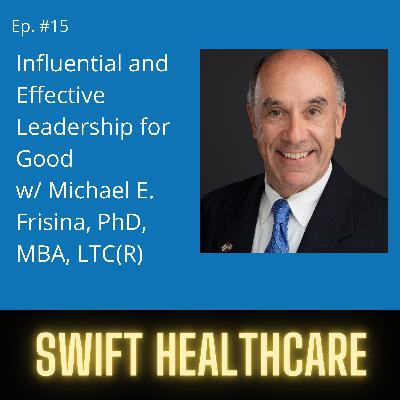
15. Influential and Effective Leadership for Good w/ Michael Frisina, PhD, MBA, LTC(R)
Description
In this episode, we explore the four fundamental human needs, strategies for developing your influence as a leader, and best practices to not only increase your effectiveness but also build your character as a person who does good in the world.
What are our four fundamental human needs as individuals and leaders – and how do highly collaborative relationships and social networks meet our needs as individuals and leaders? Tune in and find out!
Our guest is Michael E. Frisina, founder and president of The Frisina Group, LLC. and The Center for Influential Leadership who is responsible for teaching, publishing, and speaking on the current trends in organizational performance.
Dr. Frisina serves as Chairman of the Health Administration Advisory Council for the American Public University/American Military University and is also an Executive in Residence with The University of North Texas School of Public Health.
Dr. Michael Frisina links:
https://www.thefrisinagroup.com/
https://www.linkedin.com/in/michael-e-frisina-phd-ltc-r-united-states-army-717a9614/
Music Credit:
Jason Shaw from www.Audionautix.com
THE IMPERFECT SHOW NOTES
To help make this podcast more accessible to those who are hearing impaired or those who like to read rather than listen to podcasts, we’d love to offer polished show notes. However, Swift Healthcare is in its first year.
What we can offer currently are these imperfect show notes. The transcription is far from perfect. But hopefully it’s close enough - even with the errors - to give those who aren’t able or inclined to audio interviews a way to participate. Please enjoy!
Transcript:
Influential & Effective Leadership for Good w/ Michael Frisina, PhD, MBA, LTC(R)
[00:00:00 ] Patrick Swift, PhD, MBA, FACHE: [00:00:00 ] Welcome folks to another episode of the Swift healthcare video podcast.
[00:00:03 ] I'm Patrick Swift. And I'm delighted that you're here listening, watching, and we have a fantastic show for you. And the focus of our show is influential and effective leadership for good. And we have the illustrious Michael E. Frisina . Michael, welcome to the show.
[00:00:22 ] Michael Frisina, PhD, LTC(R): [00:00:22 ] Thank you, Patrick. Great to see you. Great to be with you.
[00:00:25 ] Hello everyone.
[00:00:26 ]Patrick Swift, PhD, MBA, FACHE: [00:00:26 ] . Thank you Michael, for being here and folks, let me share with you. Michael's bio. This is impressive. And here we go. Michael E. Frisina is founder and president of the Frisina group and the center for influential leadership. Responsible for teaching. Publishing and speaking on the current trends and organizational performance, Dr. Frisina is a retired career officer of the United States army medical department, and a former civilian healthcare executive. He served in multiple roles in his career. Uh, currently he serving as, uh, including all the work he's [00:01:00 ] doing as chairman of health administration advisory council with American public university American military university.
[00:01:06 ] He's the author of two books, influential leadership. Change your behavior, change your organization, change healthcare. I love that title and leading yourself to a higher level of performance. And he's working on a third book right now. All right. With the ACHE . Is that right? Michael? Yeah.
[00:01:22 ] Michael Frisina, PhD, LTC(R): [00:01:22 ] Health administration press titled effective leadership behavior.
[00:01:26 ] Patrick Swift, PhD, MBA, FACHE: [00:01:26 ] Awesome. This is great. I'm excited. I'm looking forward to seeing that, um, you've authored over 50 papers and published articles on leadership and organizational effectiveness, and he's a longterm ACHE faculty member in the executive leadership track and two-time educational grant awardee. And lastly, I'll share he's an executive in residence with the university of North Texas school of public health. Welcome Michael.
[00:01:50 ] Michael Frisina, PhD, LTC(R): [00:01:50 ] Thank you, Patrick.
[00:01:52 ] Patrick Swift, PhD, MBA, FACHE: [00:01:52 ] Yeah, man. And as a salute to Texas, um, for those of you watching the show, I've got my cowboy hat here. This is a 10 gallon resist all [00:02:00 ] hat and being a native Texan. I just have to, I have to throw out some, some heres to Texas, uh, for, um, for the show. And Michael, I want to begin by saying thank you for your service,
[00:02:11 ] Michael Frisina, PhD, LTC(R): [00:02:11 ] well, thank you. I'd still be doing it. If they didn't tell me I was too old, but I still, I can still pass the old physical fitness test. I don't know. I can do the new one, but I can still do the old
[00:02:20 ] Patrick Swift, PhD, MBA, FACHE: [00:02:20 ] one. That's fantastic. I wish I could say that. Um, but thank you for your service and my pleasure in honor of, um, veterans.
[00:02:28 ] Um, there's two things. One I want to bring up folks, um, is I'm a regular contributor to the wounded warrior project, monthly contribute my wife and I support the wounded warrior project. Um, very supportive of that. Um, and if you watch my show, you know, I drink a lot of coffee. And, um, I'm constantly sipping on my coffee as I'm talking to my guests and I have some coffee that someone sent me.
[00:02:51 ] This is not a paid endorsement. Um, this is just, uh, a dear colleague of mine sent me Trident coffee, um, which is a veteran owned business. So we need to support our veterans. [00:03:00 ] And it sounds a little like mariachi and their son of a son of a sailor is, um, uh, organic Mexico, choppa Chiapas , us and my Mexican grandmother.
[00:03:09 ] I is from Chiapas , the, the birthplace of, uh, some very, um, uh, socially progressive, uh, leaders in Mexico for a revolution. And certainly we need a revolution in healthcare. So a lot of good stuff to throw out here in the beginning of our show, and
[00:03:25 ] Michael Frisina, PhD, LTC(R): [00:03:25 ] it's not bad coffee. Uh, if you'd like to, uh, Try it, um, it's Navy coffee.
[00:03:30 ] It's not army, you know, army good army coffee. You can stand a spoon up inside a cup of coffee, but as the Navy goes, you know, go army beat Navy, um, former faculty at West point, I've got to make sure I stay true to the core. So, um, go army beat Navy, but it's not bad coffee.
[00:03:50 ] Patrick Swift, PhD, MBA, FACHE: [00:03:50 ] Uh, for an army guy, uh, saying that about me coffee that's high praise. So, uh, Dr. Frisina , thank you. And, and, um, we've got a good sense of humor at the same time. [00:04:00 ] You know, we've got some good content for you. Um, uh, and we're going to be talking about, um, effective leadership, influential and effective leadership for good. So let's get right to it. So starting with influential leadership, you and I had a little brief conversation before, and what we started touching on was fascinating to me.
[00:04:16 ] And I want you to you to ask you to share with us. From your framework in all your experience and the perspective you've had. You've distilled a lot of great content for folks who are listeners, whether you're a leader or you're an aspiring leader. I don't care if you're in high school. I don't care if you're a 68 year old CEO of a hospital, we all can learn about leadership.
[00:04:36 ] And this show is about best practices. As about understanding leadership and new, a new, a new, even if you're a black belt, if you maintain a white belt attitude, you can learn more and you can be better and you can do good. That being said, let's talk about the four fundamental human needs. Dr. Frisina .
[00:04:53 ] Michael Frisina, PhD, LTC(R): [00:04:53 ] Sure. If, if leadership is anything, it's a social activity. We live our lives in a variety of social [00:05:00 ] networks. Our family is a shelter network. You have a group of friends and colleagues you can serve and service organizations, and then you have work. And if work isn't anything, the workplace, it's a network of social activity.
[00:05:12 ] So because of that, we can look at what, what I. Like to base the majority of our work on is the brain itself and how the brain functions from a physiological perspective, not psychology, but neuroanatomy, the different parts of the brain and different parts of the brain and how they interact. Uh, as we engage in these social networks and the neurochemicals that are stimulated from.
[00:05:35 ] Uh, social network behavior, uh, very simply, you know, the idea of leadership for good changing the world for good relieving. Some of the burden, the pain, the chaos of the world around us, you know, there's enough behavior that contributes to evil. We need to be focusing on behavior that focuses on contributing good and overcoming the evil with good.
[00:05:56 ] And so fundamentally the whole idea of [00:06:00 ] influential leadership and how you measure your effectiveness. As in your leadership behavior, there is no more critical element to your teams. Being able to function, to work, to focus on your objectives, to line objectives, to key results to you, getting the results you desire as a leader, then your individual leader behavior.
[00:06:17 ] And so the foundational thought that I had that got all of this started. Patrick about 10 years ago, was this one thought that individual leader behavior is the single most important predictor to how a team performs and believing that to be true. I wanted to be able to have science-based approach to proving it.
[00:06:36 ] And so we turned at that time about 10 years ago, this burgeoning growth in neuroscience and discovering parts of the




 United States
