


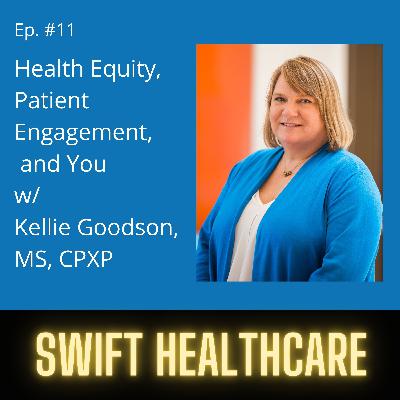
11. Health Equity, Patient Engagement & You w/ Kellie Goodson, MS, CPXP
Description
In this episode, we discuss what health equity is all about, what we can do to advance patient and family engagement, and how these issues matter to us all when it gets right down to it.
Our guest is Kellie Goodson, MS, CPXP, a thought leader in the areas of person, or patient and family engagement (PFE) and equity in health care quality and safety improvement. She has led a multi-year analysis of hospitals leveraging and deploying PFE in quality and safety improvement that demonstrated a correlation between high levels of PFE and improvements in patient outcomes, specifically lower rates of 30-day readmissions and falls with injury. She has worked with multiple health systems to improve patient outcomes using quality improvement science through the lens of health disparities identification and resolution.
Kellie co-led national Affinity Groups for the topics of PFE and health equity for the Centers for Medicare and Medicaid Services and has served on National Quality Forum committees, including the National Quality Partners Action Team to Co-Design Patient-Centered Health Systems.
Kellie received her Bachelors of Science in Business from the University of New Hampshire and her Masters of Science in Integrated Health Care Management from Western Governors University. She also received her Certified Patient Experience Professional (CPXP) designation.
Kellie Goodson, MS, CPXP on LinkedIn:
https://www.linkedin.com/in/kellie-goodson-ms-cpxp/
On Twitter @kac0102
Music Credit:
Jason Shaw from www.Audionautix.com
THE IMPERFECT SHOW NOTES
To help make this podcast more accessible to those who are hearing impaired or those who like to read rather than listen to podcasts, we’d love to offer polished show notes. However, Swift Healthcare is in its first year.
What we can offer currently are these imperfect show notes. The transcription is far from perfect. But hopefully it’s close enough - even with the errors - to give those who aren’t able or inclined to learn from audio interviews a way to participate. Please enjoy!
Patrick Swift PhD, MBA, FACHE: [00:00:00 ] Welcome folks to the Swift healthcare video podcast. I'm Patrick Swift. And I want to thank you for dialing in for joining us. I have a special guest Kelly Goodson for the show. Kelly. Welcome to the show.
[00:00:11 ] Kellie Goodson, MS, CPXP: [00:00:11 ] Great. Thanks to be here with you today, Patrick.
[00:00:13 ]Patrick Swift PhD, MBA, FACHE: [00:00:13 ] Absolutely. I think we're going to have, okay. Fantastic show. And let me read you folks. Uh, Kelly's bio here. Very impressive. Uh, person Kelly is a thought leader in the areas of person, patient, and family engagement and equity. In healthcare quality and safety improvement, she has led a multi-year analysis of hospitals, leveraging and deploying patient family engagement in quality and safety improvement.
[00:00:36 ] She has worked with multiple health systems to improve patient outcomes, using quality improvement science through the lens of health, disparities, identification, and resolution. Let's not just identify it, but let's find the solution to it as well. Kelly has Cola and listened to this. Kelly has co-led national affinity groups.
[00:00:53 ] For the topics on the topics of patient family engagement and health equity, for who, the centers for Medicare and Medicaid services. I think you've heard of them and is deployed on the Nash has served on the national quality forum committee, including the national quality partners action team to co-design patient-centered health systems.
[00:01:12 ]Kelly, welcome to the show. I'm delighted you're here. And what are we talking about here? Folks? We're talking about patient family engagement. We're talking about health equity and you, and what that means is that this topic relates to all of us. This isn't just, um, a sub. A component with them. What we do with healthcare is all of us, whether we're in finance, whether you are in environmental services, cleaning, helping, cleaning the floor, whether you're in a physician, caring for patients, whether you're a CEO, I'm a CEO has gone undercover boss and I have, I've helped clean the floors and wiped down toilets and beds.
[00:01:47 ] This is all of us together. And the work that we do right. So I'm in the show. Kelly, we're going to talk about a lot of incredible stuff. And I want to ask you also just the top of the show. What are you up to these days? You've done so much.
[00:02:00 ] Kellie Goodson, MS, CPXP: [00:02:00 ] Yeah, thanks, Patrick. Uh, currently I'm working at Visiant, which is a, , member owned member driven healthcare performance company. We've got not-for-profit academic medical centers and community-based hospitals across the country. I've also started partnering with a new startup called diversity crew.
[00:02:20 ], and that's a consortium of passionate people, really wanting to help improve diversity, equity and inclusion, not only in healthcare, but in, in. All industries. And I also work with a company called ATW health solutions. It's a consulting company out of Chicago. Again, working in that patient engagement and health equity space.
[00:02:43 ] Patrick Swift PhD, MBA, FACHE: [00:02:43 ] excellent. Well, shout out to all those companies and, and just kudos for being part of all that. And we're, we're, we're taking a look at patient family engagement and health equity. We could talk about that for hours, right? But let's break that down for the purpose of the show and just talk about the tools and, and I know there are two tools that you're using this work.
[00:03:02 ] Can you tell us about that?
[00:03:04 ] Kellie Goodson, MS, CPXP: [00:03:04 ] Yeah. So I really focus on how to use patient and family engagement as well as health equity in your quality improvement efforts. So, you know, let's start with patient and family engagement. It's really, it's known. Throughout the industry that when an individual patient is activated and engaged and educated about their own health care, that they get better outcomes.
[00:03:30 ] Um, this has been studied for decades and, uh, I just want to mention Dr. Judy Hibbard who created, uh, what she called the PAC patient activation measure or Pam tool that actually she created.
[00:03:42 ] Patrick Swift PhD, MBA, FACHE: [00:03:42 ] healthcare without another acronym.
[00:03:44 ] Kellie Goodson, MS, CPXP: [00:03:44 ] know, right. Uh, but this patient activation measure really brought to light that patients are at different levels, uh, of their own, you know, knowledge, education, confidence in how to care for themselves.
[00:03:58 ] So, , Dr. Hebert came up with four levels of patient activation, you know, starting from sort of that traditional, , passive, , you know, Patient that really just receives healthcare. Just, you know, it's more of that one way street, they just receive the information , they do their best, but they don't really have the confidence to care for themselves.
[00:04:16 ]And then it, you know, it goes all the way up to level four, the highest level where. They're their own advocate and they are really, um, understand their condition. They, they advocate for themselves. They're looking for the best, , you know, medications and procedures and solutions for themselves. So this, this, , patient activation concept that Dr.
[00:04:38 ] Hibbard really brought out is one of the most researched and most studied, um, patient engagement tools. So it's, it's really brought to light how. Outcomes can be improved when we activate and engage our patients.
[00:04:53 ] Patrick Swift PhD, MBA, FACHE: [00:04:53 ] And that's so critical Kelly, because it reminds me of a, a gentleman I took care of in the two thousands, diagnosed with my Justina and gravis on, on a neuro rehabilitation unit. And when I first met him black gentleman in his thirties, and when I engaged him, I asked him how he was doing. And, and w w what are we doing?
[00:05:16 ] What are you doing here? How can we help you to get his input and his own words? And he said something that stuck with me. He said, what's the point in talking with you about this? Because no one really listens. And he had been misdiagnosed, poorly assessed and gone through a arduous, horrible journey of not.
[00:05:35 ] Being properly assessed and then treated and had been completely disempowered and stuff. My focus when I heard that, um, was to be his best friend, to engage, to get his story, to prop him up, uh, to be engaged in empowered. And what you're describing is these four levels in which the. One person is the least engaged and there is a bias I think we have of, well, if the patient is not really engaged and they must not really care about their health, and there is so much we can do. To engage our patients and also engage our colleagues to be part of this journey. So this gets to, I just, I love it. I love that you started with that and thank you for, uh, tickling my memory from, from 20 odd years ago, uh, , of an patient I was caring for, because this is about engagement.
[00:06:22 ] When we engage people. There are better outcomes. There's better. Self-esteem, there's better health. There's better quite frankly, joy and heart in what we do in this dyad, this collaboration with, with our patients and with each other.
[00:06:34 ] So let's switch gears, , to health equity and, , how can it be a tool for quality improvement?
[00:06:41 ] Kellie Goodson, MS, CPXP: [00:06:41 ] Well, let me, I'm going to ask you a question. I'm going to have you put your old CEO hospital's CEO hat on and
[00:06:47 ] Patrick Swift PhD, MBA, FACHE: [00:06:47 ] Oh, I got a hustle here. Okay. A




 United States
