


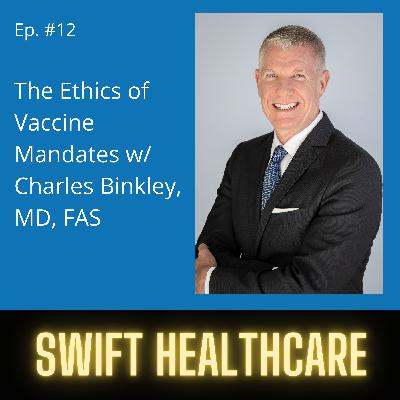
12. Ethics of Vaccine Mandates w/ Charles Binkley, MD, FACS
Description
In this episode, we discuss the ethics of mandating people to receive the COVID vaccine (vaccine mandate) and whether this is prudent. Nothing is black and white in this episode and our guest is Charles E. Binkley, M.D., F.A.C.S., Director of Bioethics at the Markkula Center for Applied Ethics at Santa Clara University.
Dr. Charles Binkley, an experienced cancer surgeon, bioethicist, and health care quality leader, directs the bioethics program at the Markkula Center. Dr. Binkley attended Georgetown University School of Medicine and completed his surgery training at the University of Michigan where he was awarded an NIH fellowship in pancreatic cancer research. Dr. Binkley has served on the Committee on Ethical, Legal, and Judicial Affairs of the California Medical Association, as well as on the Board of Directors of the San Francisco Medical Society.
Dr. Binkley is a Fellow of the American College of Surgeons and also directs the Health Care Ethics Internship and Honzel Fellowship in Health Care Ethics at Santa Clara University. His research is focused on the ethical application of AI clinical decision support systems as well as surgical ethics. His research and writings have been published in Cancer Research, Annals of Surgery, Journal of the American College of Surgeons, STAT News, and America Magazine.
Dr. Charles Binkley, MD, FACS links:
https://www.linkedin.com/in/charlesbinkley/
https://www.scu.edu/ethics/about-the-center/people/charles-binkley/
Twitter: @CharlesBinkley
Music Credit:
Jason Shaw from www.Audionautix.com
THE IMPERFECT SHOW NOTES
To help make this podcast more accessible to those who are hearing impaired or those who like to read rather than listen to podcasts, we’d love to offer polished show notes. However, Swift Healthcare is in its first year.
What we can offer currently are these imperfect show notes. The transcription is far from perfect. But hopefully it’s close enough - even with the errors - to give those who aren’t able or inclined to audio interviews a way to participate. Please enjoy!
Patrick Swift, PhD, MBA, FACHE: [00:00:00 ] Folks, welcome to another episode of the Swift healthcare video podcast.
[00:00:03 ] I'm Patrick Swift. I'm delighted that you're here and I have a wonderful guest for you for this episode, Dr. Charles Binkley, Charles. Welcome to the show.
[00:00:11 ] Charles Binkley, MD, FACS: [00:00:11 ] Thank you, Patrick. It's a real pleasure to be here.
[00:00:14 ] Patrick Swift, PhD, MBA, FACHE: [00:00:14 ] Yes, I'm delighted. And, and Charles, Dr. Brinkley is, is, uh, based out of currently California. So you can feel the warmth for those of you watching this episode can feel the warmth. And if you're listening, I just want to encourage you to feel that California warmth and those rays. So Dr. Charles Binkley is.
[00:00:32 ] Listen to this. He's an experienced cancer surgeon, bioethicist and healthcare quality leader. He directs the bioethics program at the Markkula center at Santa Clara university, the Jesuit university of Santa Clara of Jesuit university of the silicone Valley. I'm happy to throw that in there cause I love the Jesuits.
[00:00:50 ]Dr. Binkley attended Georgetown university school of medicine, go G-town. And completed a surgery training at the university of Michigan awarded an NIH fellowship in pancreatic cancer research. Do you hear the theme here of ethics and care? Dr. Brinkley has served on the committee on ethical, legal and judicial affairs of the California medical association, as well as the board of directors of the San Francisco medical society.
[00:01:14 ] He's a fellow of the American college of healthcare surgeons. He also directs. The healthcare ethics, internship, and Honzel fellowship in healthcare ethics at Santa Clara university. Dr. Brinkley, thank you so much for being on the show.
[00:01:27 ] Charles Binkley, MD, FACS: [00:01:27 ] Patrick. It really is a pleasure to be with you this afternoon. And it is 70 and sunny out here in San Francisco. You can see the sun coming through the window here, but after having spent seven long, cold years in Ann Arbor, I feel like I deserve at least a couple of decades of California sunshine.
[00:01:43 ] Patrick Swift, PhD, MBA, FACHE: [00:01:43 ] Absolutely. That is good karma. That is a, the universe coming through and I can feel that warm. So thank you. I'm broadcasting out of Maplewood, New Jersey. We're still hoping for that. Uh, in the New York city tri-state area, we're still hoping for that warm weather. So, uh, I'm glad you're here, Charles. And, and we're talking in this episode about ethics of vaccine mandates with Dr.
[00:02:04 ] Charles Binkley MD. So. Let's jump right into this. And how did you get into this work overall?
[00:02:11 ]Charles Binkley, MD, FACS: [00:02:11 ] Well, my involvement with ethics really spans my entire career and it's taken different forms from, , chairing clinical ethics, consult committees and, and major hospitals. , to working on ethics, education, you know, how do you teach, , healthcare providers, ethical behavior? How do you instill in them? , the things that we profess and that patients expect from us.
[00:02:32 ]and then also, how do you create policies that guide, , healthcare professionals, when they face ethical dilemmas? And so I haven't been involved with it in my entire life. And also thinking about, you know, some of their specific ethical issues that cancer patients face that physicians caring for cancer patients face, , that surgeons face.
[00:02:51 ] You know, I used the opportunity, , to segue into a different phase of my career where I'm dedicating most of my time to, , ethics, to teaching. , to writing and research and then also doing a clinical ethics consultation in healthcare quality consultation. So that's really, you know, my path, , to my current position.
[00:03:11 ] Patrick Swift, PhD, MBA, FACHE: [00:03:11 ] and I love the path that this, , this thread that you have shared is from the clinical care to the surgical care, to then integrating that into what we do and, and supporting healthcare providers and leaders and being ethical in what we do. So help me unpack ethics because, , you know, I've got a PhD.
[00:03:30 ] People argue as stands for piled higher and deeper (LOL). Um, when we talk about ethics, , it means different things to different people. So, , could you share with the audience what you mean by ethics?
[00:03:42 ] Charles Binkley, MD, FACS: [00:03:42 ] Yeah, absolutely. And it's a great question. So I always start from the idea of a profession. So, , healthcare is considered a profession, whether that be as a healthcare provider, a healthcare leader, a healthcare executive. It's considered a profession. And so a profession begins by an assumption. There are things to which members of that profession, profess , and things that the community that the public can expect of members of that profession.
[00:04:09 ]And so what are the things that the community of healthcare providers, the healthcare leaders profess. So first of all, it's to do good and avoid harm, and that's sort of the cornerstone of the profession. So based on that profession, , then you can distill certain ethics. And so again, the ethical translation of that is that, you know, we will prioritize our patients that we will do good to them, and the tools of medicine can be used for good and for harm, you know, everything that we do as a surgeon, I was, you know, acutely aware of that.
[00:04:36 ] Every time I wilted. A scalpel, it can, can heal and it fell so harm. And so what we profess is that these tools that we've inherited will use for good and avoid harm to the best of our abilities. And also in that is that we will not necessarily define. Benefit and harm by our value system, but by the patient's value system.
[00:04:59 ]And we'll, we'll come to a place where we use the tools of our training and our experience, our professional responsibility, but also really listen to the patients and engage them and their decision-making. And so that it's, it's not, it's not only joint. , but it really is. We each guide the other to come to what is right in that situation.
[00:05:18 ] And then, you know, we oftentimes think of justices, you know, am I treating the patient in front of me the same way that I treated the last patient that I saw and the next patient that I'll see. But I really think that, that our challenge as healthcare providers is to think about justice much more broadly. And it's not only, it's not just about the individual patient in front of you, but our all patients having the same level of access to care that I'm providing. And I think about this, particularly in the context of cancer care and right now in the context of vaccinations for COVID, but you know, to think about cancer care, right.
[00:05:50 ] You know, are we concentrating high quality cancer care only in large academic medical facilities and taking it away from public hospitals, , in an attempt to improve care. So the idea is, is that healthcare quality, you know, the more you do, the more you concentrate, the more you have different disciplines and interdisciplinary discourse, a higher quality of the care is, but as you, as you move some of those resources.
[00:06:13 ] Away from, , public hospitals away from rural hospitals, you may actually be cutting off your nose to spite your face. So the very patients who need that may not have access to it. So the intentions again are based around beneficence non-maleficence, , but you may not really be considering autonomy and justic





 United States
